Déjà vu all over again.
Anyone who reads my blog knows that I have a passion for the US Navy and the men and women who keep us safe. I have been enlisted and was later given the privilege to lead so many of them through clam seas and storms. But I also recognize that the navy is led by ever changing groups of civilians who do not have the collective wisdom sufficient enough to do simple math or physics.
The best sailors in the world have limits.
With a never-ending series of world events that involve the oceans and waterways required for commerce and freedom, we soon find out how well the civilian leadership has planned and executed to support freedom of the seas. Sadly, they often come up lacking.
Some world elements are beyond our control. Dictators and tyrants will always find a way to defeat their own people’s desires for freedom. Oten times, the people involved just wanted to be left alone and live their lives. But evil senses weakness and appeals to people’s lower nature. Even religion has been used to cow and suppress an otherwise normal nation. Fanatic religion is the worst since it preaches peace but only under their watchful eye and doctrine. I remember the prosperity and general freedom of Iran before 1979. Yes, they had flaws. But nothing like the hegemony exhibited by the radical Islamic leadership of today.


It is foolish to imagine that reasonable people can negotiate with this type of cultural evil. Throughout history, evil dictators have used our good will and good intentions against us. The single biggest form of betrayal in our flaccid leadership is thinking something is different now. The enemy sits back and laughs at us while simultaneously launching endless volleys of missiles at us. So, our response is to send in the navy.
But the is one problem in this equation. The navy finds itself stretch so thin (and getting thinner) that it is starting to show the effects of endless rounds of failed policy.
From a recent article:
As the Middle East heats up, the Navy struggles to deploy replacement ships
Story by Paul McLeary
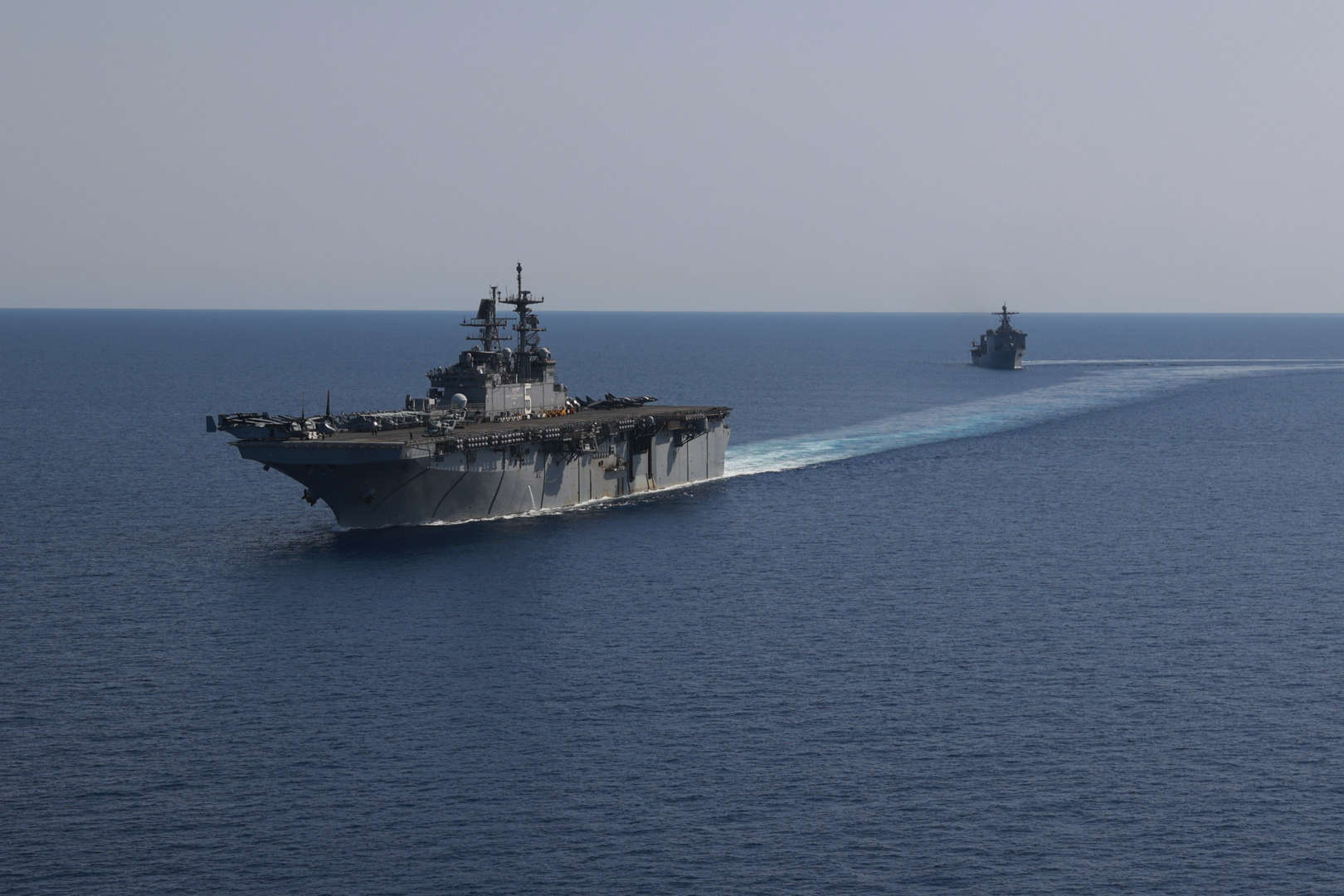
“A group of warships led by the USS Bataan has done it all over the past six months.
From warning off Iranian ships in the Persian Gulf to patrolling the Red Sea to filling in for an aircraft carrier off the Israeli coast, the workhorse amphibious ships Bataan and USS Carter Hall and their force of 2,000 Marines have been at the center of the action in a volatile Middle East.
Yet the group is past the point that it should have started heading home for some much-needed rest and is still on station because replacements are in short supply.
“There is no end in sight” for the Bataan’s deployment, one Defense Department official said. The Bataan was “just extended again, and if the president wants to keep them there, they’re going to continue to be extended,” said the official, who agreed to speak about current operations under the condition of anonymity.
The U.S.-led strikes on Houthi ballistic and attack drone launch sites Thursday night was predominantly a maritime affair, with Tomahawk missiles launched from a U.S. submarine and F-18 jets catapulted from the deck of the USS Eisenhower aircraft carrier near the Yemeni coast. The strikes underscore the role the Navy can and does play in the region, and the importance Washington policymakers place on keeping American ships as a steady presence near any hot spot.
While neither the Bataan nor the Carter Hall were involved in those strikes, their presence is a key part of the U.S. and allied presence in the region, giving commanders options to conduct humanitarian missions, airstrikes or special operations raids.
The ship that would likely replace the Bataan — the USS Boxer — has been delayed for two months and counting, and is only now doing the training required to deploy at some point in the future.
While Navy officials declined to explain why the Boxer has been unable to leave San Diego, the holdup is emblematic of a wider issue with repair and maintenance in the Navy that has seen warships languish pierside for months after they had been scheduled to leave.
And the delays come with a real-world cost, wreaking havoc on deployment schedules. Extended sea tours like the Bataan’s have become commonplace as the Navy has struggled to be able to send ships out to replace the beleaguered crews who are spending weeks or months longer at sea than initially planned.
Originally tasked with patrolling the Persian Gulf after a series of Iranian attacks on commercial shipping last summer, the Bataan, Carter Hall and the 26th Marine Expeditionary Unit went to sea on July 10. They later rushed to the Red Sea in October after Hamas killed 1,200 Israelis in an attack and Israel launched an assault on the militants’ stronghold in the Gaza Strip.
Designed to be a quick reaction force, the ships and their Marines then shifted to the Mediterranean Sea to fill in for the aircraft carrier USS Gerald R. Ford, which had been at sea for eight months and finally headed for home this month after being extended three times by Pentagon leadership.
Now the Bataan, which is on its sixth month at sea and has no date set to return home, is exercising with NATO allies in the Aegean while staying close to Lebanon and Israel should it be called upon to evacuate civilians or undertake military action in the region.
The Boxer, meanwhile, has spent the past two years undergoing repairs and upgrades to be able to carry F-35 jump jets, a feature that few amphibious ships and aircraft carriers possess. The group is exercising off the California coast, and the official said one option being considered is to send one of the ships out alone “with a contingent of Marines, but not the full contingent it is supposed to have.”
The delay comes at a heady time, as the U.S. Navy has beefed up its presence in the Middle East in response to the war in Gaza that threatens to spill into Lebanon. Even before Thursday’s strike on Iranian-backed Houthi fighters in Yemen, U.S. destroyers and aircraft had responded to 26 attacks by the group on commercial vessels in the Red Sea, employing a total of 80 drones and several ballistic and anti-ship missiles since November.
The ships in the region are a major element of the American ability to project power across the Middle East.
The amphibious assault ships like the Boxer and Bataan are a unique tool for American commanders that allows them to launch airstrikes, provide humanitarian support and Marines to use large ship-to-shore landing craft to evacuate civilians from hostile areas. While not considered aircraft carriers, the amphibious flattops are considered workhorses for U.S. military commanders around the globe, who frequently request their presence to showcase American presence and power.
Thursday’s U.S. strikes came in response to the Houthi’s most brazen attack on commercial shipping to date on Jan. 9. American F/A-18s from the aircraft carrier USS Dwight D. Eisenhower, along with several destroyers, shot down 18 Houthi drones, along with ballistic and anti-ship missiles.
Eisenhower recently left the Persian Gulf to park off the Yemeni coast to provide options for the White House if it chooses to strike Houthi targets, an option the Pentagon is considering.
The heavy deployment of warships to the region has created a complex balancing act for the Navy, which has struggled with getting ships out to sea on time.
The Bataan and Carter Hall moved into the Mediterranean last month to backstop the USS Gerald R. Ford aircraft carrier, joining the USS Mesa Verde which was already in place. The Ford, the nation’s newest and largest carrier, had already been extended twice before turning for its home port in Virginia this month after eight months at sea.
The urgency in getting the Boxer out of port, and the lack of a backup, is one of the many side effects of a July 2020 fire onboard the amphibious ship USS Bonhomme Richard, which was undergoing refit in San Diego at the time. The fire, which burned for four days and injured over 60 sailors, forced the Navy to scrap the massive, big-deck ship, and has led to a yearslong scramble to replace its presence in the fleet.
“This comes down to poor maintenance management overall,” said Bryan Clark, a retired submarine commander now at the Hudson Institute.
“This is also the problem you have when the fleet gets older, you have no surge capacity, and with the ship repair capacity that is not aligned with Navy plans, which keep changing,” he added. “You’ve got a real shortfall in the number of amphibs you can deploy.”
The DOD official said there are few options for commanders to speed up the movement of amphibious ships out of port as conditions worsen in the Middle East and Indo-Pacific allies look for the U.S. Navy to provide presence in the face of an increasingly aggressive China.
Asked what can be mobilized to meet a crisis quickly, the official conceded, “the answer is no one.””
Those last words are chilling.
On the same day as I read this, I also saw that Taiwan has elected a leader who is proudly independent and rejects mainland China’s vision of a unified China. Unified China means breaking the back of a free and independent nation that we often want to dilute in order to appease. Too many American leaders for over fifty years have not had the guts to support fully the desire for people to be free of tyranny.
And now, our navy is being pulled in so many directions without a proper plan or vision, they are starting to show signs of fracturing. Recruitment is down, maintenance is mired in the mud, new construction is slow in coming, and leadership is foolishly spending limited dollars on made up social issues and frivolous pursuits.
One bright hope
The United States Navy has a proud legacy of overcoming the negligence of any particular set of civilian leadership that has gratefully passed into history. I believe that at our core, Americans love freedom and despite our periodic journeys into fantasy based on the current trends of the day, the American Bluejacket and the officers that lead them can overcome the biggest threats.
From the very first days, we sailed in ragged ships against superior foes and beat them. Our undersupplied men found ways to use American ingenuity and an indomitable spirit to win the day. Our history shows time and time again that we find the collective will to preserve this experiment called a Republic against all odds.

 theleansubmariner
Aloha Mac,
I love your posts, I read them every time they arrive in my inbox. If I end up in or near PA, I’d love to track you down and just shake your hand.
Cheers & Happy New Year…..Jim.
Jim, it would be an honor to meet you in person. Our visit to Charleston is starting to shape up very nicely. The local Navy command is incredible to work with and we are building some very good bonds with the Charleston USSVI base. I know you are unable to join us but know that I will make sure your work is well represented at the Gathering.
Happy New Year to you as well
Mac
A very important post summarizing the current state of the Navy, surface and submarine as well. I was dismayed when the Navy closed Charleston Shipyard and especially Mare Island with its building capability. I thought someday we would have problems and now that is here. But also the Littoral Combat Ships, the Stealth Destroyers, and the Gerald Ford put unnecessary strain on the system with designs not ready for prime time.
Great content, and it is a severe problem for our nation. J
It is all too true; I drive for Lyft to help what we laughingly call our budget, and I have had multiple conversations with those in the military and veterans (especially those of our generation) who decry the state of the union. These are dark times for our nation, and in our increasingly post-Christian nation, there seems to be no solution. I’m reminded of something someone who lived through a dark time once said; “Look inside and be depressed, look around and be distressed, look to Jesus and be at rest.” Prayer has turned the hearts of many a nation before and as the Author of Scripture said in 2 Chronicles 7:14: “If my people (Tony) who are called by my name, will humble themselves and pray and seek my face and turn from their wicked ways, I will hear from heaven, forgive their sins and heal their land.” May God awaken this once great nation to its most desperate need.