Blessed are the storytellers… for they shall inherit eternity.
Okay, so that isn’t really a beatitude. But it could be. Recently, I discovered a series of articles written by a war correspondent named Rembert F. James.
Never heard of him before?
Can’t say that I blame you. I was born in 1954 and most of his work that would have made him noteworthy was accomplished before I was born. But if you were alive and paying attention to the printed press during World War 2, you might have had a better chance at seeing his work.
Once I figured out that he wasn’t just an average reporter, I tried to do my typical research using the most common resources I utilize. Its pretty remarkable what you can find out about someone using online search engines. Between the Library of Congress and one of a hundred history related sites, you can find out pretty much about a person from date and location of birth, notable achievements and date and location of birth. But Rembert was a bit of a challenge. After a days’ worth of searching, this is what I found (with a little help from AI)
“Rembert F. James was a distinguished war correspondent for the Associated Press, known for his significant contributions to journalism during World War II. His biography is closely tied to the events of the Pacific Theatre, where he was a key figure in covering the war. James’ life and work are remembered for their impact on the field of journalism and the lives of those affected by war.”
From a previous blog article: Rembert James, military specialist and veteran reporter, traveled extensively with the United States Fleets in the Atlantic and the Pacific.
Great.
You would think that someone who was a distinguished war correspondent with significant contributions to journalism during the most significant war in American history would have dozens of pages dedicated to him.
You would be wrong.
Our friends at Wikipeda can tell you everything from who created the anchor to where the xylophone was invented.
(In case you’re curious, the modern anchor was really perfected by a guy named Rogers in England and the xylophone was partially perfected by The Toba Batak people use wooden xylophones known as the Garantung (spelled: “garattung”).They can’t explain why it’s called a xylophone but here we are.)
So the dangling question for me as I looked for an explanation about why a distinguished journalist named Rembert James is not more well know will remain a question.
But here is what I do know.
Rembert was a prolific story teller that covered much of the second world war in the Pacific and managed to earn a purple heart as a civilian while doing so.
I spent hours looking for stories with his byline in the Library of Congress’ web site that chronicles most of the historical press on record. https://www.loc.gov/collections/chronicling-america/about-this-collection/
The site is searchable by year and subject and hundreds of stories came to the surface with his name. Most of the significant stories start in 1943 and show his travels through some of the most significant conflicts the US Navy and Marine Corps would engage in until the war ended.
One of the early stories placed him at Pearl Harbor on May 22, 1943.
The work to salvage the ships that had been damaged in the attack on December 7th was well under way and the main story was about the salvaging of the USS Oklahoma. Reading the article was chilling in the way he described the up righted ship.
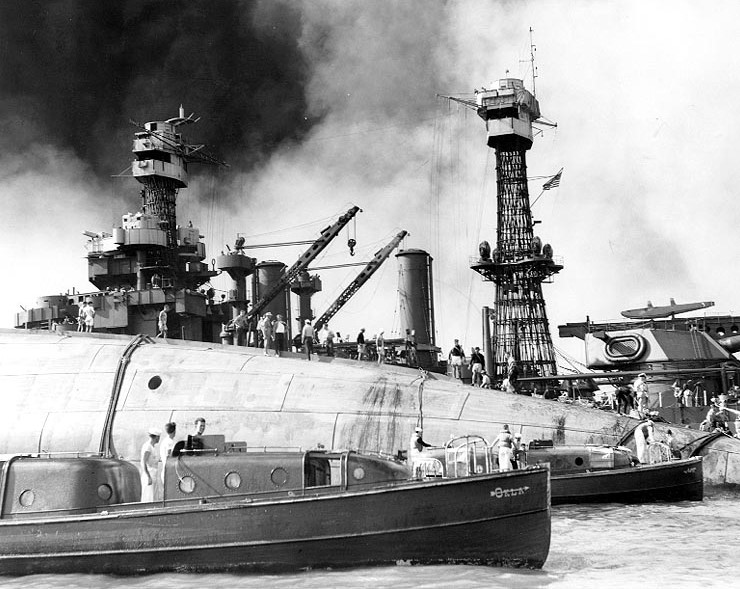
https://www.loc.gov/resource/sn83045462/1943-05-23/ed-1/?sp=6&st=image&r=0.577,0.036,0.313,0.268,0
Keep in mind that this would have been one of the first descriptive articles of the damage done at Pearl Harbor.
In the description he states: “The holds of the Oklahoma still were water filled. Below decks, the admiral said, are the bodies of 381 officers and men.” He would go on and report the deaths of the 1,071 men on board the hapless Arizona. For many who read the paper, this might have been the first glimpse of what had tragically happened on that December morning.
The Road to Tokyo
Rembert would continue on his journey not long after that time frame and find himself on some of the most brutal battlefields of the war. His travels would take him from Guadalcanal to the Marianas Islands and he would have a front row seat for the horrific battles that cost so much in life and treasure.
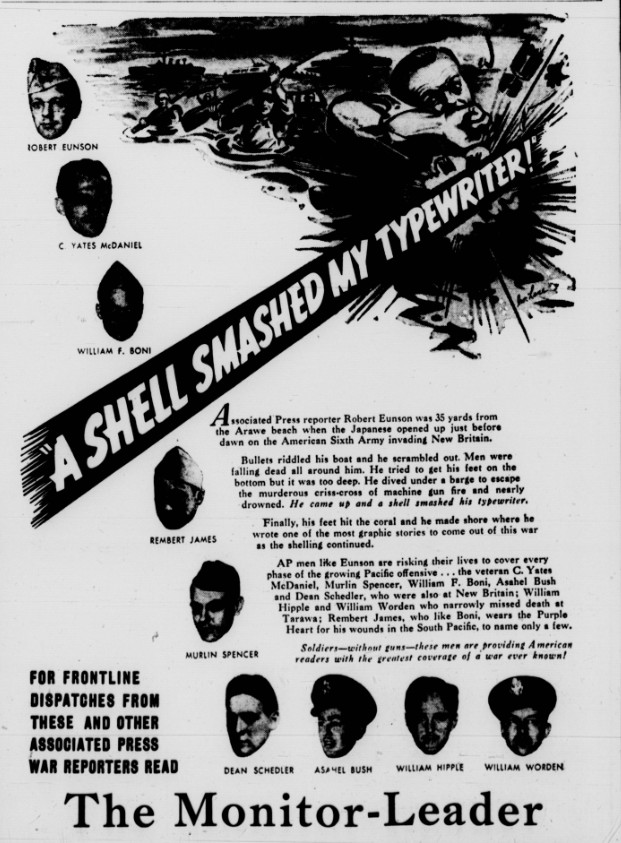
Associated Press correspondent Rembert James after return from Russell Island to Guadalcanal on Sept. 27, 1943. He would later be wounded at a place called Bougainville.
Palmer of Newsweek Killed by Jap Bomb – By United Press
ADVANCED HEADQUARTERS
South Pacific. Nov. 13, 1943—Keith Palmer, war correspondent for The Melbourne Herald and the American magazine Newsweek, was killed last night in a Jap raid on the Torokima area at Bougainville in which press headquarters was demolished. Four others were injured, including Rembert James of the Associated Press, who was hit in the feet and legs by shrapnel and suffered a broken eardrum.
The others wounded, less seriously, were Capt. Pat Osheel of Englewood. N. J., Marine press relations officer Tech. Sergeant, Theodore Link, Marine combat correspondent and former St. Louis Post-Dispatch employe, and Pvt. Paul Ellsworth of Dekalb, 111., Marine artist.
Palmer. 37, was the first correspondent to die in this area since Jack Singer of International News Service was killed aboard an aircraft carrier.
Palmer is survived by his widow and two children
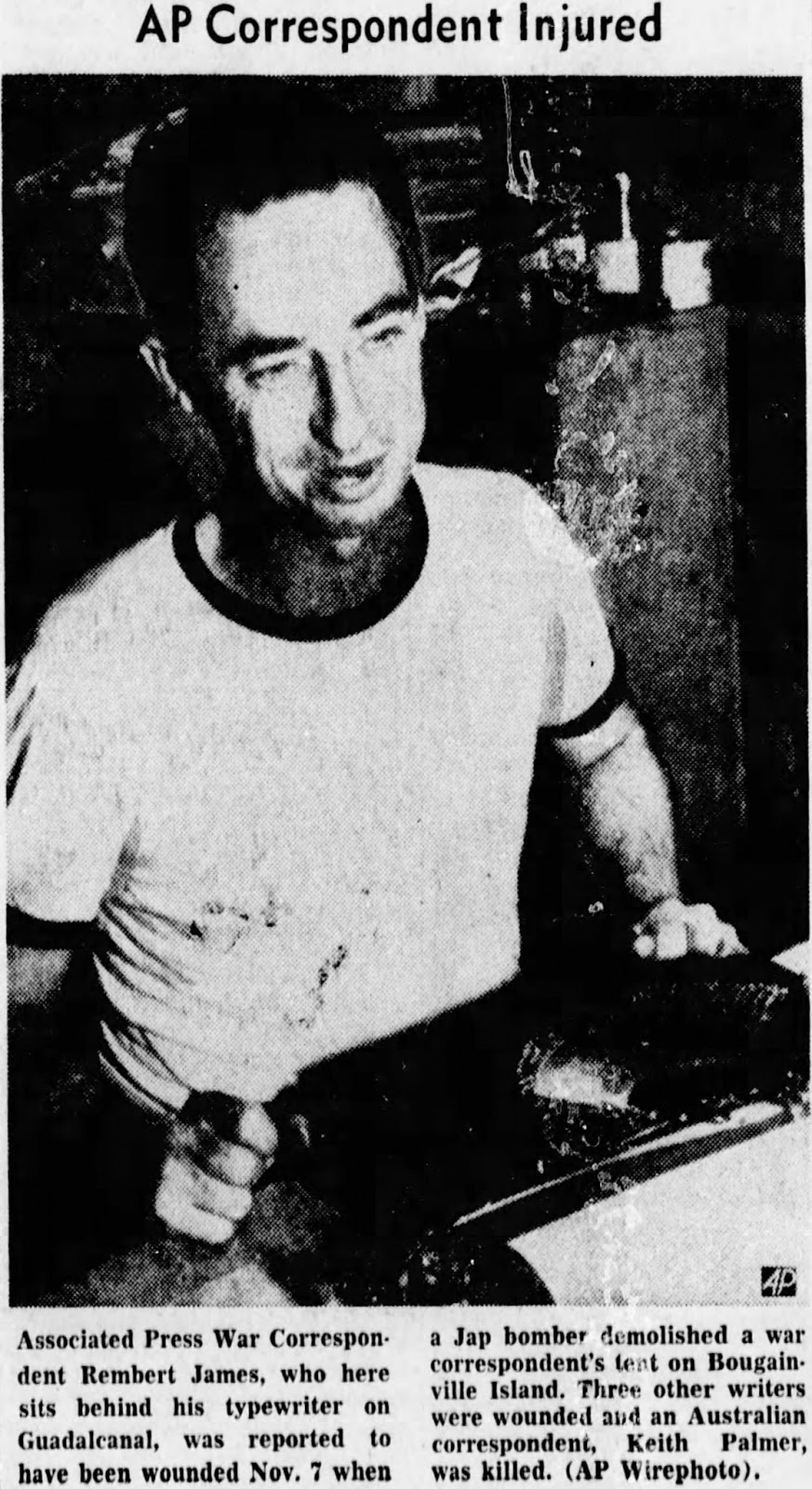
November 29, 1943
Rembert James of A. P. Awarded Purple Heart By the Associated Press
SOUTH PACIFIC ALLIED HEADQUARTERS, Nov. 29.—Rembert James, Associated Press war correspondent, was awarded the Purple Heart today for injuries suffered on Bougainville Island.
He was the first correspondent decorated by Admiral William F. Halsey’s South Pacific command.
Another Associated Press war reporter, William Boni, previously received the Purple Heart in Gen. Douglas MacArthur’s Southwest Pacific sector.
Comdr. Theodore Orr, Media. Pa., chief surgeon at the Navy Hospital where Mr. James is recuperating, read the citation and presented the medal to the 37-year-old newspaperman with his own congratulations. (Means he would have been born in 1906)
Mr. James suffered a ruptured ear drum, arm abrasions and shrapnel wounds in both feet and both legs November 7. He is recovering, but is likely to require hospitalization for five more weeks.
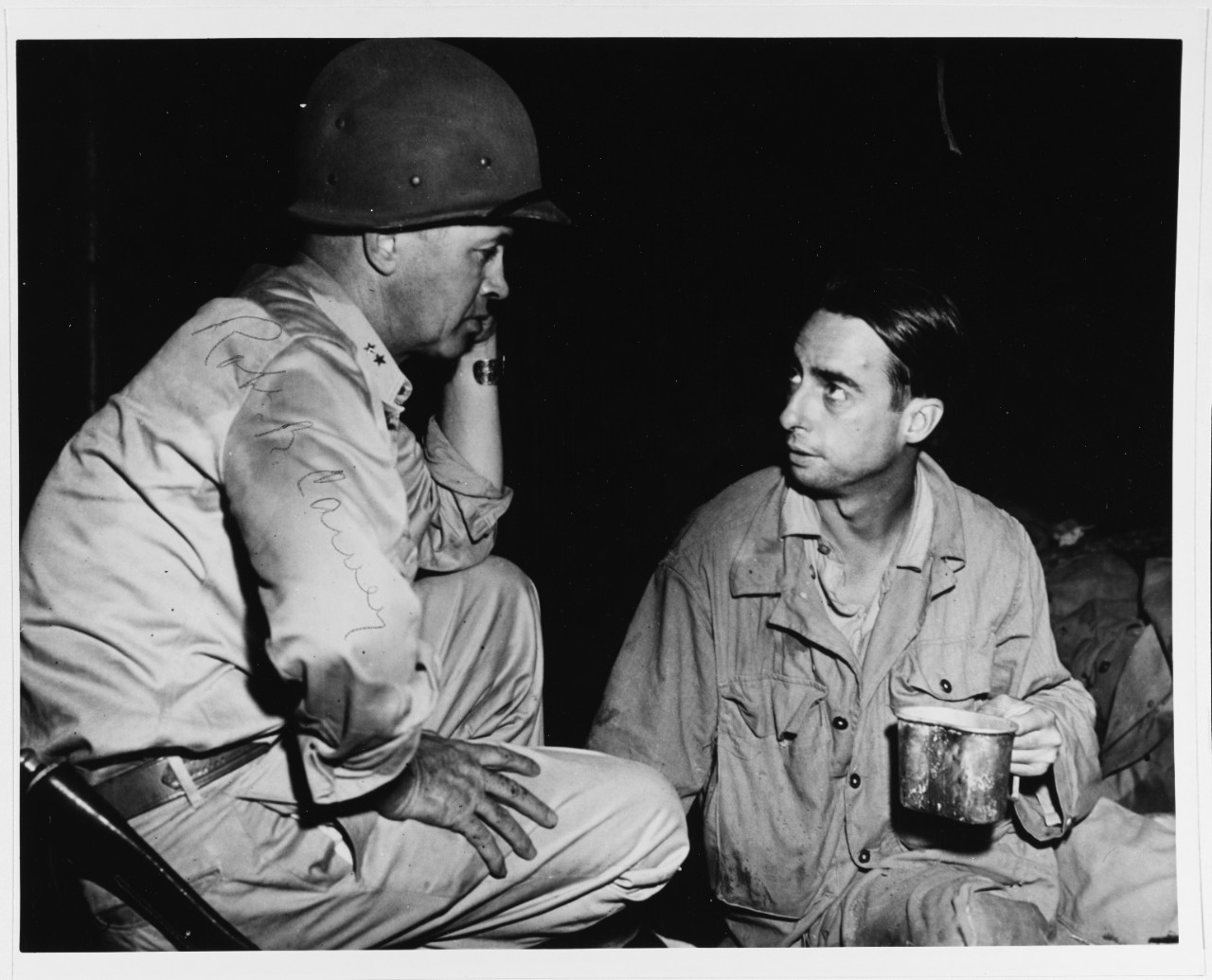
James’ recovery must have taken him back to Pearl Harbor.
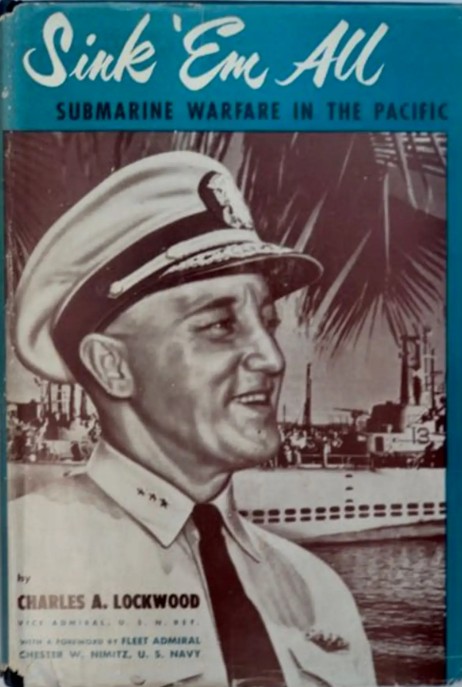
On June 7, 1944, his assignment was to interview Admiral Lockwood for a story about submarine warfare up to that point.
Evening star (Washington, D.C.), June 7, 1944
Lockwood Hails Men and Subs for Pacific Undersea Record
By REMBERT JAMES,
Associated Press War Correspondent.
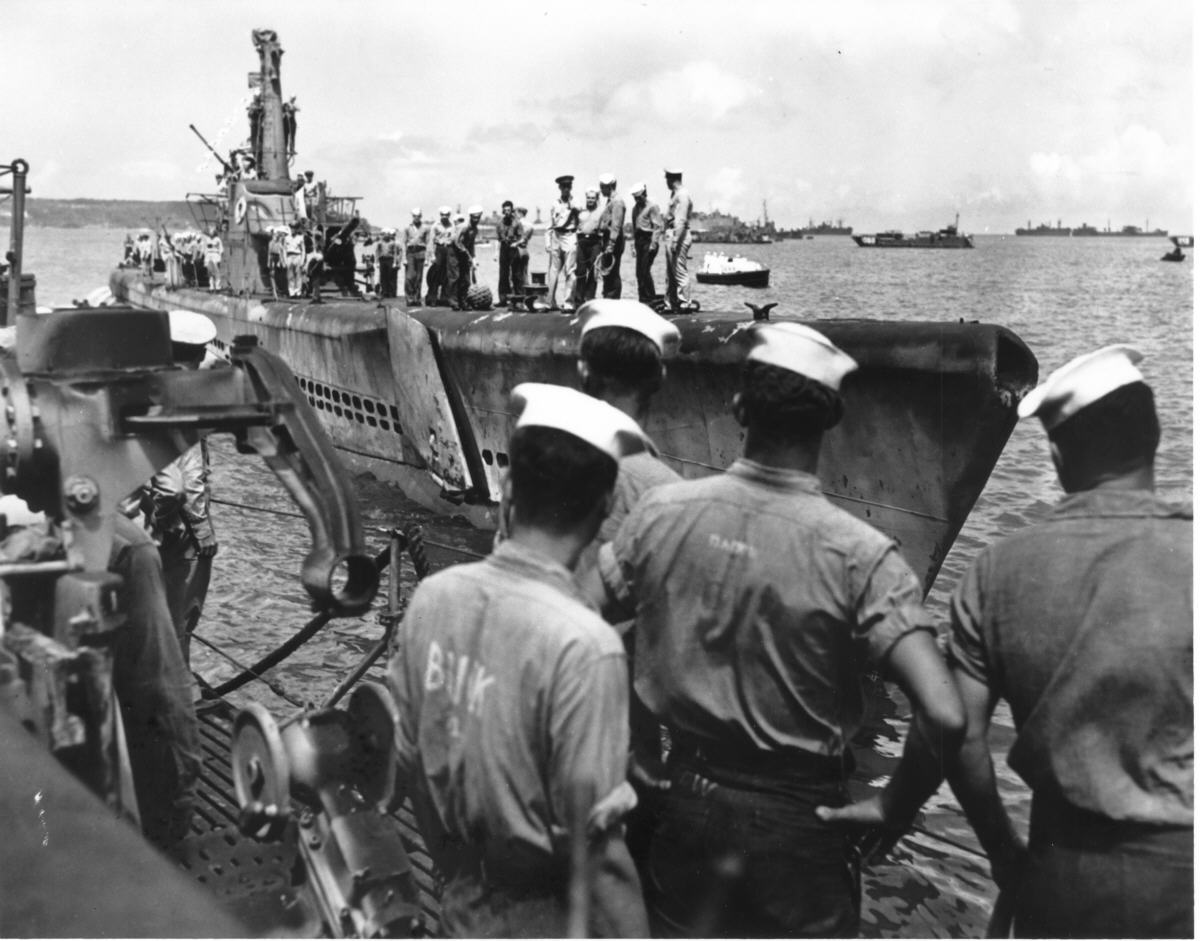
PEARL HARBOR. —Across the submarine’s sinister, black war coats were green and brown streaks. Sea water is hard on paint, and she had been out a long time.
The young skipper maneuvered his weary craft up to a dock. A Navy band was lined up there, playing a marching tune. Waiting beside the band were 40 or 50 officers and enlisted men.
It was Pearl Harbor’s greeting to a returning submarine.
The skipper spotted in the crowd the familiar, intent face of the person he wanted most to see, a youngish officer with three silver stars on the collar of his khaki shirt—Vice Admiral Charles Andrews Lockwood, Jr., commander of the Submarine force of the United States Pacific fleet.
First man aboard the submarine after the gangway was placed, the admiral greeted the skipper warmly.
Below in the submarine’s air-conditioned wardroom they had coffee and the skipper made his first verbal report on results of his cruise.
Admiral Host at Dinner.
Forty minutes later, the admiral came ashore smiling. He got into a polished, navy-blue sedan. The auto surged up through the winding streets, between heavily-guarded buildings that house part of the shops and some of the not inconsiderable secrets of the submarine force.
The skipper stood watching until the car, with the three silver stars and the two silver dolphins glittering on its dark license plate rounded a corner and was out of sight. Then like everyone else on the submarine, he began an eager examination of his personal mail
The next noon, at the admiral’s house, there was lunch for four—the sub skipper, the chief of staff, the commander of the training command and the admiral. For three hours afterward, the young submarine skipper talked and the admiral listened.
No one listens better than Admiral Lockwood, and the report he was hearing—like dozens of others from submarine skippers who had lunched at his house—would have made good listening for any enemy of Japan.
These reports, added up since the Pacific war began, have disclosed the certain sinking of 517 Japanese ships, and the probable sinking or damaging of 150 others—a total of 667 ships hit by American submarines.
In destroying these millions of tons of Japanese shipping, the U. S. submarine force has lost in action 20 submarines, a record naval authorities consider one of the best among all branches of the armed services.
In Charge More Than Year.
For more than a year, the man in charge of this underseas campaign has been Admiral Lockwood, hard-working, athletic, 30-vear veteran of the submarine service.
Submarines and the men who operate them are his first interest. He thinks there are two reasons for the record set against Japanese shipping.
The first is the quality, training and youthful initiative of the submarine captains and personnel.
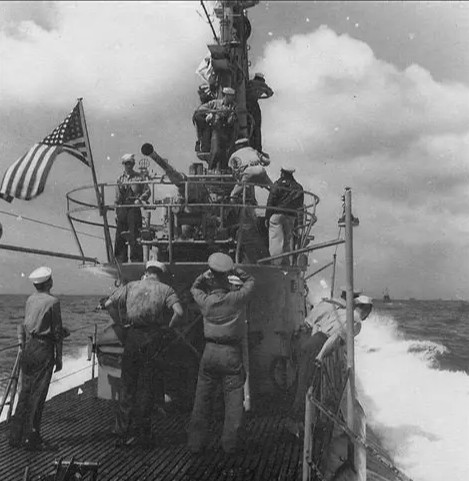
The other is the underseas craft itself.
“We’ve got the best damned submarine in the world,” he says emphatically.
It was in 1908. after President Theodore Roosevelt got the nation interested in a powerful Navy, that young Lockwood, then 18, left his home in Lamar, Mo., to enter the Naval Academy. At the academy, the dark-haired, blue-eyed young man learned his lessons, and won athletic fame by setting a midshipmen’s track record for the mile-run that lasted most of a decade.
Two years after graduation in 1912 he was in command of a submarine. Three years later, at 27. He took command of the Navy’s first Asiatic submarine division.
Now, at 53, he is the youngest vice admiral in the Navy and commander of the most effective submarine force in the Nation’s history.
Strenuous and capable, he smiles easily, speaks softly. He likes to think of himself as entirely a submarine man. The Navy considers him also one of its better diplomats.
Admiral Tennis Fan.
Younger officers regard him as one of their warmest personal friends. He plays tennis with them, invites them to dinner at his home.
Admiral Lockwood likes to talk about his young submarine skippers.
He knows exactly what each has done and cites their records as proof of the wisdom of a policy of giving young men responsible commands at the earliest possible moment. Most of them he calls by their first names or nicknames.
Admiral Lockwood learned about the Orient commanding submarines in the Pacific, gunboats on the Yangtze River of China. He polished up his diplomacy on naval missions to Tokyo, Rio de Janeiro and London. In addition, he had tours of duty in Washington, at the Great Lakes Naval Training Station, at the Naval Academy and on battleships.
He commanded the Southwest Pacific force of submarines for nine months in 1942 and 1943, after his promotion to rear admiral. He became a vice admiral In October of 1943.
He was married In Brazil in January, 1930, to Miss Phyllis Irwin, whose father. Rear Admiral W. E. Irwin, was in command of a United States naval mission to Brazil. They have two sons and a daughter. The family home now is Coronado, Calif.
James resting period did not last long. By June of 1944, he was reporting one more form the front lines at Tinian and Saipan. As early as June 18th, he was reporting from in theater about the progress of the Marines and Navy. He would report often from Saipan, Tinian and later Guam.
But his island hopping was far from finished. Next up was Peleliu where he would find himself face to face with another Marine Corps Legend.
Yanks Blast 8 Japs from Cave with Two Doors on Peleliu
By REMBERT JAMES,
Associated Press War Correspondent.
WITH UNITED STATES MARINES ON PELELIU ISLAND
Palau, Sept. 20 1944 (Via Navy Radio)
The cave had two doors. You could go in one and come out the other about 30 yards away. It was part of the Japanese defenses on Southern Peleliu.
Marine engineers exploded a charge of TNT against one door and blew eight Japanese soldiers out the other.
For the marines it was only one dangerous chore in a day’s which required them to unravel all sorts of mysterious defenses and booby traps. They are thickest in the central ridges north of the captured Peleliu airport.
Directing the marine attack on the ridges is Col. Lewis B. (Chesty] Puller, Saluda, Va„ holder of four Navy crosses. Lounging beside a field phone on a sweltering coral hillside, Col. Puller puffed wearily at a cigarette and said in some places the marines had been able to gain only 75 yards in a day while in others they gained 300 yards.
“This is the roughest ground you could ever find to fight over and the heat is causing a number of prostrations,” the colonel remarked. The temperature was more than 100 in the shade.
The phone rang. A battalion commander wanted to know whether to advance. Col. Puller said yes, go ahead and smash them. He told aid aide to “call up 50 stretcher bearers because we are going to need them.”
From an article posted on Naval Institute:
“The scale of casualties in the 1st Marine Division, but especially those in the 1st Marines, shocked everyone involved, because no one had anticipated the operation would be so difficult. (The following year, Iwo Jima and Okinawa would dwarf those numbers, with losses in 13 of the 15 Marine infantry regiments engaged exceeding those in the 1st Marines at Peleliu.) Puller was no exception. He himself had suffered through the battle with a severe infection in his thigh from a piece of shrapnel still lodged there from Guadalcanal. At a memorial service to dedicate the division cemetery on Peleliu in late September, the marks of his old wound and the recent battle were evident. He appeared thinner than usual, his face craggier, his eyes sunken and dark, his demeanor sullen. Major John S. Day, a division staff officer, observed that the colonel “looked like hell” and was limping badly. Years later, Puller called Peleliu “his toughest operation” of the war.”
December 1944 would find James on board one of Admiral McCain’s flagships for the Luzon Invasion
The stories James wrote were filled with incredible detail and as the war progressed, he was careful to recognize the many men who served with great valor.
At the Luzon invasion. He made sure to relay some of the heroics of the fliers who were the point of the spear in beating back a ferocious enemy.
https://www.loc.gov/resource/sn83045462/1944-12-16/ed-1/?sp=3&st=image&r=-0.078,0.371,1.115,1.115,0
Pilots told scores of stories on attacks on enemy fields and shipping. One was related by Ensign Richard K. Reynolds, New Royal Oak. Mich., who caught a large Japanese troop ship off Western Luzon’s coast and attacked it with rockets. “I stuck a rocket in her stern,” he said, and left her burning so badly she had to be abandoned.”
Only a few minutes earlier, Ensign Reynolds along with Lt. (j. g. R. L. Hunt, Kansas City, and other pilots destroyed a similar craft just off lba, a thousand yards from the coast.
Telling about it, Lt. Hunt said: “Lt. Fred Keene, Douglaston, Long Island, hit it first with five 100 pound bombs. Then I flew in at masthead height and smacked it right amidships with a big one. She split in two.”
Lt. Comdr. Leonard J. Check, Minto, N. Dak., a fighter squadron leader, killed two Japanese pilots and destroyed their planes and a truck in a deadly game of hide and seek this morning. It took two strafing runs but Comdr. Check caught both and set the truck afire. Then he went back to the field and strafed their planes.
But Comdr. Check’s day was not over. He flew to nearby Clark Field, 50 miles north of Manila, and found two more enemy planes trying to land. He attacked one and shot it down while other flyers in his division got the other.
Two pilots who helped keep Luzon under combat patrol all last night told how they strafed a factory and railroad cars at the town of San Ferando; attacked shipping off the coast and heckled airfields.
Lt. Theodore Wolfe, Memphis, Tenn., flying along Subic Bay shore today, spotted an enemy destroyer which he attacked and damaged.
South China Sea
James’s postings would continue through January where he stayed with McCain’s fleet.
There would be many more successes but no more bylines from him as the allies continued their arch through Iwo Jima and later Okinawa.
Not even a single article about the attacks on Hiroshima and Nagasaki.
His last article was about something that happened that the Navy probably did not want known at the time. Typhoon Cobra was first spotted on December 17, in the Philippine Sea. By the 18th of December, the typhoon would arrive in full force and wreak havoc on the armada. It sank three US destroyers, killing at least 790 sailors, before dissipating the next day.
One of James last articles in theater was about the carnage that resulted from that loss. Task Force 38 arrived at Ulithi on 24 December.
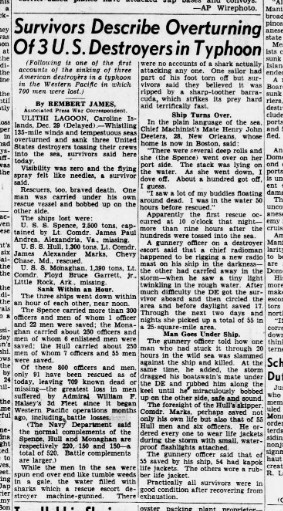
Survivors Describe Overturning Of 3 U. S. Destroyers in Typhoon
The Following is one of the first accounts of the sinking of three American destroyers in a typhoon in the Western Pacific in which 700 men were lost.
Nine other warships were damaged, and over 100 aircraft were wrecked or washed overboard.
By REMBERT JAMES, Associated Press War Correspondent.
ULITHI LAGOON, Caroline Islands, Dec. 29 (Delayed).
(The article appeared in the Washington Newspapers on January 13, 1945)
Whistling 135-mile winds and tempestuous seas overturned and sank three United States destroyers tossing their crews into the sea, survivors said here today.
Visibility was zero and the flying spray felt like needles, a survivor said.
Rescuers, too, braved death. One man was carried under his own rescue vessel and bobbed up on the other side.
The ships lost were:
U. S. S. Spence, 2,500 tons, captained by Lt. Comdr. James Paul Andrea, Alexandria, Va., missing.
U. S. S. Hull, 1,300 tons. Lt. Comdr. James Alexander Marks, Chevy Chase. Md., rescued.
U. S. S. Monaghan, 1,390 tons, Lt. Comdr. Floyd Bruce Garrett, Jr., Little Rock, Ark., missing.
Sank Within an Hour.
The three ships went down within an hour of each other, near noon.
The Spence carried more than 300 officers and men of whom 1 officer and 22 men were saved; the Monaghan carried about 250 officers and men of whom 6 enlisted men were saved: the Hull carried about 250 men of whom 7 officers and 55 men were saved.
Of these 800 officers and men, only 91 have been rescued as of today, leaving 709 known dead or missing—the greatest loss in men suffered by Admiral William F. Halsey’s 3d Fleet since it began Western Pacific operations months ago, including battle losses.
(The Navy Department said the normal complements of the Spence, Hull and Monaghan are respectively 220, 150 and 150—a total of 520. Battle complements are larger.)
While the men in the sea were spun end over end like tumble weeds in a gale, the water filled with sharks which a rescue escort destroyer machine-gunned. There were no accounts of a shark actually, attacking anyone. One sailor had part of his foot torn off but survivors said they believed it was ripped by a sharp-toother barracuda, which strikes its prey hard and terrifically fast.
Ship Turns Over.
In the plain language of the sea. Chief Machinist’s Mate Henry John Deeters, 28, New Orleans, whose home is now in Boston, said: “There were several deep rolls and she (the Spence) went over on her port side. The stack was lying on the water. As she went down, I dove off. About a hundred got off, I guess.
“I saw a lot of my buddies floating around dead. I was in the water 50 hours before rescued.” Apparently the first rescue occurred at 10 o’clock that night—more than nine hours after the hundreds were tossed into the sea.
A gunnery officer on a destroyer escort said that a chief radioman happened to be rigging a new radio mast on his ship in the darkness—the other had carried away in the storm—when he saw a tiny light twinkling in the rough water. After much difficulty the DE got the survivor aboard and then circled the area and before daylight saved 17.
Through the next two days and nights she picked up a total of 55 in a 25-square-mile area.
Man Goes Under Ship.
The gunnery officer told how one man who had stuck it through 20 hours in the wild sea was slammed against the ship and killed. At the same time, he added, the storm dragged his boatswain’s mate under the DE and nibbed him along the keel until her miraculously bobbed up on the other side, safe and sound.
The foresight of the Hull’s skipper.
Comdr. Marks, perhaps saved not only his own life but also that of 55 Hull men and six officers. He ordered everyone to wear life jackets during the storm with small, water proof flashlights attached. The gunnery officer said that of 55 saved by his ship, 54 had kapok life jackets. The others wore a rubber life jacket.
Practically all survivors were in good condition after recovering from exhaustion.
https://www.nationalww2museum.org/war/articles/typhoon-cobra-halsey-versus-mother-nature
The Last Article
That would be the last article written about the typhoon or the aftereffects. I can’t imagine Halsey or any of his staff would have been happy in any way shape or form that this first article appeared. Frankly, I am shocked that it did. Since normal naval policy was to not identify the dead or ship names until the families could be notified, one has to wonder how this one got through.
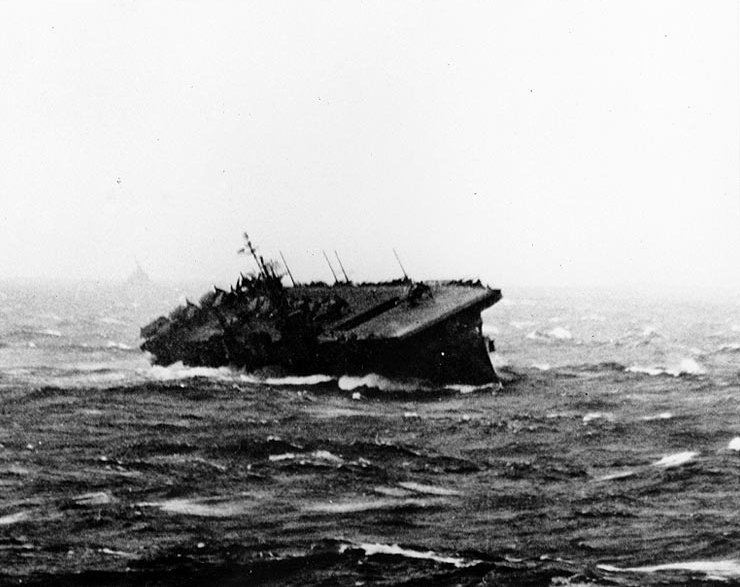
The backlash from the loss of ships and damage to so many others would follow Halsey for the rest of his career. Typhoon Cobra, also known as the Typhoon of 1944 or Halsey’s Typhoon (named after Admiral William Halsey Jr.), was the United States Navy designation for a powerful tropical cyclone that struck the United States Pacific Fleet in December 1944, during World War II. The storm sank three destroyers, killed 790 sailors, damaged nine other warships, and swept dozens of aircraft overboard off their aircraft carriers.
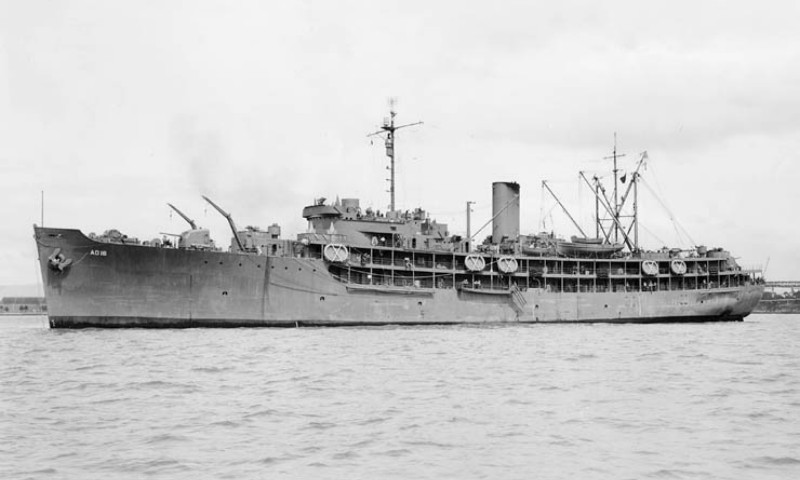
There would be a court of inquiry conducted by Admiral Nimitz on bard the USS Cascade in December of 1945. Halsey was relieved of his command during the proceedings. The court found “errors in judgment committed under stress of war operations and stemming from a commendable desire to meet military requirements. The court ultimately recommended a Court Martial, but no actual blame was ever put on his record. Because of Halsey’s popularity, Washington Leadership, including Roosevelt, felt that he was too popular of a figure for such an action.
A few standard press releases would be sent out under James’ byline, but it was obvious that they did not have the same character as his previous postings. From my perspective, it’s almost as if someone else wrote them an assigned his name to them.
Most were very much like general announcements that would have come from a very restricted source. Then they just stopped altogether.
The next bylines that would bear his name would place him in Moscow in late 1945 after the war was over.
He would return to the states by the late 1940’s and reestablish himself as a naval correspondent. In 1954 he would pen a series of articles on the future of Submarines.
Obituary…
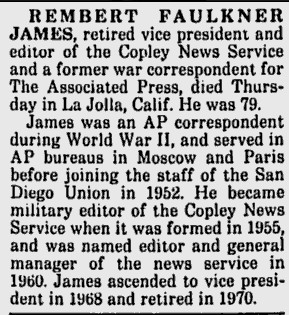
Reading the articles written by Rembert James was intriguing for me. His style and sense of conveying the struggling of the men around him gave me the feeling that I could almost feel myself standing with him observing the exact moments. Even eighty years later, the words were descriptive enough and crafted in such a way that you could be in the moment just by reading them.
I don’t know what happened to James during the gap months that he was no longer published. Maybe someone reading this will have more direct knowledge and be able to fil in the blanks. Knowing the navy’s protective nature, I am sure he was put into a place where the rest of his story’s would not cause harm to the legendary figures he could have written more about. Halsey would retake command of the Task Force and face another typhoon in June of 1945. The lessons learned did not prevent more damage but nothing like December of 1944.
In January, Halsey would relinquish command of TF 38 to Ray Spruance. Spruance held command of Fifth Fleet until May, when command returned to Halsey. In early June 1945 the Third Fleet again sailed through the path of a typhoon, Typhoon Connie. On this occasion, six men were swept overboard and lost, along with 75 airplanes lost or destroyed, with another 70 badly damaged. Though some ships sustained significant damage, none were lost. A Navy court of inquiry was again convened, this time recommending that Halsey be reassigned, but Admiral Nimitz declined to abide by this recommendation, citing Halsey’s prior service record, despite that record including a previous instance of negligently sailing his fleet through a typhoon.
There are many great stories written about the last eight months of the war.
I would have liked to have read more stories from Rembert James. It would be interesting to have a conversation with him someday to find out what actually happened after the typhoon.
Mister Mac


