 Tradition!

One of my great loves is old school musicals that made it to the big screen. Probably because I was an actor in high school and a few rare times since then. But one of my favorite musicals of all time was Fiddler on the Roof. What a great story line about overcoming great odds and keeping a faith filled life on the journey.
The lead actor was facing changes, and he sang this song about tradition.
“Because of our traditions,
We’ve kept our balance for many, many years.
Here in Anatevka we have traditions for everything…
how to eat, how to sleep, even, how to wear clothes.
For instance, we always keep our heads covered
and always wear a little prayer shawl…
This shows our constant devotion to God.
You may ask, how did this tradition start?
I’ll tell you – I don’t know. But it’s a tradition…
Because of our traditions,
Everyone knows who he is and what God expects him to do.”
Tradition!
As a writer who has spent so much time reading and documenting parts of US Navy history, I can’t help but remember the symbols and traditions that make up our navy.
One of the most visible is the enlisted dress blue uniform.
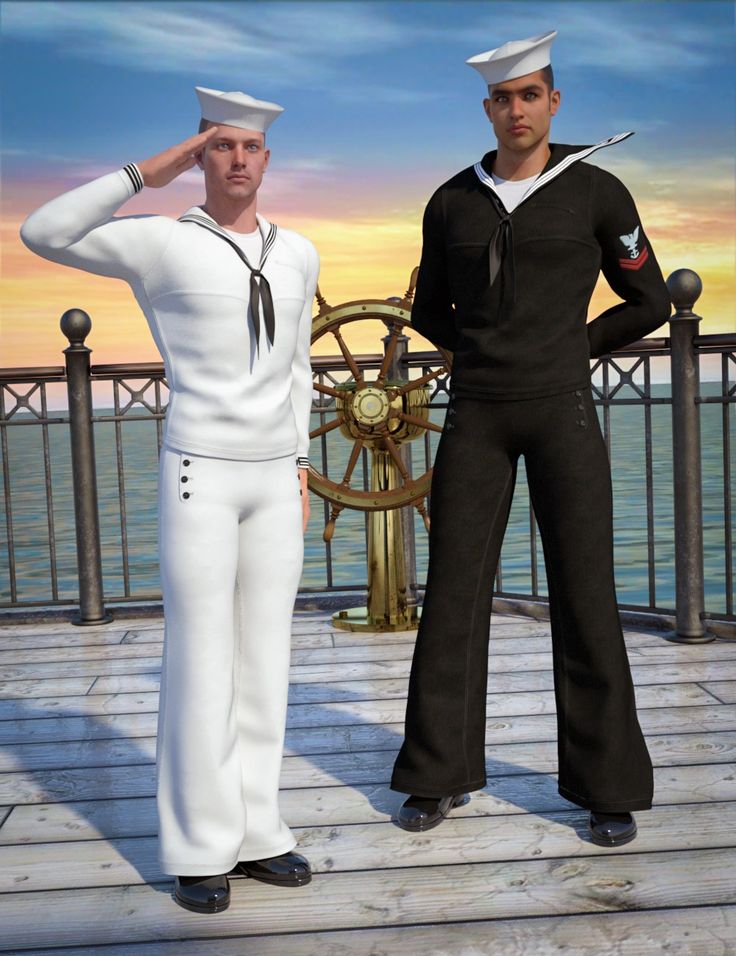
From the website newsmilitary.com
The US Navy Dress Blues Uniform is an iconic symbol of pride and tradition for the Navy. The uniform dates back to 1817, with a standardized design established after World War II. It includes a black neckerchief, jumper, white undershirt, trousers with button details, cap device featuring an eagle perched on an anchor atop a globe and black dress shoes or boots. Both enlisted sailors and officers wear them during formal events as they represent naval traditions that date back centuries while evoking respect from observers. Wearing the uniform signifies one’s duty to serve and adds gracefulness when worn correctly!
I have no idea what they are talking about with the cap device. Not sure I have ever seen that which is described.
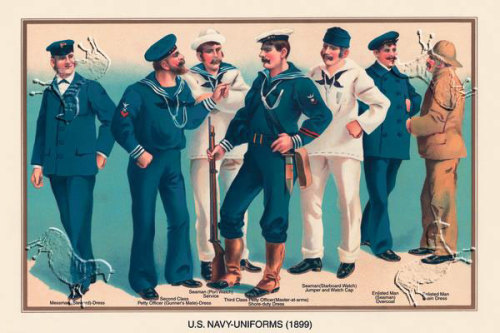
But something about the dress blue trousers has started a dialogue on Facebook.
From the current regulations:
Article 3501.92. (Males) Trousers/Slacks, Blue, Jumper (Broadfall) (E1-E6)
- Description.
Navy blue made of 100% wool serge with 13 non-functional buttons and a hidden center-front zipper closure. Buttons are 25-line, and with black anchors. The design also includes left and right front welt pockets, one right rear pocket, laced gusset at the back, inverted side creases and flared legs (Figure 3501.92-1). Male and female trousers/slacks have gender specific sizing.
- Correct Wear.
Button all buttons and lace gusset from inside out, bottom to top, and tie. Bitter ends of lace are tucked in. Trousers/slacks will hang approximately 2 inches from the floor at the back of the shoe. Trousers/slacks should be tailored to include a 2-inch hem to provide material for adjustments. - Ownership Markings.
Turn trousers inside out, fly down, waistband away from you. Center surname, first and middle initial (if applicable) on rear pocket, a 1/4 of an inch below horizontal seam using white ink; complete manufacturer’s tag using indelible ink.
Note.
Male Sailors may continue to wear the previous trouser design (with functional front fastener buttons) until no longer serviceable.
(Note: I checked the women’s dress blues. They are exactly the same except I am sure sized a bit differently)
What? Hidden front closure??? THEY PUT A ZIPPER IN THERE ???????
Blasphemy.
Well to be fair, the uniform has undergone some changes even in my short life. Many of us remember the abandonment of the traditional cracker jack in the seventies. The idea was that a more business-like uniform would reflect a higher level of professionalism. Or something like that. The suit and tie were attractive but made us look like we were glorified Air Force guys. Plus, the addition of the combination cap diluted the difference between E-1 and Chief.
From the Navy Historical Center:
The Decision to Change; 1970’s
In 1973 the most sweeping change in the history of enlisted dress occurred. Based on a survey conducted in 1970 it appeared that there was some fleet desire, principally among the more senior petty officers, for a different, more distinguished garb. Based on these findings, the sailor was removed from his traditional uniform and placed in a suit and tie which corresponded to the officer/CPO style. The intention was to create a single uniform appearance and present enlisted men in a uniform which was thought to reflect the increasing complexity of the modern Navy.
The action to utilize a suit style for all enlisted has been one of the most controversial changes to affect the Navy in its uniform history. From a practical standpoint, the adoption of a different uniform for dress wear was not the result of a requirement. The jumper/bell bottom style had evolved in a work environment where each piece of the garment originally satisfied a need. With the absence of fully rigged sailing ships and the advent of more comfortable work uniforms, what a sailor wears for dress occasions is now a matter of style.
The most obvious impasse to acceptance of the suit and tie outfit to the enlisted and general public is that it breaks with tradition. While the components of the jumper style uniform serve no nautical purpose today and are not related to anything worn in the civilian world, it has served to identify sailors all over the globe for too long a period of time. Most navies of the world have utilized a similar outfit and most still retain it for non-rated personnel. Throughout the course of uniform history there has continued a strong resistance to changing traditional garments. Sailors prefer to be distinctively dressed. It was the same in 1830 as it is in the 1980’s.
Return to Tradition; 1980’s
The break with tradition, when coupled with unforeseen inconveniences of the suit and tie uniform, were unacceptable. Therefore, in 1980, the Navy again began to issue the jumper style uniform as a dress uniform to recruits. Women’s uniforms also underwent a sweeping change to increase their practicality and to make them more parallel to the men’s uniform.
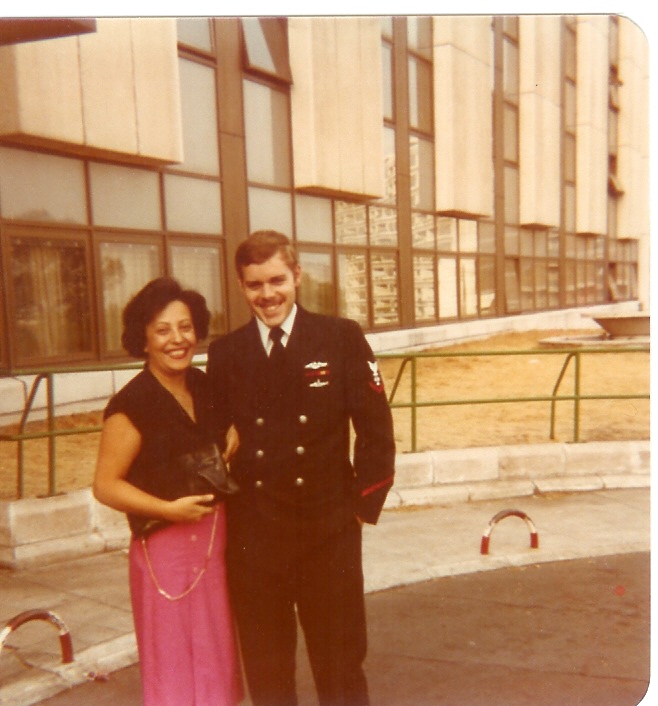
Most of us were glad when the navy came to its senses. I call that the golden age.
But even though there was a swagger about the old uniforms, there were also rules.
From the 1940 Bluejacket’s Manual: REGULATION CLOTHING
All clothing you receive from a supply officer in the Navy is regulation clothing. In every case this clothing is made of excellent material and is much cheaper than any you can purchase ashore. Many men want “tailor-made” clothes and spend large sums ashore to get them. In most cases the cloth in these clothes is not as good as in the clothes purchased from the supply officer. The pattern is usually not strictly regulation, and these men frequently get into trouble over this. Get in the habit of buying regulation clothing from the supply officer, for you will never then be wrong. Your ship’s tailor can make alterations at very small expense so that your uniform will fit well.
Tailor Mades
My Dad was a sailor during the Big War. He actually got misty eyed when talking about the set of tailor mades he had purchased in San Francisco back in the day. The picture of him swaggering down the street with his buddies is one of my favorite pictures of him.
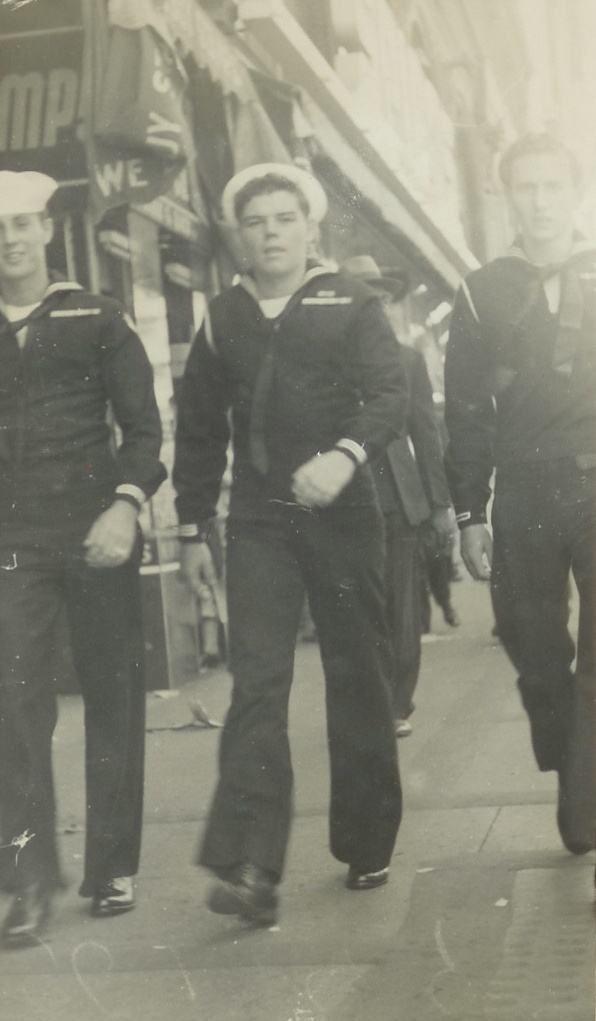
When I joined in 1972, his promise to me was that he would pay for my tailor-made uniform as soon as I got to my first ship. I am pretty sure he was more excited than I was. But time passed and we never quite finished that goal.
After he died, I inherited his uniform, his fathers from WW1 and of course I still have mine. Time and the cedar closet have shrunk all three. None of them fit anymore.
But I just checked. No zippers. Just thirteen buttons and a laced up back.
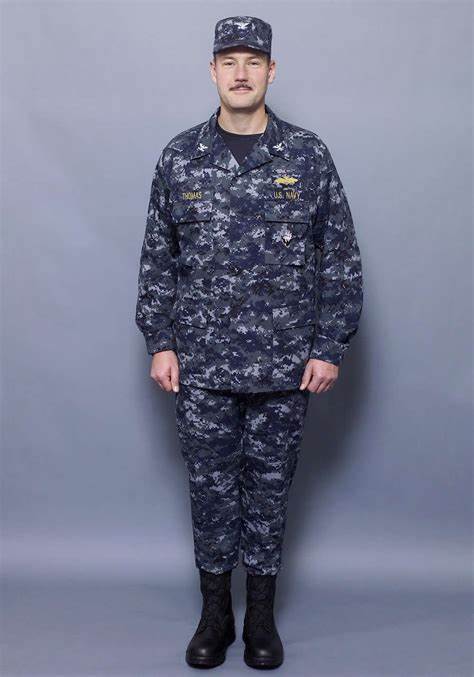
I suppose that change is always inevitable. Seeing males and females dressed alike has been a bit of an adjustment. But so was seeing so many wearing various forms of camouflage a few months ago when we were in Norfolk. The blue camouflage certainly was a surprise since the ocean is kind of blue. If a sailor went over the side, I can imagine that might be problematic. But the new green camos really threw me for a loop.


Old Farts
One of the comments in the Navy related Facebook post said that the Old Farts should take a deep breath and let the sailors be sailors. I guess at nearly seventy years old, I fall into that category. To be honest, I went through a number of changes in uniform over my twenty years. I never wore my dress blues after one port visit to San Francisco.

I ended up mostly wearing dungarees or coveralls (poopy suits for you Bubbleheads). I was happy to put on Khakis when I made Chief and later Warrant. But even then, I think I had on blue coveralls until the week I retired.
In my mind, there was never a more distinguished look that screamed United States Navy Sailor more than those Navy Dress Blues with the jumper and thirteen buttons.
And one of my favorite memories as a young lad on leave was having my girlfriend checking out to see that all thirteen buttons actually worked. (Sorry Debbie… it was long before I met you…lolol)
Mister Mac

 theleansubmariner
Submariners are a special breed. Do you miss it?
All the time. Probably why I write so many stories
Mac
That’s what I thought.
There’s not a one of us, upon putting on their “Crackerjacks” for the first time, didn’t think “these things are supposed to be real chick magnets”. I remember after finishing sub school and all my IC pipeline schools going home on leave on my way to my first boat. I had an uncle that was on the boats in WWII, but had been in decline and was in a veterans home not far from my home town. My mother voluntold me to go visit him (which I was more that happy to do), but insisted that I wear my dress blues (which I resisted, but guess who won that one). From the moment I set foot in the door there was a flash mob of “old farts” that surrounded me and I could barely make my way down the passageway (so much for being a chick magnet). I’d like to be able to say that we talked for hours about his experiences, but the truth is that he didn’t even know who I was (to be fair, my Aunt later told me that he was losing memory in reverse chronological order and that he didn’t even remember his own son by that time). I took comfort in knowing that I made a lot of guys day just by showing up in something that they instantly recognized. Mothers are usually right.
ICFTBMT1(SS) Maxey, USN (retired)