
It has been fascinating to watch the application of drones and guided missiles over the past twenty years in various conflicts.
The evolution of microelectronics has changed the way wars are fought in ways that mirror science fiction at its finest. I was reading an article about ENIAC earlier today and it reminded me about the size of the earliest computers.
ENIAC (Electronic Numerical Integrator and Computer) was the first programmable, electronic, general-purpose digital computer, completed in 1945. Other computers had some of these features, but ENIAC was the first to have them all.
By the end of its operation in 1956, ENIAC contained 18,000 vacuum tubes, 7,200 crystal diodes, 6,000 relays, 70,000 resistors, 10,000 capacitors, and approximately 5,000,000 hand-soldered joints. It weighed more than 30 short tons (27 t), was roughly 10 ft tall, 3 ft deep, and 100 ft long, occupied 300 sq ft and consumed 150 kW of electricity.

The computer I have sitting on my desk is probably more capable than the inventors probably ever dreamed ENIAC would lead to,
So, developing an airborne weapon that had some ability to have independent control in the 1940’s could not have been an easy task.
The desperate struggles to dominate the enemy during world war drove innovations at a furious pace. The Germans were constantly being told about wonder weapons that would change the course of the war.
The allies also developed many new technologies that challenged the existing rules of science.
One of those innovations was the BAT.
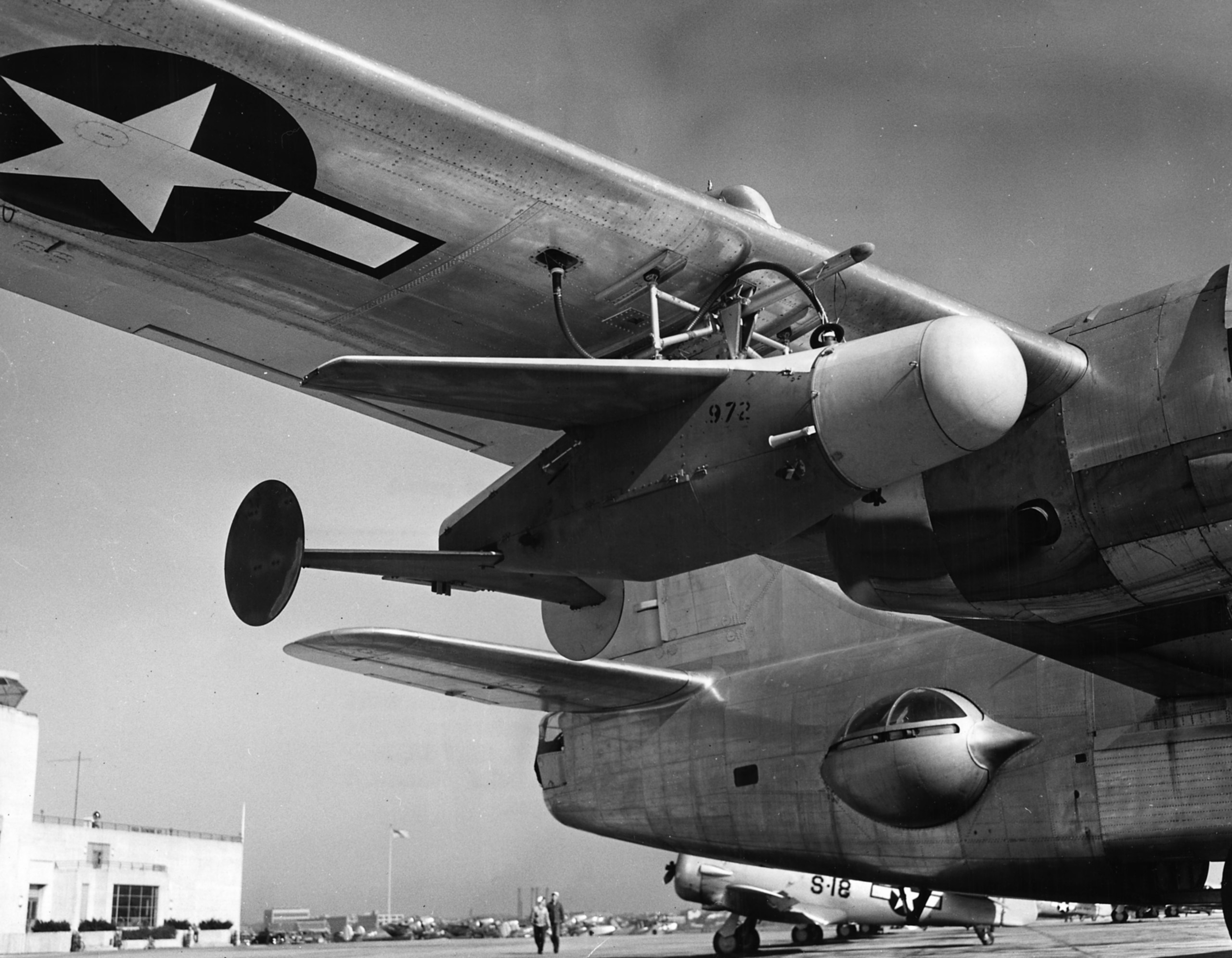
The Bat was the first successful guided weapon developed by the U.S. Navy, and actually the world’s first operational guided missile, which didn’t need operator input after launch.
In 1942, the U.S. Navy began the development of radar-guided anti-shipping glide bombs, and one of the first such projects was the Pelican semi-active radar homing missile. Parallel to that, the U.S. Navy developed a glide bomb with an active radar seeker using a similar airframe as the Pelican and a 450 lb. (1000 lb.) bomb load. Because this missile homed on reflections of signals it had sent out itself, it was called Bat because of these animals’ echo-ranging and homing capability. Bat was originally designated Bomb MK 57, but this was soon changed to SWOD MK 9 (SWOD = Special Weapons Ordnance Device; Pelican became SWOD MK 7. Drop tests of Bat in late 1944 were relatively successful, and the weapon was declared combat ready in January 1945.
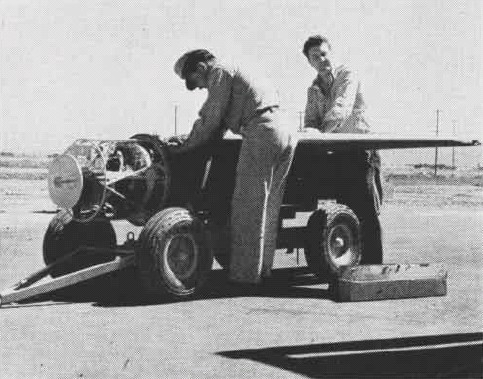
The ASM-N-2 Bat was a United States Navy World War II radar-guided glide bomb which was used in combat beginning in April 1945. It was developed and overseen by a unit within the National Bureau of Standards (which unit later became a part of the Army Research Laboratory) with assistance from the Navy’s Bureau of Ordnance, the Massachusetts Institute of Technology, and Bell Telephone Laboratories. It is considered to be the first fully automated guided missile used in combat.
The antiship variant of the Bat (SWOD, for “Special Weapons Ordnance Device”, Mark 9 Modification 0) eventually saw combat service beginning in April 1945 off Borneo, dropped by Consolidated PB4Y Privateers (one bomb mounted under each wing) at altitudes of 15,000 to 25,000 feet at airspeeds of 140 to 210 kn (260 to 390 km/h). Several Japanese ships were sunk and the kaibokan Aguni was damaged from a range of 20 nmi.
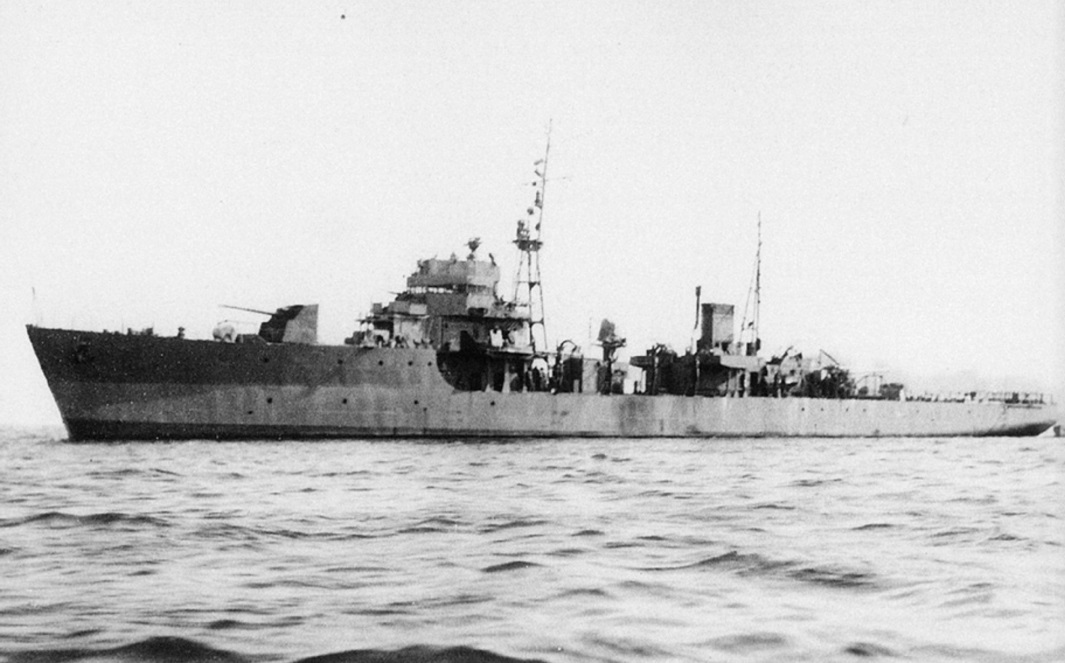
This vessel is frequently misreported as having been sunk by a destroyer. Several Bats were also fitted with modified radar systems (SWOD Mark 9 Model 1) and dropped on Japanese-held bridges in Burma – the same targets that the MCLOS-guidance, half-ton (AN-M65 GP bomb) weight VB-1 Azon PGM ordnance was designed to take on – and other land-based targets. The Bat’s pioneering radar guidance system was easily confused by radar land clutter, particularly against targets close to shore. A total of approximately 2,600 Bat missiles were deployed.
After the war, the naval designation ASM-N-2 was applied to the unit.
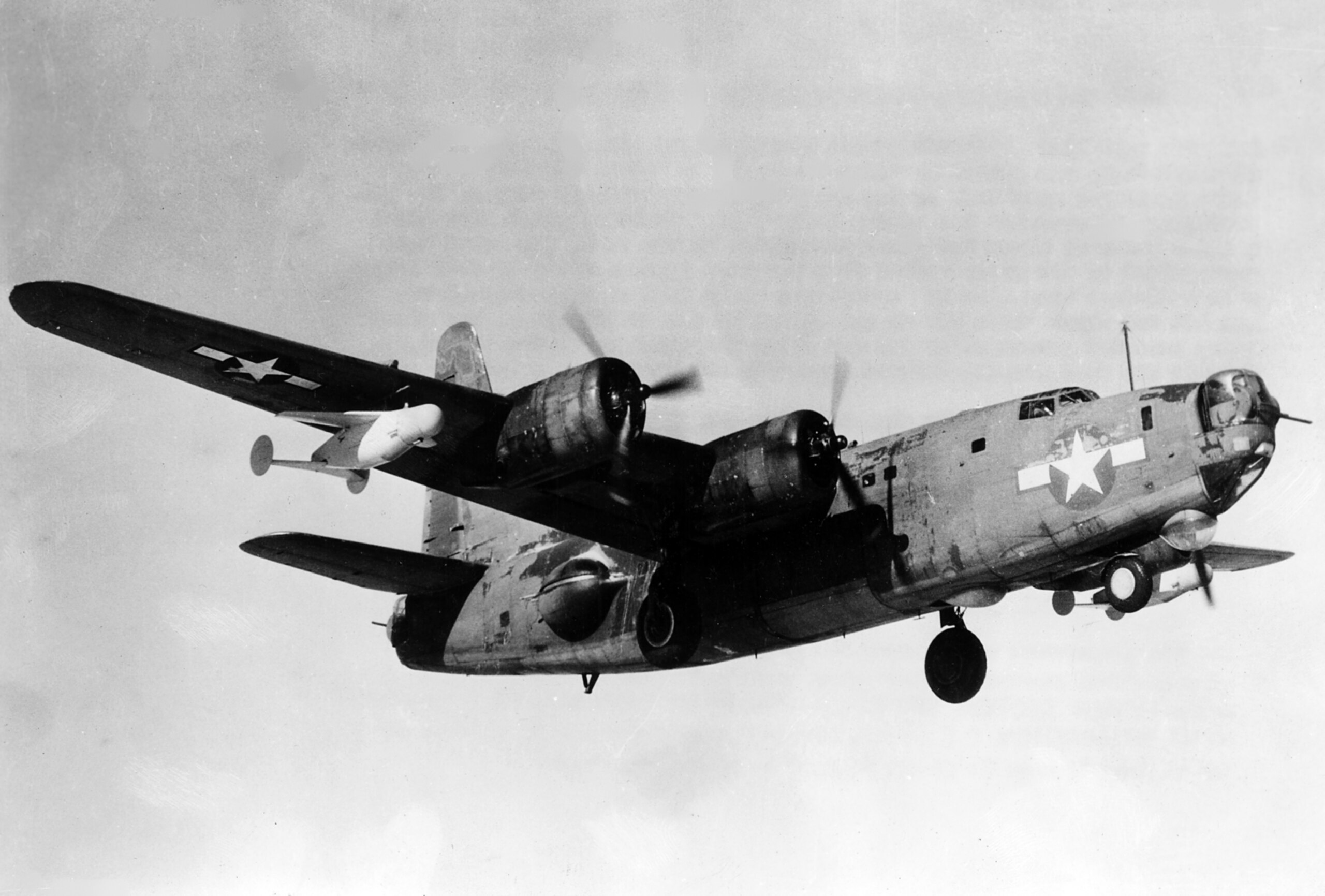
The Privateer was the primary launch platform for the Bat, but other aircraft were also modified to launch the weapon, including the Vought F4U Corsair, Curtiss SB2C Helldiver, and Grumman TBF Avenger. The primary post-World War II aircraft to carry the weapon was the P2V Neptune.
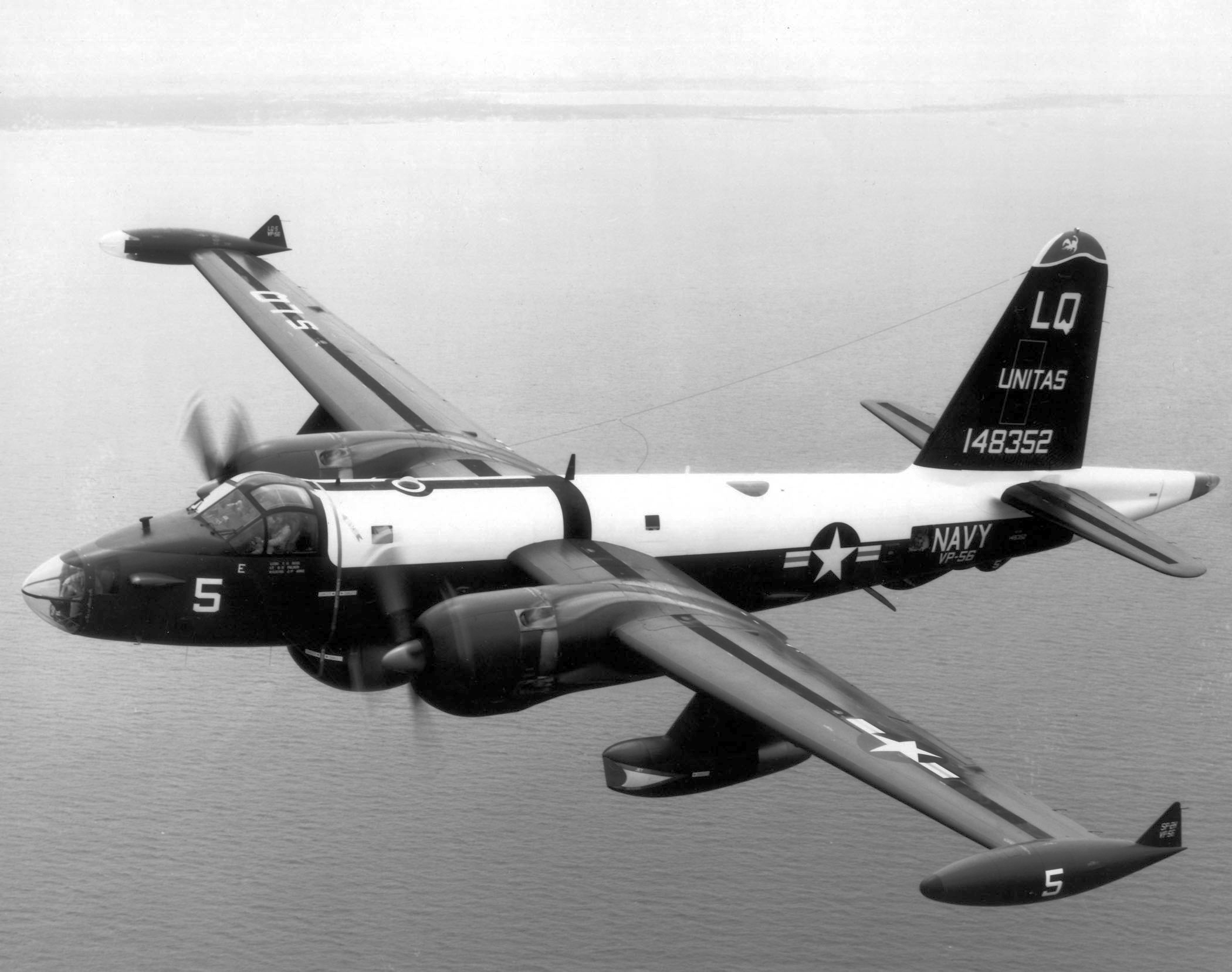
After the war, the navy and its supporters were more willing to open up about the technology that had been kept out of the public eye. I can’t help but wonder if they felt threatened by the creation of the atomic bomb which was largely controlled by the army. After all, with a weapon that had such destructive capability, why would the country need a navy? Reading many books and stories about the post-world war period, there were a lot of people from the President on down that were thinking the same thing. Truman and his supporters sought to streamline the military into a single cohesive unit (Department of Defense) and the navy was seen by many as an expensive drain on the economy. Since bombers could theoretically deliver the knockout punch that would end any future war quickly, maintaining a fleet seemed to be questionable. Plus, the plan was to create a new air force so why maintain a navy air force when you could have a unified command.
SO, it was interesting that the existence came to the public eye and even more interesting that the technology around it would become exposed.
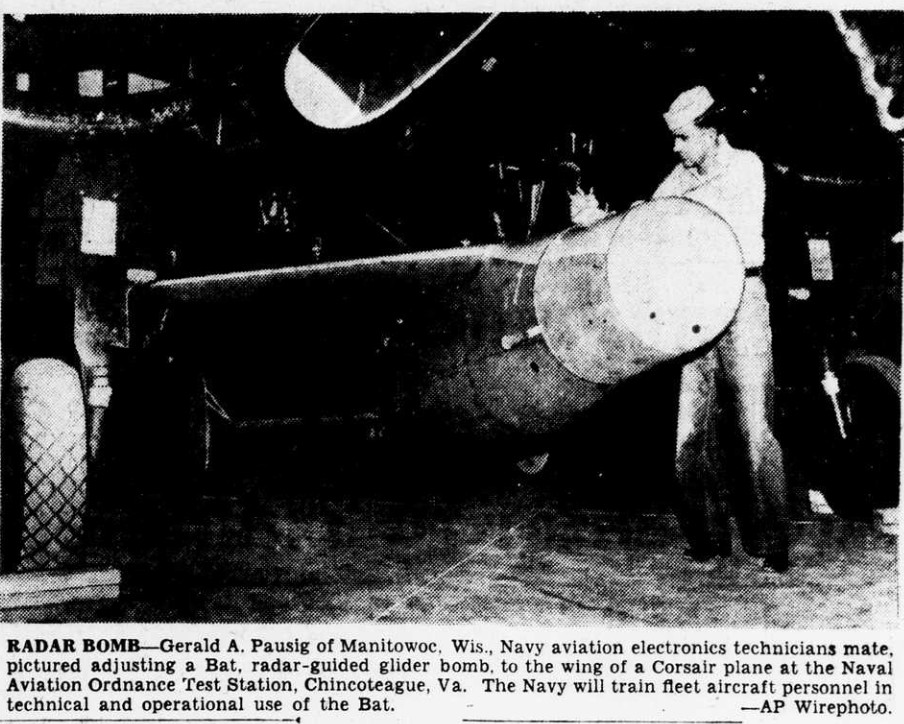
The American citizen (Omaha, Neb.), April 22, 1946
Bomb Guided by Radar Is Deadly
The “Bat” Is Able to Trail Vessels Unerringly Navy Reports.
NEW YORK. The Bat radar-guided bomb that identically followed enemy warships and merchant men and sank them no matter how hard they tried to elude it, was announced here by the Bell Telephone laboratories, with authority by the navy, according to the New York Times.
The weapon is equipped with radar in its nose by which it sends and receives signals from the target. Wherever the target goes it follows, twisting and turning with it until their pathways merge in final explosion.
The navy’s electronic Bat guides itself by radar pulses in the same manner in which the natural bat guides itself by the echoes of supersonic pulses emitted by it in flight. It is released from a mother plane after it is made certain that the ship discovered the Bat belongs to the enemy.
The radar-guided bomb is about 12 feet long, has a 10-foot wingspread and carries half a ton of high explosives. The radar equipment weighs about 200 pounds and its speed is comparable to that of a plane and its range great enough so that the mother ship can open, well out of range of the enemy best anti-aircraft fire.
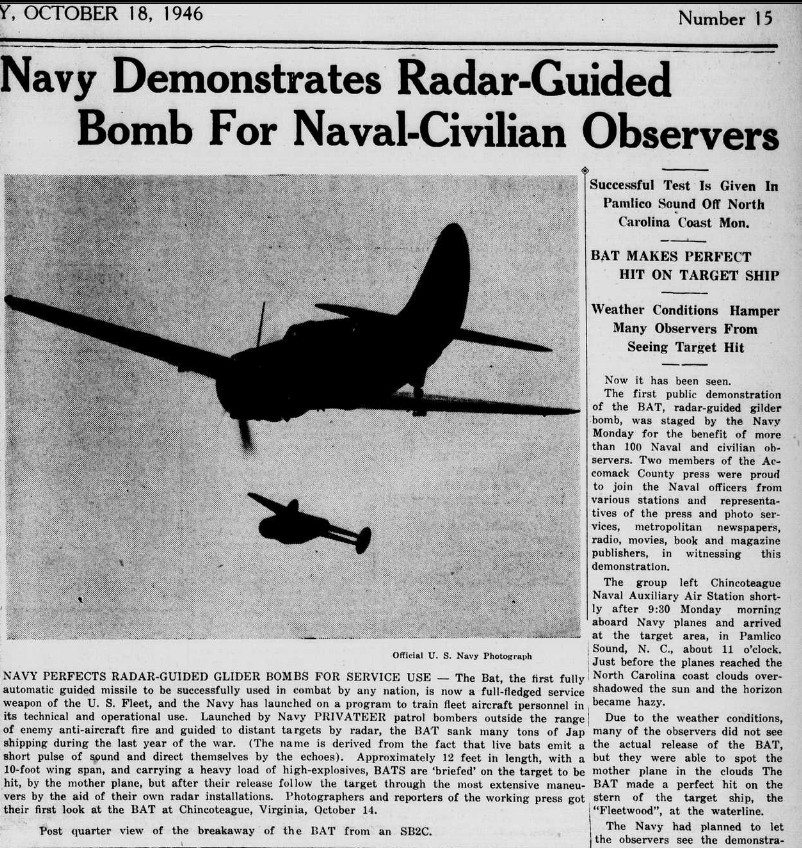
Shows the Direction.
The unit includes a transmitter, a receiver, and the circuit that indicates the direction of the target and flashes its finding electrically to the Bat’s autopilot. Another part of the unit, the monitor, mounted in the mother plane, presents signals from the Bat to the pilot and radar observer, so that when the Bat picks up a ship, a tell-tale “blip” appears on the monitor’s scope.
After the Bat’s find is definitely identified as enemy the pilot heads his plane toward the prey, releases it at the proper distance. From this point it is “on its own.” If the target ship changes its course the Bat knows it a split second later and changes its own accordingly. There is no way to avoid the electronic ‘‘homing instinct.”
In developing the Bat, the Bell engineers were up against the problem of finding out what happens inside a pilotless missile on its way to destruction. At the beginning the testing was done by making trial runs on our own ships, approaching the target as closely as possible without actual collision. This procedure often proved exciting to all concerned. One ship tracked the mother-plane’s dive with anti-aircraft guns cocked, but fortunately no one pulled a trigger.
Employ Gondola Blimp.
In the final field test of the Bat radar equipment was fastened on the front of a blimp gondola. With a daring, unidentified young man astride it to watch its operation, with motion picture cameras to read with various test-meters, they cruised slowly toward the target. On the basis of this and other tests, supplemented by theory, various improvements were made.
By early 1945 final trial release were completed and the Bat was given orders overseas. Privateer search planes equipped to carry Bats appeared on Philippine airstrips in May of that year. The Bat’s combat record against Japanese shipping has not been revealed in detail, but one incident in which two planes sighted two ships by radar over a distance of 20 miles has been disclosed.
Our planes went in close to identify the ships visually as Japanese destroyers. When they were met by intense anti-aircraft fire, the Privateers banked and flew out of range. One of them undisturbedly launched its Bat—and it glided straight for the leading destroyer, where it blew off her bow. The other destroyer began lobbing shells toward the Privateer, but they were far short.
In the post-war years, the U.S. Navy tried to improve Bat’s accuracy and reliability, but a live test series against an obsolete battleship in 1948 yielded very disappointing results.
The latter were in part attributed to radar interference from other ships and aircraft.
Because that meant that the ASM-N-2 could be fooled by very simple radar countermeasures, Bat was removed from the inventory in the early 1950s.
[1] Norman Friedman: “US Naval Weapons”, Conway Maritime Press, 1983
[2] Frederick I. Ordway III, Ronald C. Wakeford: “International Missile and Spacecraft Guide”, McGraw-Hill, 1960
[3] Bill Gunston: “The Illustrated Encyclopedia of Rockets and Missiles”, Salamander Books Ltd, 1979
Another innovation that was a precursor to what is going on in the world today was the use of radio-controlled aircraft. In the mid 1940’s the application of radio control for planes was growing. These “drones” were certainly not the miniature drones that can be purchased commercially. They were larger aircraft that were used to replace the towed target sleeves that were used for gunnery practice.
Peninsula enterprise (Accomac, Va.), July 19, 1946
Radio Controlled Planes Being Used at Chincoteague NAAS
Radio controlled planes, called drones are now being used in large numbers at the Chincoteague Naval Air Station according to information given out from the station.
They are used primarily for anti-aircraft and gunnery targets for fleet training units.
They had been on the field previous to May 1st but had not been used. They are now being used in practice almost daily.
More about the RC drones can be found here:
https://worldwar2inreview.blogspot.com/2025/03/radioplane-drones-first-american.html
But not everyone was an enthusiast of the emerging technology.
In order for the country to make progress, location for testing needed to be set aside. Extensive studies during the war identified a location near Chincoteague VA called Wallops Island. This location was ideal because of its proximity to the ocean and its reliable climate. The creation of the center would create jobs and infrastructure at a time when the country was winding down from the war. You would think everyone would be thrilled at the prospect of a large government project that brough money into the community. SO it surprised me a bit to find a letter to the editor on the front page of the local paper (The Peninsula Enterprise)
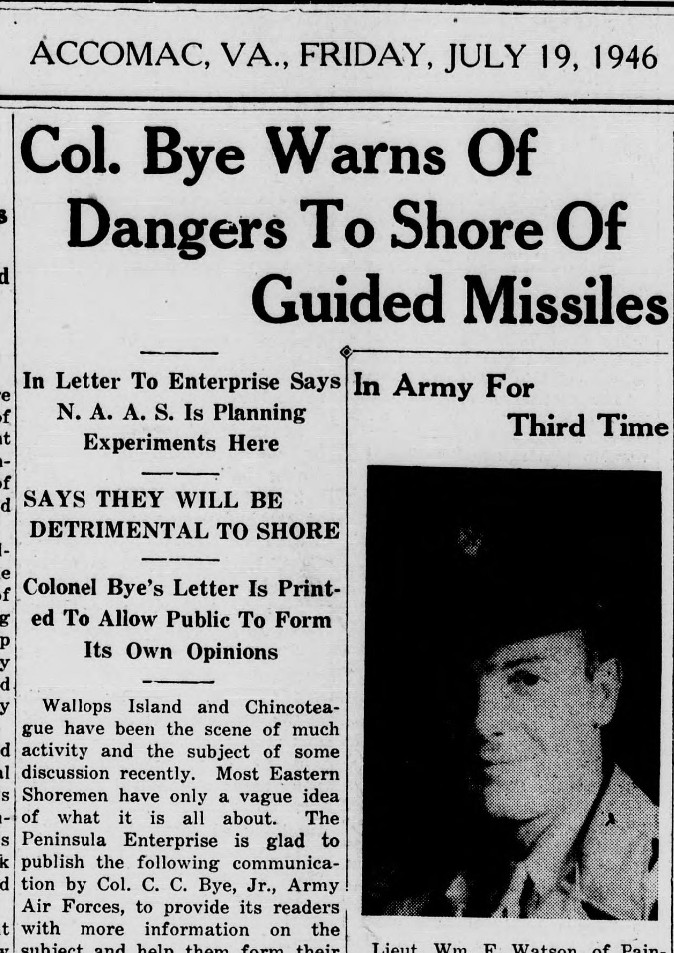
Col. Bye Warns of Dangers to Shore of Guided Missiles
In Letter to Enterprise Says N. A. A. S. Is Planning Experiments Here
SAYS THEY WILL BE DETRIMENTAL TO SHORE
Colonel Bye’s Letter Is Printed to Allow Public to Form Its Own Opinions
Wallops Island and Chincoteague have been the scene of much activity and the subject of some discussion recently. Most Eastern Shoremen have only a vague idea of what it is all about.
The Peninsula Enterprise is glad to publish the following communication by Col. C. C. Bye, Jr., Army Air Forces, to provide its readers with more information on the subject and help them form their own opinions.
Mr. John Edmonds, Editor
The Peninsula Enterprise
Accomac, Virginia
Dear Mr. Edmonds:
Undoubtedly most of your readers have already heard that the Naval Air Station at Chincoteague intends to expand its activities in the immediate future to include experimental work on guided missiles. This may sound innocent enough but its effect will be to establish a permanent Bikini Atoll right here on the shores of Virginia and if in the next five years the area within 25 miles of Chincoteague is not made uninhabitable it will at least be a most undesirable place to live.
In a letter to Congressman Bland, Admiral G. F. Hussey, Jr., Chief of the Bureau of Ordnance, U.S Navy, describes the use of the proposed range as follows:
“With regard to the size, description, character, and weight of bombs to be used, all categories of aircraft bombs, projectiles, rockets and missiles will in all probability be used at one time or another. This would encompass the field from the .50 caliber machine gun projectile to the 4000 lb. bomb. Firing points will tie of two types: (1) From planes on the ground, or ground launchers. (2) From airborne planes.
The aircraft participating in the bombing and rocket firing experiments will not only be based at the Naval Air Station at Chincoteague, but will come from other Naval bases, aircraft carriers serving with the fleet at sea.
Outside of dropping an atomic bomb there is no program the Navy could embark upon which would be more detrimental to the people and the country side for miles around.
Development of guided missiles is in its infancy but their present size and destructive power can be visualized by briefly reviewing those in the hands of the Germans when the war ended.
You can be sure that those under current development by both our Army and Navy are superior but that their characteristics are secret and cannot be given here.
The V-l, the first guided missile to be used against Britain had a range of about 150 miles and carried a warhead of 2000 lbs. of high explosive. The overall weight at launching was 4,860 pounds, 836 pounds of which was fuel. It was approximately 25’/2 feet long, with a wing spread of 17‘/2 feet. The V-2 is a true rocket design for longer range, 46 ft. long and 4 1/2 ft. in diameter. It weighed approximately 13 tons at launching, about 9 tons of which was fuel load. It travelled at the speed of 1 mile per second (3600 miles per hour or 25 per cent faster than a rifle bullet). Both of these missiles were in mass production and extensively used during the war.
There were numerous other controlled missiles developed and used by the Germans and on their drawing boards was the A-10, capable of being fired across the Atlantic with 125,000 lbs. of fuel. The development of their missiles was so dangerous that the Germans established their experimental station at desolate Peenemunde on the Baltic, an area far removed from civilization. They spent $100,000,000 in operations there in 1936, the year it was started.
I give these few facts and figures on the Germans to bring out the tremendous scope inherent in the program the Navy has in mind. It is well to consider the little chance local people will have of influencing the program once it is under way regardless of its destructive nature. Remember that guided missiles are still in the early stages of development and no one today knows the extent of their possibilities. We do know, however, that in the experimental period their behavior is most unreliable and impossible to foresee so that anyone in the vicinity of such tests is in a most hazardous spot. I have checked the Navy’s announced program with a competent civilian expert and he estimates the danger area to be 150 miles.
The U. S. Navy had no intention of notifying the inhabitants of Chincoteague and vicinity that this area would be used for a rocket and bombing target range and it was by accident that the news leaked out. By Admiral Hussey’s own admission this site was selected as the location for this work more than three years ago and there has been no thought of showing the local inhabitants any consideration in spite of the ruinous effect these plans will have on the community.
A delegation from Chincoteague, including the mayor, visited Washington and after having the Navy’s plans direct from Admiral Hussey, lodged a protest with Congressman S. 0. Bland, who immediately protested to the Navy. At this point the Navy’s political might swung into action. Representatives were sent to Chincoteague to emphasize the money the Navy could pour into the area and by double talk to quiet any fears that had been aroused.
In a period of a few days 370 telegrams were received by Congressman Bland favoring the project from people representing themselves as Chincoteague residents. A thorough check of the signatures on the telegrams developed that less than 10 percent were actually from Chincoteague and practically all of them were employed at the Naval Air Station. You can draw your own conclusions as to the methods used to have the telegrams sent.
Admiral Hussey then wrote a letter to Congressman Bland which was forwarded to the Chincoteague Council and this letter is a masterpiece of evasion insofar as to the effect the Navy’s plans will have on the Chincoteague area. It was written in slippery language designed to give the impression that dropping bombs and shooting rockets was a nice quiet little game that would not bother anybody and an asset to any community. However, great care was taken in the wording to avoid promising or guaranteeing anything concerning their operations.
On the basis of this letter and glib assurances by the Navy’s representatives the Chincoteague Council passed a resolution stating that the Council of the Town of Chincoteague favored the project provided that:
- There will be little annoyance due to explosion.
- There will be no loss of oyster, fish, clams and crabbing grounds.
- There will be no interference with boat traffic.
On the basis of this resolution Congressman Bland has withdrawn his protest and the Navy is now free to proceed with its plans.
Due to the Navy’s representations being so ambiguous and unrevealing about the unfavorable and harmful aspect of their plans the Chincoteague Council does not have a clear conception of what will occur. To indicate the extent that the Chincoteague Council has been misled, I wish to point out that in letters which are enclosed herewith, Admiral Hussey states that rockets will be fired into waters harboring some of the best oyster, clam, crab and fish grounds on a continuing basis as an integral part of the program.
If this is done it is only a matter of time until these grounds are hit by rockets and if this results in no losses it will be a succession of miracles. Admiral Hussey also states, quote, “It is anticipated that under peace time conditions the range will be utilized no more than 14 days a month.” The range referred to includes part of the inland waterway from Chincoteague Bay to Chesapeake Bay and its use necessitates closing the range to boat traffic. As far as annoyance or danger, due to explosions or falling missiles is concerned, no one can tell what this will be, but there is bound to be some involving not only annoyance but loss of life and property. It is difficult to imagine anyone choosing to live under the perpetual threat of falling rockets, bombs and machine gun bullets to say nothing of the possibility of accidents to the aircraft transporting these missiles.
There is only one way to stop the Navy from launching this destructive program in the Chincoteague area and that is for the residents of Accomack County to rise up and emphatically protest to their State and Federal Officials.
If this is not done, within 10 years the whole area around Chincoteague will be one vast Naval test range, the town of Chincoteague a thing of the past and the abundant natural resources of the area destroyed. It will cast a curse upon the entire peninsula for once this project is started the investment and commitments will become greater and greater and make it impossible to confine the scale of experiments within moderate limits.
Several weeks ago, I challenged the Navy, though the Mayor of Chincoteague, to a public debate in order to bring into the open the disastrous effects that the Navy has so adroitly concealed from the local citizenry.
This offer was rejected, but it still stands.
Sincerely yours,
Charles C. Bye,
Colonel, A. A. C.
Washington, D. C.
12 July 1946
(Bye was the commanding officer of the 4th Bombardment Wing of the 8th Air Force from January 27 – April 19, 1943. Although the wing was activated in June 1942 and moved to England in August-September at this stage it only had a skeleton staff. It wasn’t properly manned until January 1943 and didn’t get its three B-17 groups until the spring 1943.)
The Wallops Island Gun Club
Colonel Bye was not a resident of the area when he penned the letter but was a very active member of the Wallops Island Gun Club which was being forced to sell their private reserve to the Navy for the purposes of establishing a testing ground for weapons. The club was not happy to lose their privileged access.
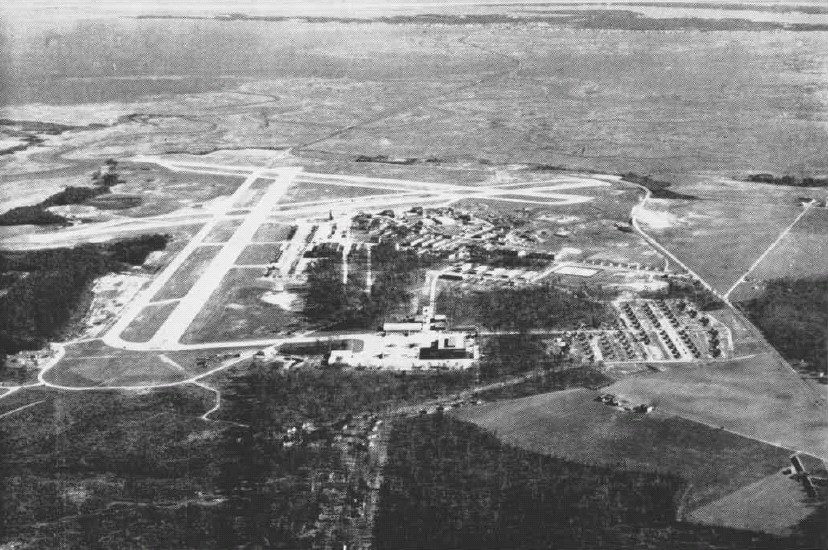
Naval Auxiliary Air Station Chincoteague was a U.S. Navy Auxiliary Air Station near Chincoteague Island, Virginia. In 1941, the United States entered World War II; early the following year, the Germans torpedoed two merchant ships off the Assateague coast. To guard the coast, the United States Army established two small posts on Virginia’s Eastern Shore, one each at Accomac and Chincoteague. The Navy established the Chincoteague Naval Auxiliary Air Station in 1943, across from Chincoteague on the mainland. One young pilot being trained there, future president George Herbert Walker Bush, got in trouble for “buzzing” the house of a young woman he had met at a dance.
In 1959, NASA acquired the former Naval Auxiliary Air Station Chincoteague, and engineering and administrative activities were moved to this location. In 1974, the Wallops Station was named Wallops Flight Center. The name was changed to Wallops Flight Facility in 1981, when it became part of Goddard Space Flight Center.
The Navy returned to Wallops Island in the early 1980’s, to start construction and development of Surface Combat Systems Center. Today in joint partnership with NASA, NOAA, and the USCG, Wallops Island has capabilities that will extend far into the future to make Wallops Island a leading competitor in state-of-the-art technologies.
I have no idea what happened to Colonel Bye. It’s too bad that his paradise was replaced with the facility evolved into what exists there now.
But with all of the advances in naval weapons and technology around the world, I am glad that we have dedicated professionals doing their best to make sure our sailors have the very best technologies possible.
Seeing the carnage being done in Ukraine and other places around the world, I don’t think we can be too cocky to think that we might be exempt from the potential damage in the coming war.


