Cold War Stories: Atomic Submarines that could Dive Deeper than ever
Most Mondays I get a chance to share stories with students from the Naval Nuclear Power Training Unit that are based at the Weapons Station in Goose Creek in South Carolina. The young people are the best and brightest of their generation and will someday man the ships and submarines that defend us. My portion of the day is talking about the Cold War which most experts agree lasted from 1945-1991. I give a presentation called Steel Boats and Iron Men which is a presentation I have been giving since I retired from the navy in 1994.
The presentation itself has grown and adapted over the years to include submarine development and operations. It’s all unclassified so my Chinese friends can really gain nothing by lurking on the site. I keep an eye on who visits from around the world and they must have someone designated to visit me every once in a while, since I see an increase in visits from there when the tagged items include anything submarine.
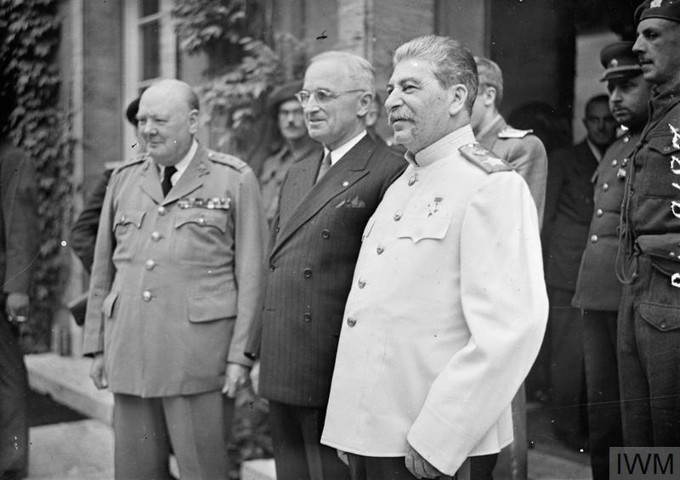
1945-46 were pivotal years in the Cold War since that was the time frame when major shifts in the world were occurring. The defeat of the Axis powers (Germany, Italy and Japan) was the first significant thing. The introduction of atomic power on the public stage was another important stimulus for a global conflict. One nation having in its hands the ability to manipulate the most basic element (the atom) must have sent a significant shiver through the halls of powers that might be opposed in ideology or intent. Finally, the disposition of the nations around the globe that were suddenly free from one form of tyranny only to be faced with an even more draconian master set the stage for the actions of every nation for the next 4 years.
The Soviet Union had lost nearly twenty million people (soldiers and citizens) in the generations since it had been founded. Most of those were as a result of wars that were started in part by Germany. During the course of the second world war, the Russian army had pushed the Germans back to their capital Berlin and in the process, liberated many of their neighboring countries. The victories led to an unintended consequence. The countries that were liberated from one type of tyranny found themselves helpless to remove the liberators. Russia saw the need to create a buffer between themselves and any future wars by expanding their Soviet system to anything they touched.

It’s important to remember that the goal for Communism as originally expressed had always included a global approach.
The collectivism envisioned by the founders always included someday uniting all of the Workers of the World. From the earliest days, communist agitators were present in every major developed country. Hitler was an incredibly evil man with no good intent in his heart, but even Hitler hated communists. In America, we had our own fledgling movements for socialism or communism but the free loving patriots kept them most in check. The early FBI was designated as one of the agencies to watch for sympathizers and agitators and the people of the United States were not inclined to surrender their freedoms to support the novel ideas of collectivism. The devastating attack on Pearl Harbor and the national effort to support Japan’s and Germany’s defeats cemented the need to work against any evils. Even though some individual rights were stifled during the war to support the troops, there was an understanding that once the war ended, the country would return to peace and prosperity.
Prosperity is the key difference between the two points of view. Communism and the collective were theoretically envisioned as a completely shared prosperity. Democracy and capitalism recognized that efforts of the individual would reap rewards that were not dependent on the efforts of others. Any person could rise above his station and become wealthy. Hard work was rewarded with tangible benefits that were not tied to the state.
Of course there are flaws in both systems.
I have yet to meet any person who can justify why a basketball player earns millions of dollars while a mechanic who actually produces a product or value-added service earns a fraction of that amount. You could list a thousand example of imbalance but in the end, the one true fact is that anyone can devote their time and talent to any endeavor in a free country and rise above their peers. Not all of us can be a Bill Gates, but the fact that a Bill Gates can rise to his level is the very hallmark of a free and capitalist system.
The communist model also has its own flaws.
Too many for me to list in this post but some of the ones that come to mind are just as unfair. The leaders always seem to have the nicest house and advantages while preaching sacrifice to the people who have no power. They also are rich from the efforts of the collective. In the history of communism, there have never been any exceptions. I suppose it’s just mankind’s evil inner nature to take advantage of their power and use it to subjugate others. Plus, in Russia’s case, setting up puppet governments in Eastern Europe while they were at their weakest was just the ultimate betrayal of generations of people who just wanted to be free.
It became obvious in those post war years that whichever nation controlled the technology to create machines that could be powered by this new energy would be able to control much of the potential growth and freedom for the foreseeable future. Discussions about using atoms to power submarines and ships had already been underway in the halls of the pentagon. But for the average American still coming to terms with this new source of power and destruction, how it would translate to reality was still a far off mystery. But by late 1945, the idea was starting to emerge.
New York Times December 13, 1945
Submarine Navy With Atom Fuel And Surface Speed Held Safest; Dr. Alvin M. Weinberg Tells Senate Group the Warships of the Future May Travel 1,000 Feet Below Sea Level
WASHINGTON, Dec. 12-The Navy of the future, powered by atomic fuel, will travel 1,000 feet under water as fast as today’s surface vessels, a 30-year-old physicist told the Senate Committee on Atomic Energy today.
By way of emphasizing the need for international amity in the atomic era, he said the ocean depths would provide the only safe refuge in an atomic war.
The witness was Dr. Alvin M. Weinberg, chief of the theoretical physics section of Clinton Laboratories in the Oak Ridge, Tenn., atomic bomb plant. He stressed the peaceful applications of nuclear force, while Dr. Clarke Williams of City College, New York, another atomic bomb maker, offered a plan of inspection that might be used by an international atomic energy control agency.
A plea for international control based on treaties and good faith; was expressed by Dr. John A. Simpson, who began making atomic bombs four years ago at the age of 25. A member of the Nuclear Studies Institute of the University of Chicago, he is at present working in the metallurgical laboratory plutonium project.

The powder keg (Hastings, Neb.), January 4, 1946
Navy Of Atomic Subs Is Foreseen (SEA)
A Navy of submarines operating 1,000 feet below the surface of the ocean as fast as ships now operate on the surface is one of the possibilities of the atomic age foreseen by a 30-year-old physicist testifying before the Senate Atomic Energy Committee. And these submarines, powered by atomic energy, would be “the safest place on this tortured planet.” according to the prophet. Dr. Alvin M. Weinberg, chief of the theoretical physics section of the Clinton ridge laboratories in the Oak Ridge, Tenn., atomic bomb plant. “The atomic fire at Hanford (the atomic bomb plant in Washington state) burns without oxygen,” Dr. Weinberg said. “Here is an ideal fuel for use in a submarine.” He also said that one pound of “fissionable” material releases as much energy as several million pounds of ordinary fuel, and because of its portability, would be economical in places like the Arctic. Space travel that now seems fantastic would have to be considered as a serious possibility, he added.
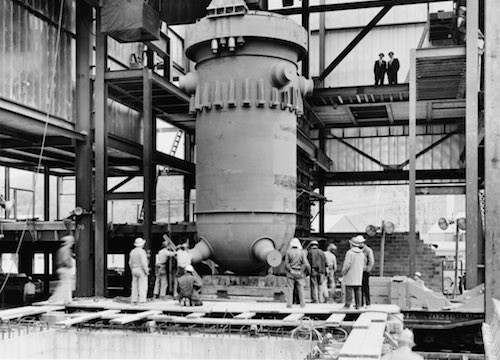
Meanwhile, the German scientists working on atomic research who had been captured by the allies in secret raids were being allowed to return to their homeland.
NAZI SCIENTISTS TO RETURN HOME WASHINGTON, Jan. 10, 1946—(U.P.)
Eleven noted German atomic scientists, “kidnaped” by Anglo American forces last spring, are being allowed to return to Germany under orders to remain in the U. S. or British zones, it was revealed today.
The group includes Otto Hahn, first man to split the uranium atom, a feat that laid groundwork for the atomic bomb. They are expected back in Germany today after months in British custody. The hitherto secret story of their kidnaping cleared up one of the most intriguing mysteries connected with Germany’s atomic research. Hahn simply vanished during Nazi Germany’s last days. For months scientists had tried in vain to learn what happened to him. The Nobel prize committee wanted him to go to Sweden to accept an award for his atom-splitting. It received a letter from Hahn saying “circumstances” prevented his appearance there. But the letter gave no hint of his exact whereabouts.
British sources now have unfolded the story to the United Press.
Hahn was seized by a fast-moving team of British and American officers who darted into crumbling Germany last spring. He was badly wanted by the Allies to keep him from continuing his scientific work for the Nazis. His discoveries revealed not only the tremendous power from splitting the uranium atom but also indicated that “chain reaction” was a possibility. It was this “chain reaction” that made the atomic bomb feasible. As a free agent, Hahn was considered a direct menace to the United Nations. His former laboratory associate, Dr. Lise Meitner, had escaped from Germany, taking with her Hahn’s latest ideas.
Dr. Meitner had branded Hahn a Nazi, a charge denied by his scientific friends in America. Following his seizure in Germany, Hahn was taken directly to England where he and other German scientists were placed on a heavily guarded farm 40 miles outside of London. British intelligence maintained a close watch on the group. Practically every word the Germans said among themselves was recorded. It was this intelligence watch that made the British believe Hahn was a Nazi.
During World War I Hahn served with a Landwehr regiment on the Western Front, and with the chemical warfare unit headed by Fritz Haber on the Western, Eastern and Italian fronts, earning the Iron Cross (2nd Class) for his part in the First Battle of Ypres. After the war he became the head of the KWIC, while remaining in charge of his own department. Between 1934 and 1938, he worked with Strassmann and Meitner on the study of isotopes created by neutron bombardment of uranium and thorium, which led to the discovery of nuclear fission. He was an opponent of Nazism and the persecution of Jews by the Nazi Party that caused the removal of many of his colleagues, including Meitner, who was forced to flee Germany in 1938. Nonetheless, during World War II, he worked on the German nuclear weapons program, cataloguing the fission products of uranium. At the end of the war, he was arrested by the Allied forces and detained in Farm Hall with nine other German scientists, from July 1945 to January 1946.
Operation Epsilon was the codename of a program in which Allied forces near the end of World War II detained ten German scientists who were thought to have worked on Nazi Germany’s nuclear program. The scientists were captured between May 1 and June 30, 1945, as part of the Allied Alsos Mission, mainly as part of its Operation Big sweep through southwestern Germany.
They were interned at Farm Hall, a bugged house in Godmanchester, near Cambridge, England, from July 3, 1945, to January 3, 1946. The primary goal of the program was to determine how close Nazi Germany had been to constructing an atomic bomb by listening to their conversations.
Atomic Power development in Germany, but to what end?
The conversations at the Farm revealed that the Nazi’s were nowhere near making the progress on a weapon as had been suspected. Most of the scientists revealed that little energy had been placed in doing what the Americans had completed with the Manhattan project. In fact, the nuclear progress was dedicated to an “engine” that might someday be powered by nuclear power. In my research, no specific outcome for the engine was identified as the primary purpose although it is not beyond imagination that a submarine engine could have been a focus. German submarines towards the end of the war included some models which would operate using compressed gasses to allow for longer submergence.
During World War II the German firm Walter experimented with submarines that used high-test (concentrated) hydrogen peroxide as their source of oxygen under water. These used steam turbines, employing steam heated by burning diesel fuel in the steam/oxygen atmosphere created by the decomposition of hydrogen peroxide by a potassium permanganate catalyst.
Several experimental boats were produced, though the work did not mature into any viable combat vessels. One drawback was the instability and scarcity of the fuel involved. Another was that while the system produced high underwater speeds, it was extravagant with fuel; the first boat, V-80, required 28 tons of fuel to travel 50 nautical miles, and the final designs were little better.
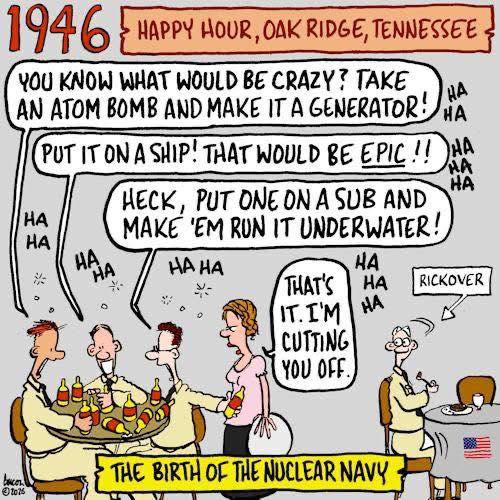
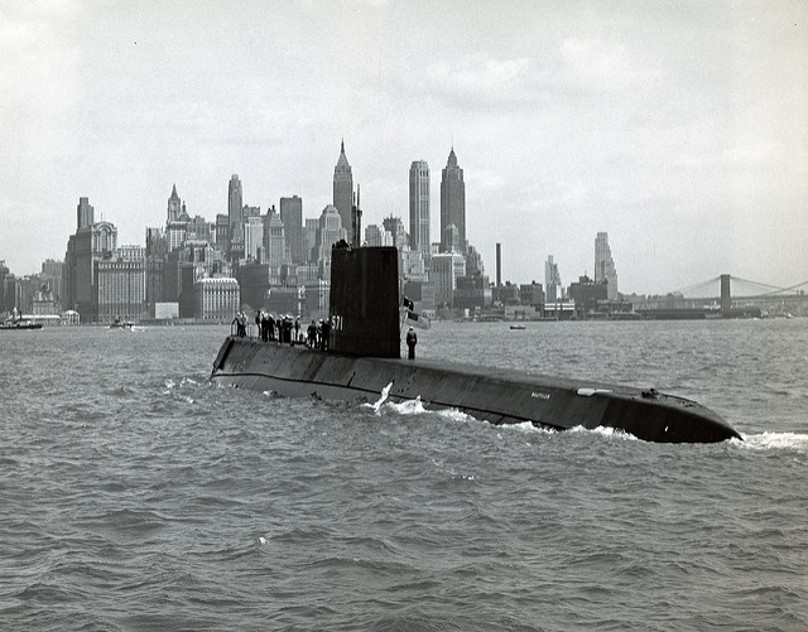
But the idea of using the new atomic power inside submarines was an idea that theoretically could change naval warfare forever. One of the strongest proponents of the idea was none other than one of the most influential voices in the United States Navy – Admiral Chester Nimitz.
Nimitz had seen first hand the power of a submarine force that had such a great impact on the second world war. When the opportunity to advance the idea beyond theory surfaced, he endorsed what would become the beginning of the nuclear navy.
The story is best told by Nirman Polmar in an article in Naval Institute Proceedings:
https://www.usni.org/magazines/naval-history-magazine/2024/february/first-atomic-submarine

 theleansubmariner
Admiral Chester Nimitz was. submariner. He was a part of the early submarine development in the US.