Chapter Nine: “A cowardly, underhanded weapon”
As Cassin Young and his classmates were being trained in the art and science of submarine warfare in the summer of 1919, forces across the Atlantic Ocean were gaining strength to try and cut short his and many other’s careers on submarines. The British had been particularly hard hit by the submarine menace during the war. Their great fleet was ill prepared for the new type of weapon and the Admiralty had a decided prejudice against any kind of weapon that would challenge their global seafaring superiority. The German submarines that sailed against them had dealt a crippling blow to plans and strategies and based on a preliminary review after the war, could have been even worse.
The giant battle fleets had been built with the idea that enough guns and enough armor would be capable of turning the tide in any naval engagement. Generations of sailors had been trained on how best to employ their massive sea monsters in decisive battles that would give Britain the advantage. The technology had always focused on better means of propulsion and better means of delivering the massive shells from their main guns in a battle. The little submarines changed much of that. With a minimum amount of technology, these small craft could sneak up on ships at sea or in port and deliver a weapon that there was no known weapon capable of stopping. The torpedo that came into being was designed to even the scale between massive navies and navies with more limited resources.
At the completion of the war, one of the many disarmament conditions was that the German High Fleet would have to be scuttled or delivered over to the victorious allies as war prizes. This included the remaining submarines that had not been lost or destroyed in the later stages of the war. In the terms of the treaty, the submarines were turned over to the British with a small number being made available for the Americans. The only stipulation for the American designated boats was that they could be used for fund raising but, they had to be destroyed and not used by the Americans as operational boats.
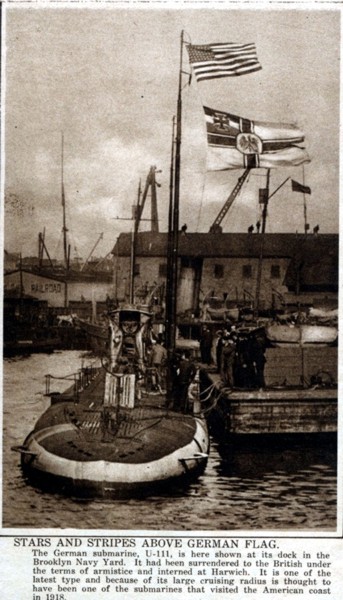
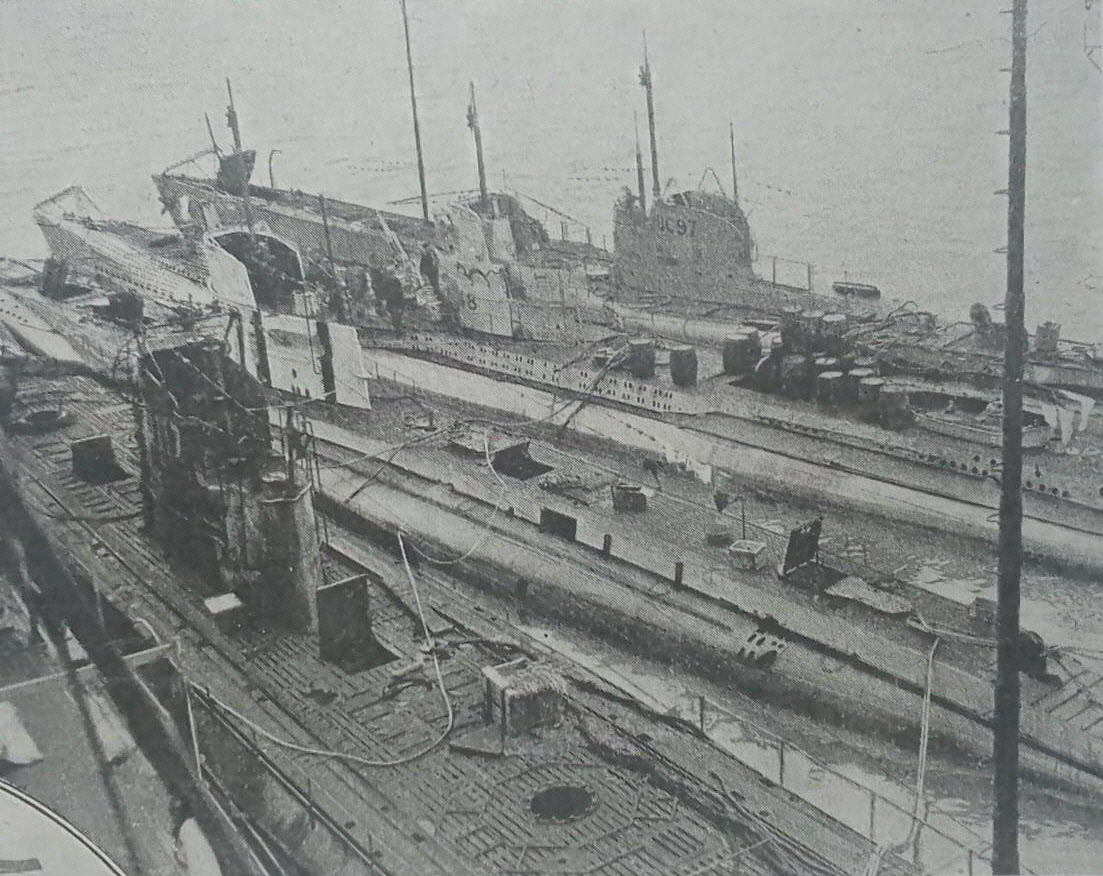
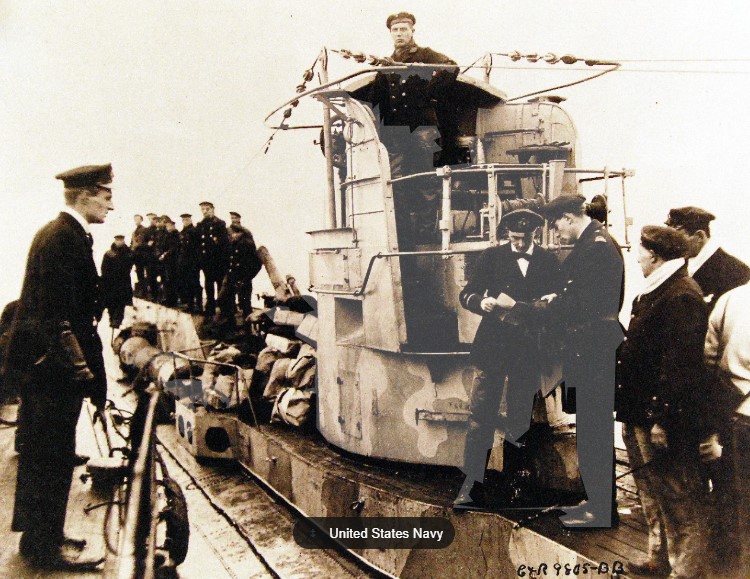
Nine days after the armistice in 1918, most of the German submarines that were to be surrendered arrived in Harwich England to be interned by the allies. The US Navy expressed an interest in acquiring some of the latest types of U boats and the Allies allowed them to have six boats – U 117, U 140, U 164, UB 148, UB 88, and UC 197. The main condition was that each boat would be destroyed within one year of being turned over to the Americans. Twelve officers and one hundred twenty enlisted men arrived in England in March of 1919 to ferry the six submarines back to the US. The crew of the U-164 found that their boat had been stripped of most of its equipment and was quite incapable of serving the purposes it was intended. One of the greatest stories of American ingenuity and creativity was the replacement of the boat with the U-111. Lt. Commander Freeland A. Daubin saw the predicament of trying to make the hapless U-164 ready for sea and made his way around the docks where other boats were being kept and manned by skeleton British crews. He found the U-111, went on board and talked his way into obtaining this boat as a replacement. This boat was in much greater shape having been commissioned in December 1917 and only making three combat cruises during the past year of the war.
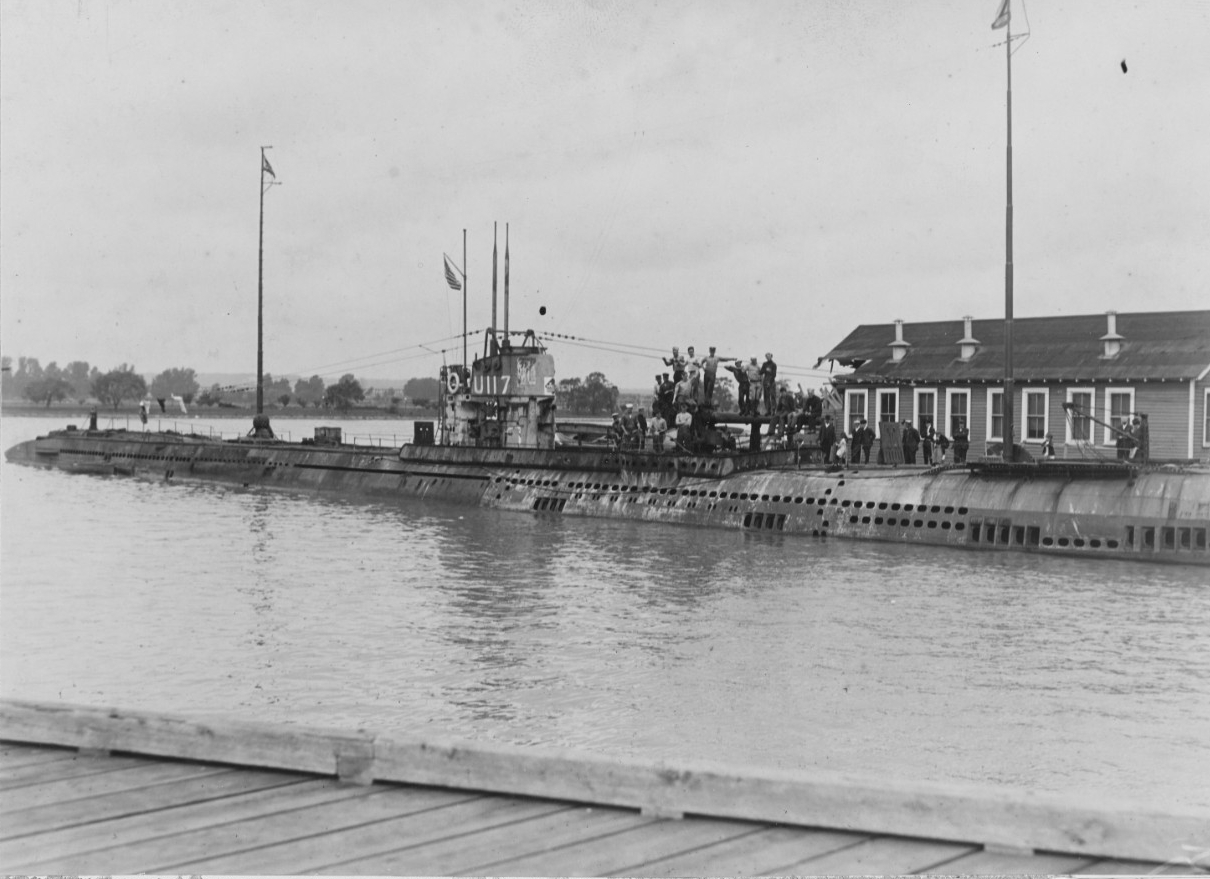
The remaining five boats began their journey on April 3, 1919 and on April 7, the U-111 sailed form Harwich down through the English Channel and on to America.
The Captain decided to make up lost time by sailing a great circle route which ended up gaining time but also many challenges. All across the Atlantic, the little boat was subjected to rough sea conditions, gales and heavy fog. At one point, the boat came very close to sinking when an open sea cock allowed sea water to enter the boat and cause her to become heavier than she should have been. One of her crew members climbed into the bilges below the engines and finally found the sea cock and saved the boat from sinking. The harrowing journey did not end soon enough. The Executive Officer of the boat told reporters that they had run short of food since the meager stores on board only included pickles, jelly and potatoes with little fresh water. The potatoes had gone bad on the journey over, the water ran out as they sighted New York harbor and there was only enough fuel left for about five hours of steaming.
Even as far back as 1915, newspaper and magazine articles talked about the inherent dangers of riding on one of these “terrors of the undersea”. Even under the best of conditions, numerous submarine accidents up until this point in 1919 underscored the dangers of the small craft. Submariners realize every moment of every day that this may be their last day and the expectation of death gives them a sense of coolness and professionalism in the way they go about even the most mundane tasks. When the equipment that surrounds you means the difference of life or death, a special sense of awareness comes over each man. Sounds become telltale signs of impending trouble. The boat reacting to the sea at different depths is felt be each of the sailors as they make their way through the watery deep. There is no detail that is too trivial or too minute in its properties to escape the attention of the men of a submarine. While this trip would not test the crews in all of the fine art of submarining, they were still subjected to the laws of the sea. Waves come amazingly fast and with unexpected fury in even a calm sea and that terror is felt very keenly in a submarine on the surface in a storm. Since the boat is designed to sink, any unexpected inrush of water could seal the crew’s fate in a few minutes. It is easy to imagine the relief of the crew that brought the U-111 to America as they sighted America upon their safe arrival.
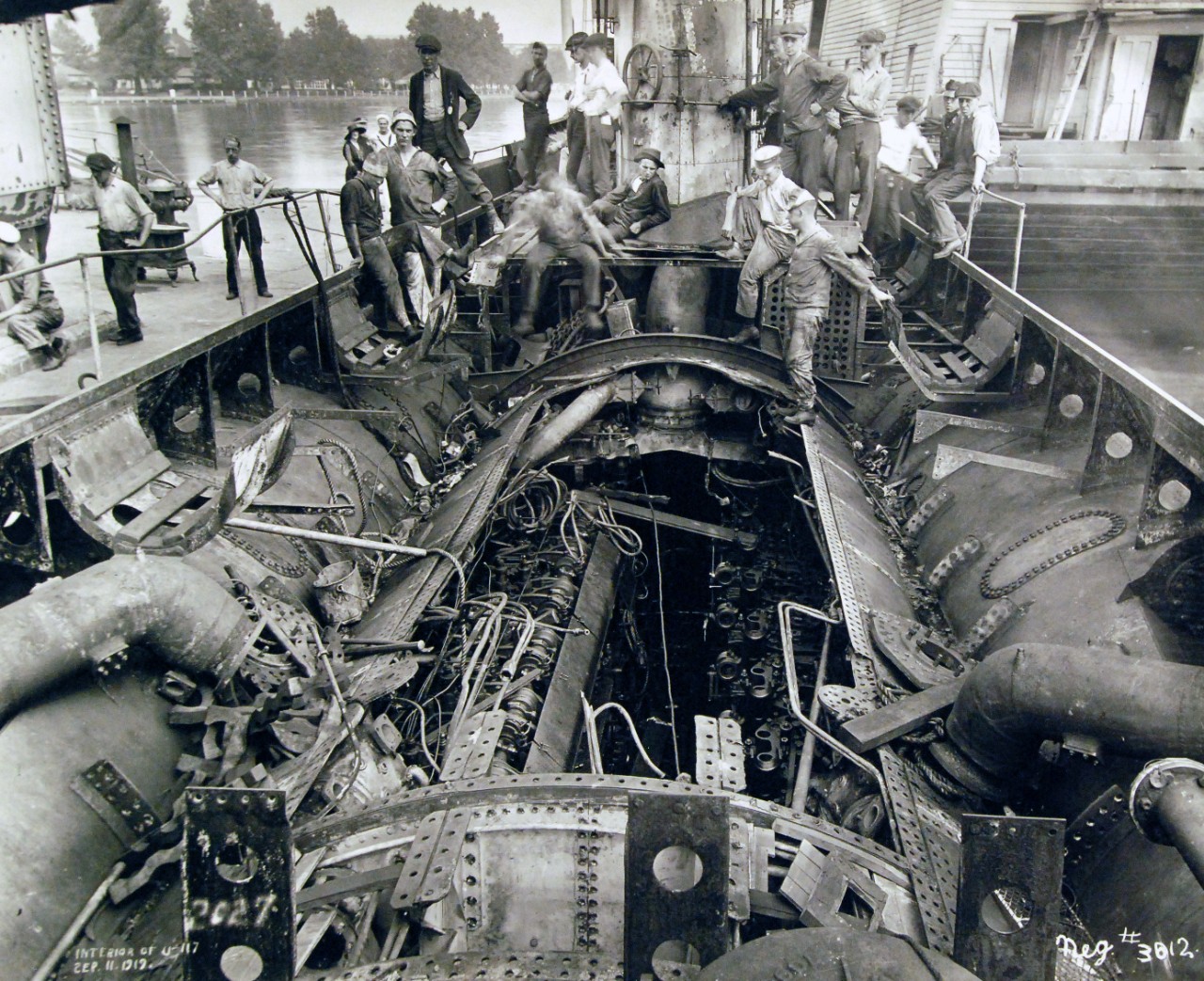
In New York, throngs of people came aboard to view firsthand this menace to mankind. Newspapers printed dozens of pictures of this technological wonder and for the next year the country would marvel to stories about how the Americans and Allies had developed ways to detect and overcome the menace. All of those words were meant to reassure people that the sea devils were not the unbeatable weapons that they had once been touted as. The truth of the matter however is something quite different. German engineering and the use of newer technologies beyond what the American’s had been capable of developing were revealed as engineers and civilian shipbuilders also studied the boats. They wanted to learn everything they could about these boats and their influence was quickly felt in the American submarine building community. As Cassin Young was entering submarine school, the U-111 and the other boats were finishing their original itinerary of visiting eat coast cities to help with War Bond Drives.
The Bridgeport times and Evening Farmer. (Bridgeport, Conn.), 11 June 1919
“The surrender of their deadly instruments, such as the submarine, that scorpion of death which sent women and children to their death, was perhaps the most bitter pill of all and when these instruments of warfare are seen at our docks with the American Flag proudly waving over the German Flag it is wormwood and gall to the Hun’s souls. These submarines are being made recruiting stations for our Navy and a large number of young men after going through the deadly boats have at once enlisted in order that the sea may be kept free from German Submarines forever. At present there is one of the largest types at a dock in the Brooklyn Navy Yard. It was surrendered to the British in the terms of the armistice and interred in Harwich England for a time. It is the U111, and because of its large cruising radius is thought to have been one of the submarines that did such deadly work on the American coast in 1918 and for this reason Great Britain gladly permitted it to be shown in this country with the American Flag waving above its periscope. Another spent some time in Baltimore and Annapolis and served as a recruiting office while still others were anchored in Boston and places further south. All these are the latest type and show the large amount of time and money which have been spent on their building and which in the mind of the hated and cruel Von Tirpitz were to win a war for Germany.”
The recent war had cost the American people many billions of dollars and the continuation of the fund-raising drives is one example of the need to address that cost.
But possession of the U-111 was important from a discovery standpoint.
From the Navy Secretary 1920 report:
SUBMARINES DEMONSTRATED THEIR EFFECTIVENESS.
“Light cruisers proved their worth during the World War and should be with every fleet. The work of the submarines during the war demonstrated strong and weak points of the type, which has not yet reached its full development. No nation, if it is to be prepared to engage in warfare upon the sea, can afford to neglect the submarine or to spare any pains to develop it to meet its needs. This type has come to stay as a factor in naval warfare unless outlawed by international agreement. Its abuse by the Germans in their ruthless campaign should not blind us to the fact that there is a large field for its legitimate use. Without accepting the theory of the enthusiasts, that submarines alone can be developed to meet adequately all needs of naval warfare, we must all agree that the sub marine cannot be ignored and has a field of its own in the conduct of war upon the sea which cannot be filled by any other character of ship.”
STUDYING TYPES OF GERMAN NAVAL VESSELS.
“Careful and detailed study is being given to the types of German naval vessels brought to the United States during the year, with a view to ascertaining their strong and weak points for the benefit of our own designs.
The department, of course, was already well informed as to the general features of the German designs, except the submarines. Inspection in detail of the vessels has, however, strongly impressed our officers with their lack of habitability and comfort at sea, as compared with United States naval vessels. These features of habitability and comfort have always received great attention from American naval designers. Although they are not so conspicuous on paper as various so-called military features, our Navy regards them as vital for the fighting vessel.”
The recently acquired German submarines were now subjected to a series of engineering and operational tests including a race with an American submarine.
The results of the race were definitely not favorable to the American builders and there were some attempts on the part of leadership to dismiss them as an anomaly.
The submarine completed her assigned itinerary late in the summer of 1919. Following that, she and UB-148 were subjected to an extensive series of performance tests before being laid up at the Philadelphia Navy Yard. During the summer of 1921, she returned to sea for another series of tests, this time as a target for gunnery and aerial bombardment tests. As a result of those experiments, her battered hulk went to the bottom of the ocean sometime in July 1921.
But the impacts on American naval construction would be felt for years to come.
In the submarine school Young and his fellow officers would attend, technical and tactical information would be the main subjects. Up to this point, academy men like Young would have gained an understanding of steam and electricity in the course of their studies. Weapons and tactics would have been focused on long range and short range naval guns and their use against a similar opponent. The math and science required would have been geared towards employing these weapons in a traditional combat environment. Now, the men in submarine school would have to learn an entire new vocabulary and entirely different technology. The modern submarine of 1919 would be powered by a diesel engine on the surface and an electric drive when submerged. Knowledge of the sea and operating in its environs would still be needed, but the added dimensions of operating under the sea would have to be adjusted to. Navigation was still at the front of every seafaring officer’s mind but now the complexity of navigating while submerged and without some of the typical tools would have to be mastered. The boats were still dependent on the traditional tools of a mariner but the added layers of technical and operation complexity had driven the need for this school. The fact that the first real class of officers in the post war school were all graduates of the Class of 1916 or later emphasized the need for men who had better disciplines in math, science and engineering. It was an early building block for future submariners to come that would lead to an age where submariners were no longer surface officers serving a tour on submarines but were submariners for life.
The advantage for Young and his fellow submariners would be twofold. They would gain a faster way to command and promotions. They would also get a chance to ride the new wave of technology that promised a sure way to a secure future. Since submarines cost less to build and operate, they were much lower on the priority list of the budget cutters when it came to cut backs. The early submarines would also prove that the original vision of a coast hugging weapon could be adapted and improved to the point where it would be a first line weapon in future wars.
Nowhere would that be more evident than in the days following December 7, 1941
Mister Mac
Next up – Chapter Ten: She married a submariner

 theleansubmariner