I was honored to be able to provide the keynote talk at our community Memorial Day Service.
Memorial Day in my family has traditionally been one of the most important days of the year. Growing up, I can remember watching my Dad prepare for the day. His leadership was inspirational and helped me to understand how important it was to remember all of the sacrifices made by men and women who I would never meet. The following is the notes section from my presentation.
How do you define freedom?
The answer for me would come over the course of my life’s journey. Obviously living in America, freedom is all around us. The schools most of us took for granted, the churches where people could gather together and worship their deity with little interference from the government, and sports venues where we could cheer on our favorite teams as they demonstrated their skills.
But from the time I was old enough to understand the significance, it was the Gardens of Stones where I came to learn about freedom. You may better know them as cemeteries.
Mt. Vernon Cemetery was literally in my backyard. The cemetery dated back to the end of the Civil War and for my great grandparents, it was the “New” cemetery. As a young boy, only the front half was filled with graves. The part that sat next to our back yard was empty of graves and we used the open space for football, sled riding in the winter and just a place to go when you needed to be alone. The paved roads were great for us to ride our bikes without having to worry about traffic and it was a short walk to my grandmother’s house on the other side where the freezer always had ice cream inside. Four generations of my family are interred there and even the new part of the cemetery is now filled almost to overflowing.
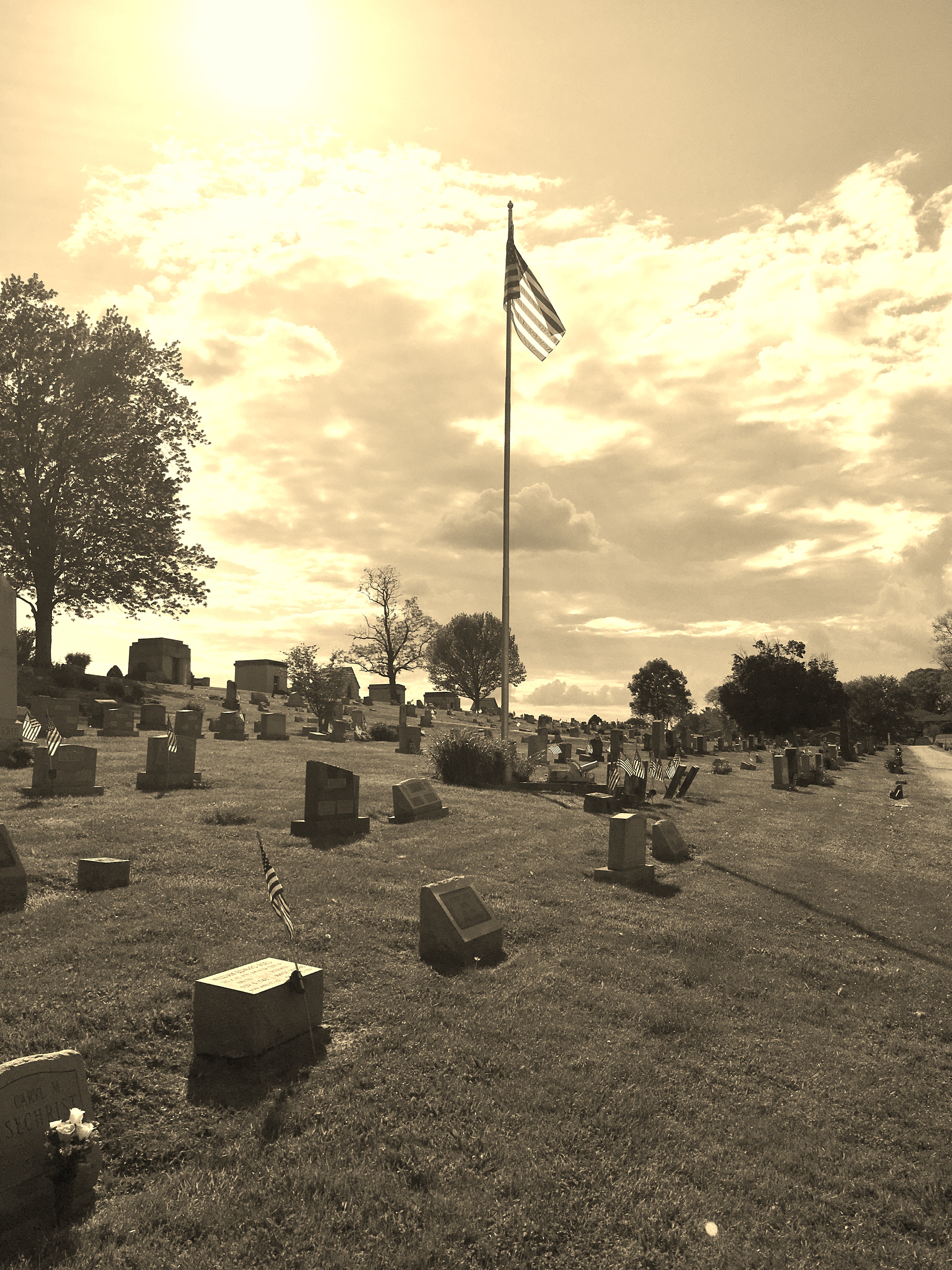
But it was also a place for learning and service.
When we were younger, we were part of Troop 99 of the Boy Scouts. One of the service activities we participated in was putting up flags before Memorial Day. I can still remember grabbing a bundle of flag and running through the old section searching for graves that indicated a member of the armed forces was buried there. Some graves had metal flag folders, some only had inscriptions.
Not all were alike. Some had the dates of service. Some had the fateful letters KIA inscribed. In our little corner of the world, we had veterans as far back as the revolutionary war. But it was rare to find a KIA. KIA of course stands for Killed in Action. I never really gave it much thought at the time about the journey that brought them to that place. But as I grew older and travelled to places like Arlington Virginia, Hawaii and of course Normandy France, the depth of those sacrifices really started to become real to me.
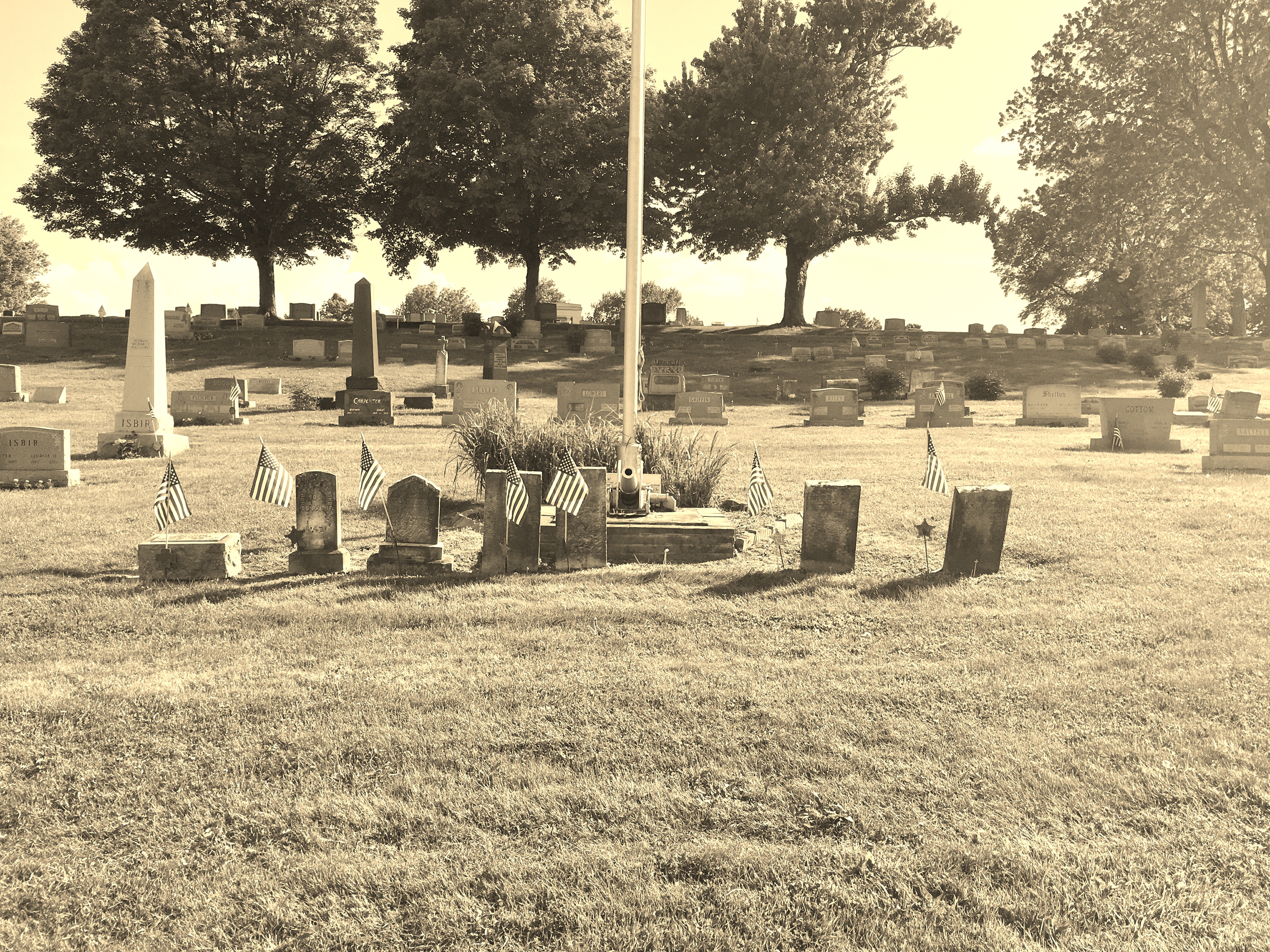
How did those heroes who died in faraway places make it home. Even in the Civil War, no battles occurred in our little community. World Wars 1 and 2, Korea and Vietnam were all fought in battlefields and oceans far away from my home. Yet here in our own “Garden of Stones” were more than a few KIAs scattered among the ones who lived out their lives after they returned to their families.
The answer of course was that in every war since the civil war, there was a group of people who went with the troops that had the difficult job making sure that the memory of the deceased and their remains would not be neglected.
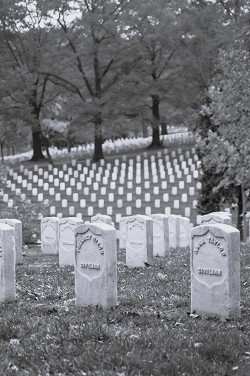
‘Dignity, Reverence, Respect.’
Those words are the creed for the Army’s Mortuary Affairs service which was formerly known as the Graves Registration Service. The history of that service dates back to the American Civil War. Prior to that, men were often just buried where they fell with little efforts to formally mark and care for their remains.
An overlooked story of World War II and its consequences, the Graves Registration Service (GRS) worked tirelessly during the war to collect and identify the dead, providing proper burial. After the war, the GRS conducted the world’s largest search and recovery effort, leading to the identification of 280,000 fallen Americans, who were provided with a final burial in the United States or abroad based upon the surviving family’s wishes.
On October 26, 1947, the first war dead from the European theater returned to the United States. Around 6,000 caskets arrived in New York City in the hold of the transport ship Joseph V. Connolly, and 400,000 Americans turned out in silent tribute to the dead, packing the streets and attending a memorial service in Central Park.
According to an article in The New York Times about the tribute, “One coffin, borne from the ship to a caisson, moved through the city’s streets to muffled drum beats and slow-cadenced marches.”
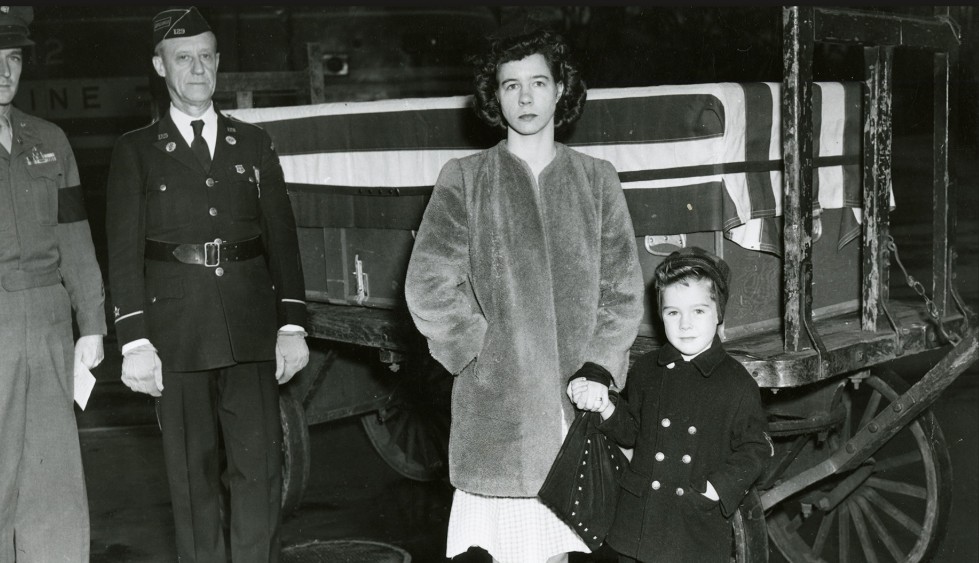
The article reported on the march of the coffin to Central Park: “At 12:45 P.M. the coffin borne from the Connolly was set on a caisson. Women who saw this wept openly and men turned away. Somewhere a bugle note sounded, to move, a procession of more than 6,000—service men, veterans, city groups. … The curbs were crowded, but here, as at sea, the silence was awesome. Nobody spoke, not even the children. Eyes were moist and lips moved in prayer as the flag-draped coffin passed, the caisson drawn by a dark armored car with two sergeants, arms folded, high in the turret.”
As the procession marched through the city up Fifth Avenue, “The crowds at the curb were moved. Some let the tears run freely. Some wiped them away.” During the service in Central Park, one woman suddenly shouted, “Johnny… There’s my boy, there’s my boy.” At the end of the ceremony, the woman again cried out, “Where is my boy?”
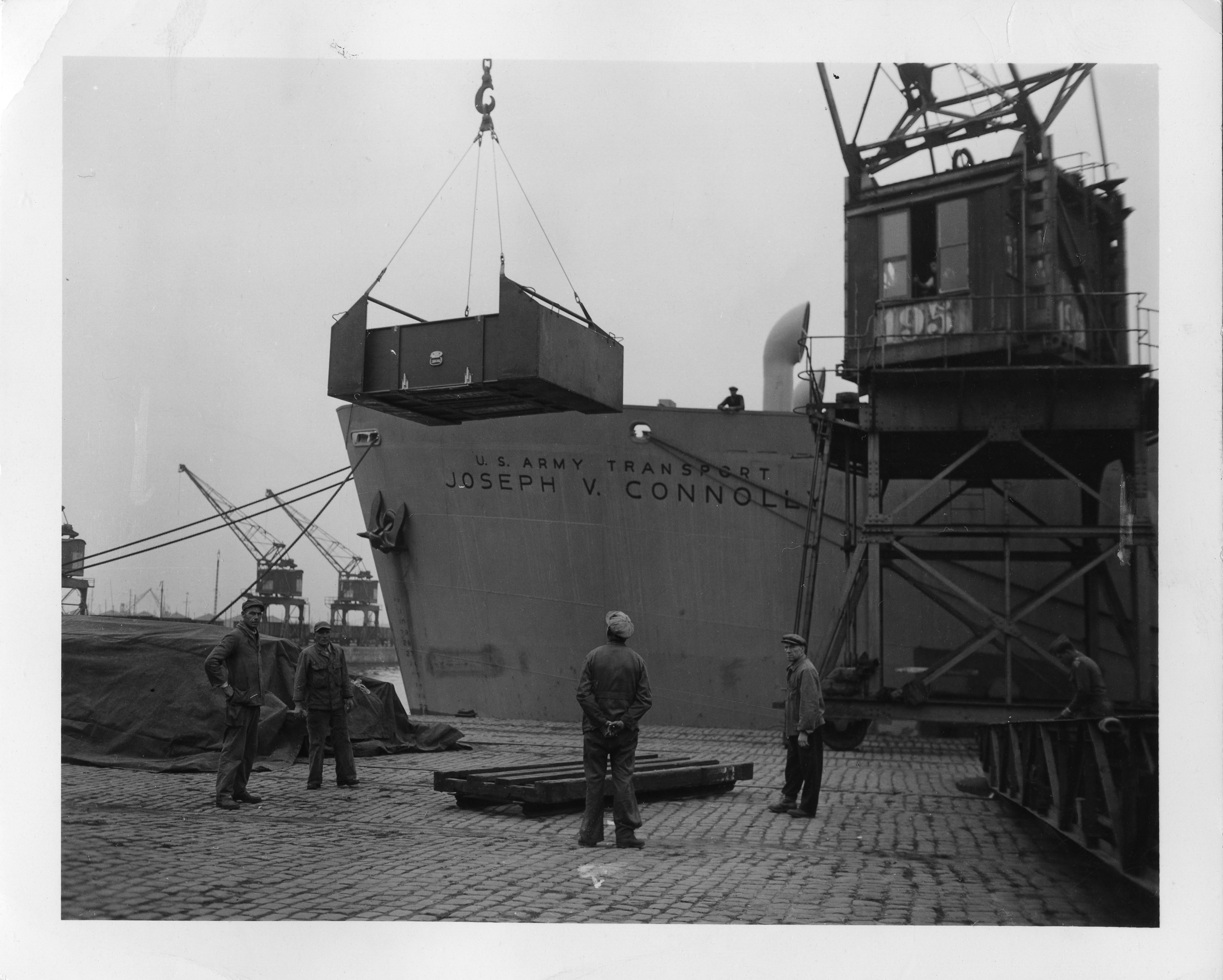
From the New York Times Article:
The Army transport Joseph V. Connolly came back to New York yesterday carrying 6,248 coffins lying row on row in her four holds. The 7,176-ton converted freighter tied up at Pier 61, West Twenty- first Street, at 11:25 A. M., after a twenty-two-day voyage from Antwerp, Belgium. Her flag flew at half-mast and her bridge and superstructure were covered with blackened laurel leaves. One coffin, that of an unidentified Congressional Medal of Honor winner, lay on the port side of the boat deck, flanked by an honor guard of two Navy officers and four Army officers and men.
On the pier, decorated with multi-colored pennants remaining from the arrival on Friday of the S. S. America, stood another honor guard of soldiers, sailors and marines, a platoon of white-gloved military policemen and an Army band. Mayor O’Dwyer, accompanied by city officials and Army officers, walked down the gangplank to the ship and thanked her master, Capt. B. W. Bostelman of 135 Seventy- ninth Street, Brooklyn, for her safe voyage. Captain Bostelman replied that he and his crew, who are all employes of the Army’s Transportation Corps, were honored greatly to be chosen to return the first World War II dead from Europe and Newfoundland.
The Mayor left the ship at 12:21 P. M. A minute later, a military police officer led the honor guard of soldiers, sailors and marines to the boat deck. They picked up the coffin and carried it to the loft of the pier as the band played Chopin’s “Funeral March” and the military policemen presented arms. An elevator took the coffin down to the main level of the pier, where it was placed on a caisson for the parade to the memorial exercises in Central Park.
After the soldiers and officials left, a gray-haired woman dressed in black walked slowly to the edge of the pier and tossed a red rose onto the boat deck where the coffin had lain. Aboard the ship, Captain Bostel- man said that although she carried 6,248 coffins, they contained the bodies of 6,251 war dead. One of the coffins, it was explained, held four men killed in an airplane crash in Newfoundland. They probably will be buried together after the Army makes arrangements with their next of kin.
The Connolly, the first of two ships that will bring back war dead from Europe this year, left Antwerp Oct. 4. She stopped at Argentia, Nfld., Oct. 15 for three days, taking aboard additional coffins. She arrived off Ambrose Lightship at 8:25 o’clock Saturday night. The trip from Argentia to New York took seven days thirteen hours, instead of the usual four days, so that the ship would arrive just before the beginning of the ceremonies yesterday.
The crew of forty-five men and officers used the time to repaint the ship and clean her. Daily, an Army escort of two officers and four enlisted men inspected the coffins in the holds, renamed passenger compartments to conform with the Army’s procedure of listing war dead as passengers, followed by the word deceased. Captain Bostelman termed the trip uneventful, except for one in- stance. Chief Engineer Stanislas Jurgeluns of Seymour, Conn., had a heart attack on Oct. 7 and was transferred to the Zeubulon V. Vance on Oct. 12 for a faster trip to New York.
Late yesterday afternoon, after the Central Park ceremonies, the pier was almost empty. An honor guard of military policemen remained on duty, however, as the caisson carrying the coffin returned to the ship at 4:43 P. M. The Connolly, named after the late president of the King Features Syndicate, will leave Pier 61 at 8 A. M. today for the Army base in Brooklyn. The public has been invited to attend simple ceremonies there at 11 A. M. After the Brooklyn ceremonies the coffin will be removed from the ship and sent to fifteen distribution centers throughout the country. The unloading is expected to take five days. It is estimated that it will be ten to thirty days before the bodies are received by the next of kin.
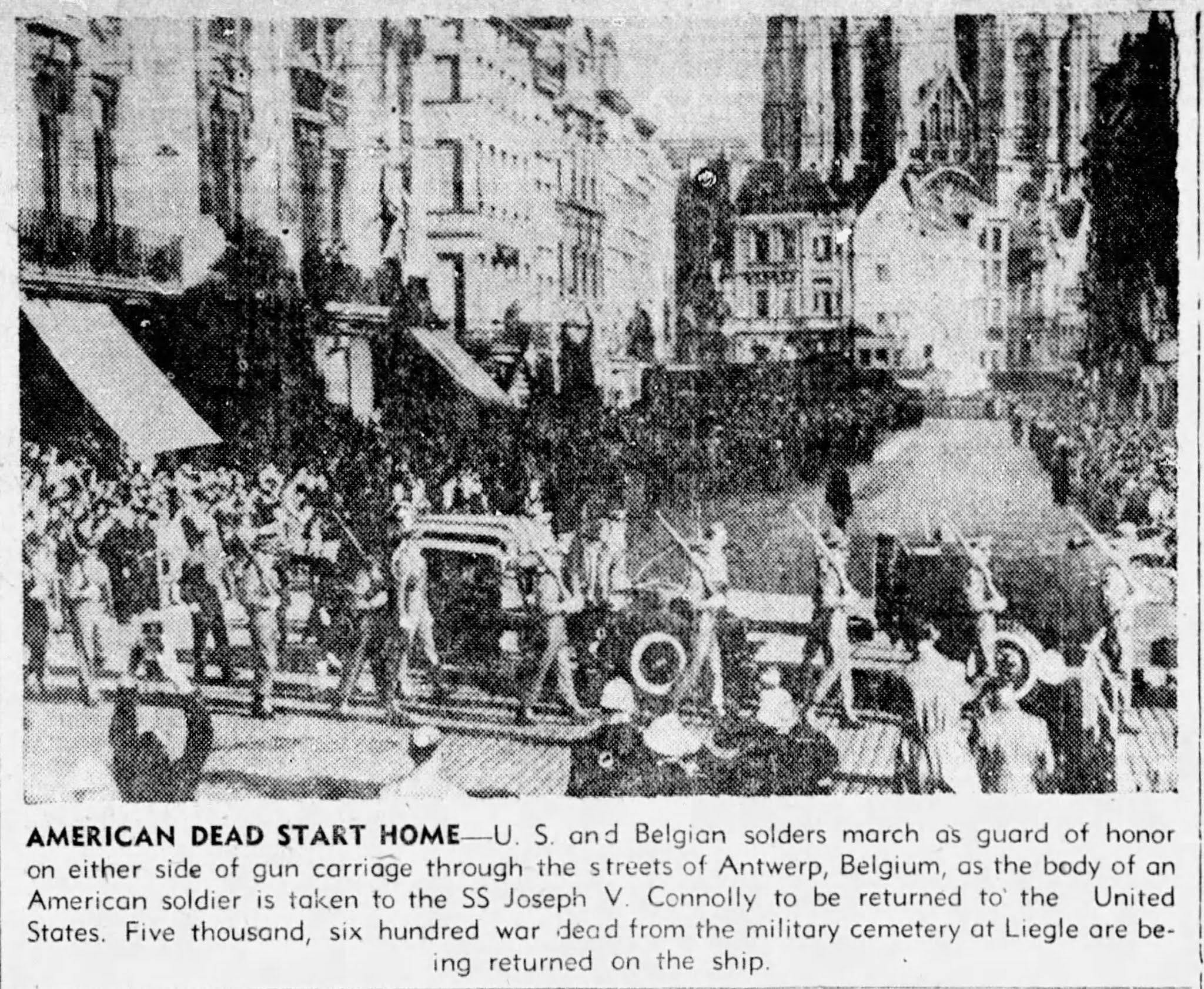
World War II had passed into history, but for some families, the end of the war did not bring closure. Years after, the pain of families remained very real, a pain that began during the war upon receiving a Western Union telegram telling of their loved one’s ultimate sacrifice.
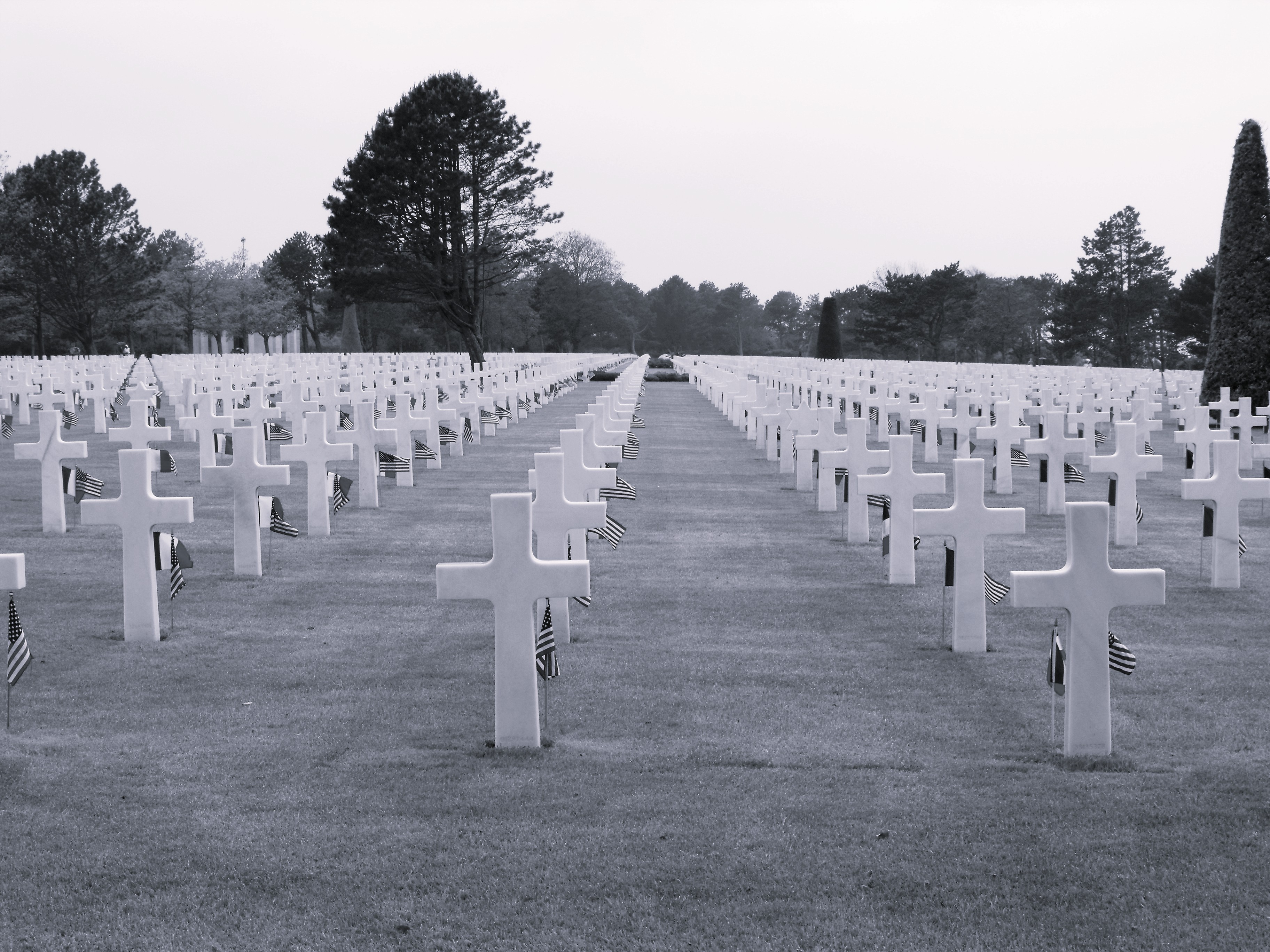
With the arrival of the war dead starting in 1947, many families who lost their loved ones were finally able to bury them after years of grief and waiting, hopefully gaining some sense of closure and resolution.
After World War II ended, the yearslong official US governmental process of interring the war dead in their final resting place began. Known as the “Return of the Dead Program,” the program established the options for the next of kin of the deceased. Families could choose between four options for the final burial of their loved ones: returning the remains to the United States for interment in a private cemetery; returning the remains to a foreign country (the homeland of the deceased or the next of kin) for interment in a private cemetery; interring the remains in a national cemetery in the United States; or interring the remains in a permanent US military cemetery overseas.
The US government sent the pamphlet “Tell Me About My Boy” to families of the deceased to explain the process of establishing the next of kin and options for final burial. As the pamphlet noted, “Tell me about my boy” was the most frequent request sent to the US Army Quartermaster General for information about the return and final burial of the WWII dead.
The postwar program was “the largest of its nature ever undertaken by any nation at any time,” leading to the recovery of over 280,000 remains that had been scattered around the world due to the war. The program led to the repatriation of around 172,000 sets of remains back to the United States, a scale unprecedented in history.
The repatriation program was uniquely an American phenomenon, with efforts undertaken for the return of American war dead overseas dating back to the Spanish–American War of 1898. After World War I, remains were also repatriated or buried in permanent American cemeteries abroad based on the wishes of the next of kin. The WWII program “stands out as a unique example of America’s respect and appreciation for those who died to preserve the free way of life.”
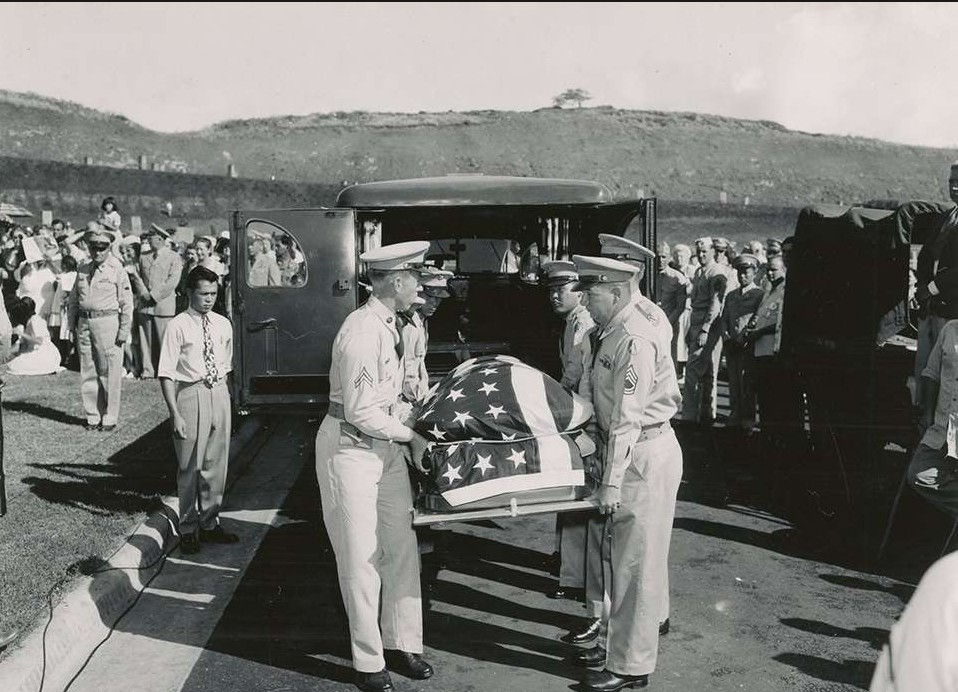
This quote from a service for a Marine who was returned to Kansas touched my heart
“We come to honor the memory of one who offered his life in the service of his Country; who has now enrolled in the great spirit army whose footfalls cause no sound. But in the memory of man, their souls go marching on, sustained by the pride of service, in time of national danger. Because of them our lives are free; because of them, our nation lives; because of them, the world is blessed. May the ceremonies of today deepen our reverence for our dead.”
A special story about another Marine family touched my heart
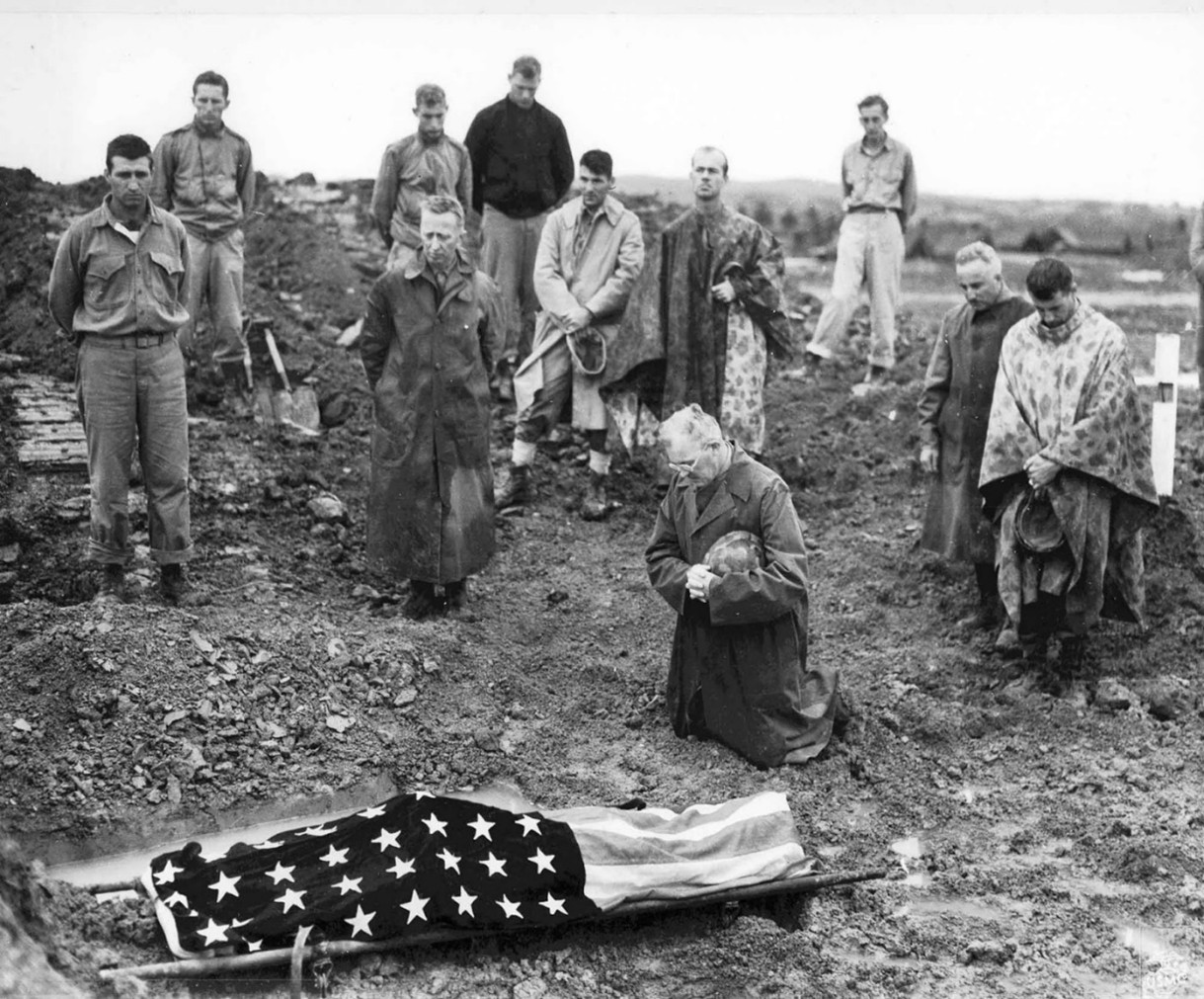
This picture depicts one of the most heart-wrenching moments to occur on Okinawa involved a family with a proud Marine heritage. Colonel (later Brigadier General) Francis I. Fenton enlisted in the Marine Corps in August 1917.
He gradually rose through the ranks until he became division engineer officer of the 1st Marine Division in July 1944. With this unit, Fenton won a Bronze Star for duty at Peleliu before landing on Okinawa.
While Colonel Fenton advanced to higher command, his younger son, Michael, enlisted in the Marine Corps on August 17, 1943, and joined B Company, 1st Battalion, 5th Marine Regiment, 1st Marine Division – the same division in which his father commanded the engineers.
Reportedly turning down a commission so he could fight at the front, Michael served as a scout-sniper (on) Okinawa.
Father and son met once during the fighting when their paths crossed at a partially destroyed Okinawan farmhouse. After exchanging news from home, including information on Michael’s older brother, Francis, Jr., who had been commissioned a Marine officer in 1941, the two family members returned to their work.
They would never talk again. On May 7, 1945, while beating back a Japanese counterattack not far from Sugar Loaf, 19-year-old Pfc. Michael Fenton was killed.
When his father received the bitter news, he traveled to the site of his son’s death and knelt down to pray over the flag draped body, a scene that produced one of the Pacific war’s most touching photographs.
Upon arising, Colonel Fenton stared at the bodies of other Marine dead and said: ‘Those poor souls. They didn’t have their fathers here’.
After the burial, Colonel Fenton returned to his headquarters and wrote a brief note to his wife, Mary, in San Diego. The soldier then resurfaced.
Fenton fixed his attention on a large map hanging in his headquarters, studied it closely for a time, then said to his subordinate, “We’d better double the guard around No. 5 bridge. The Nips may try to blow it”. The war was back on.
Mary Fenton learned of her son’s death before receiving her husband’s letter. In fact, she experienced a bittersweet two days when, on Wednesday, a telegram arrived from the Marine Corps Commandant informing her of Michael’s death. The very next day came news that her husband had been awarded a second Bronze Star.
Mrs. Fenton told reporters she was proud that Michael had done his duty as a Marine. She quoted a recent letter from him in which the youth wrote that he ‘dedicated my life to my country’ and that he was ‘prepared to die”.
Both Colonel Fenton and his older son survived the war. (I’ll save that story for another time.
Mike’s body was later exhumed from his temporary grave and is now resting in the National Memorial Cemetery of the Pacific in Honolulu, Hawaii. There, in Section D, Michael J. Fenton’s remains rest for eternity.
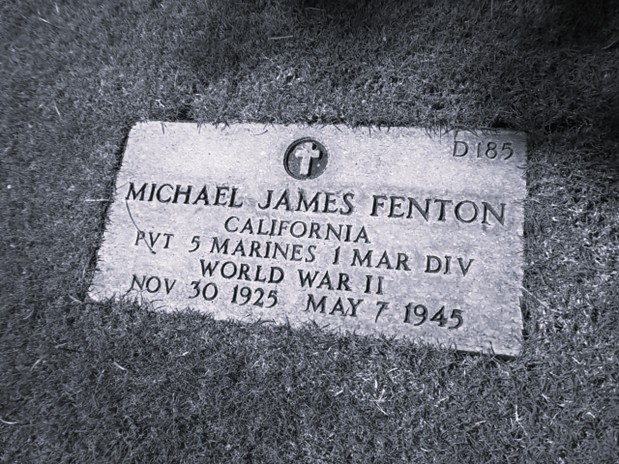
12,520
During the Battle of Okinawa, approximately 12,520 American soldiers were killed in action.
In addition to those killed, over 36,600 American soldiers were wounded during the battle,
bringing the total number of American casualties to over 49,000
The Mission Continues
For some families whose loved ones made the ultimate sacrifice in World War II, there were no funerals to attend, no graves to visit. For the family of those servicemembers who remained missing in action, whether due to their bodies never being recovered, or being one of the unidentifiable unknowns, the funerals and ceremonies of the return of the war dead did not provide some sense of closure. However, efforts to find the missing of World War II continue to this day.
Studies have shown that mortuary affairs personnel have some of the highest rates of post-traumatic stress disorder. Analysis has revealed three psychological components of handling remains: “the gruesomeness,” “an emotional link between the viewer and the remains,” and “personal threats to the remains handler.” Anecdotal evidence also suggests that those involved with the removal and disposal of war-dead often have to deal with a great amount of psychological pressure later on in their lives, as well as at the time of their duties.
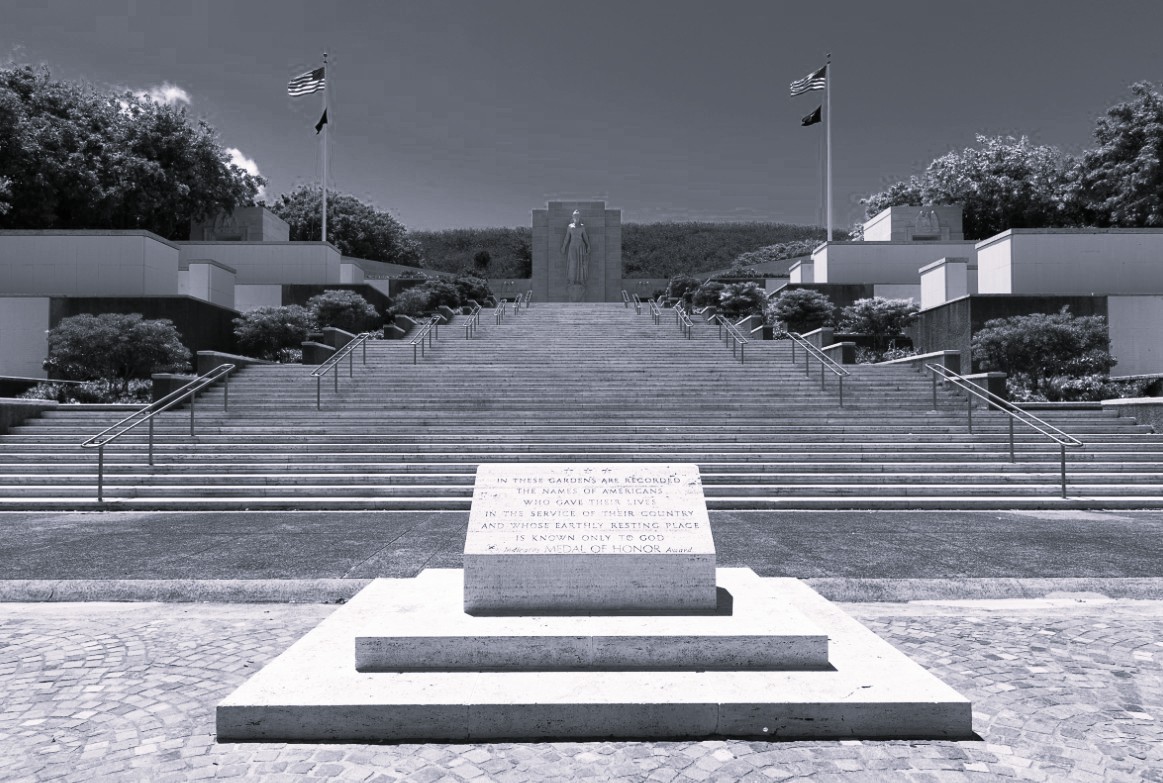
The Punchbowl
When I was a sailor stationed on my third submarine, Debbie, her mom and I visited the National Memorial Cemetery of the Pacific, located in Punchbowl Crater, Hawaii.
In the midst of what some people might consider paradise, is one of the most humbling of all places. Lost soldiers, sailors, airmen and Marines from the first days of the war at Pearl Harbor all the way to the conflict in Vietnam are buried or memorialized there.
For some, only their names are recorded since so many were lost at sea
The dedication stone at the base of staircase is engraved with the following words:
IN THESE GARDENS ARE RECORDED THE NAMES OF AMERICANS
WHO GAVE THEIR LIVES IN THE SERVICE OF THEIR COUNTRY
AND WHOSE EARTHLY RESTING PLACE IS KNOWN ONLY TO GOD
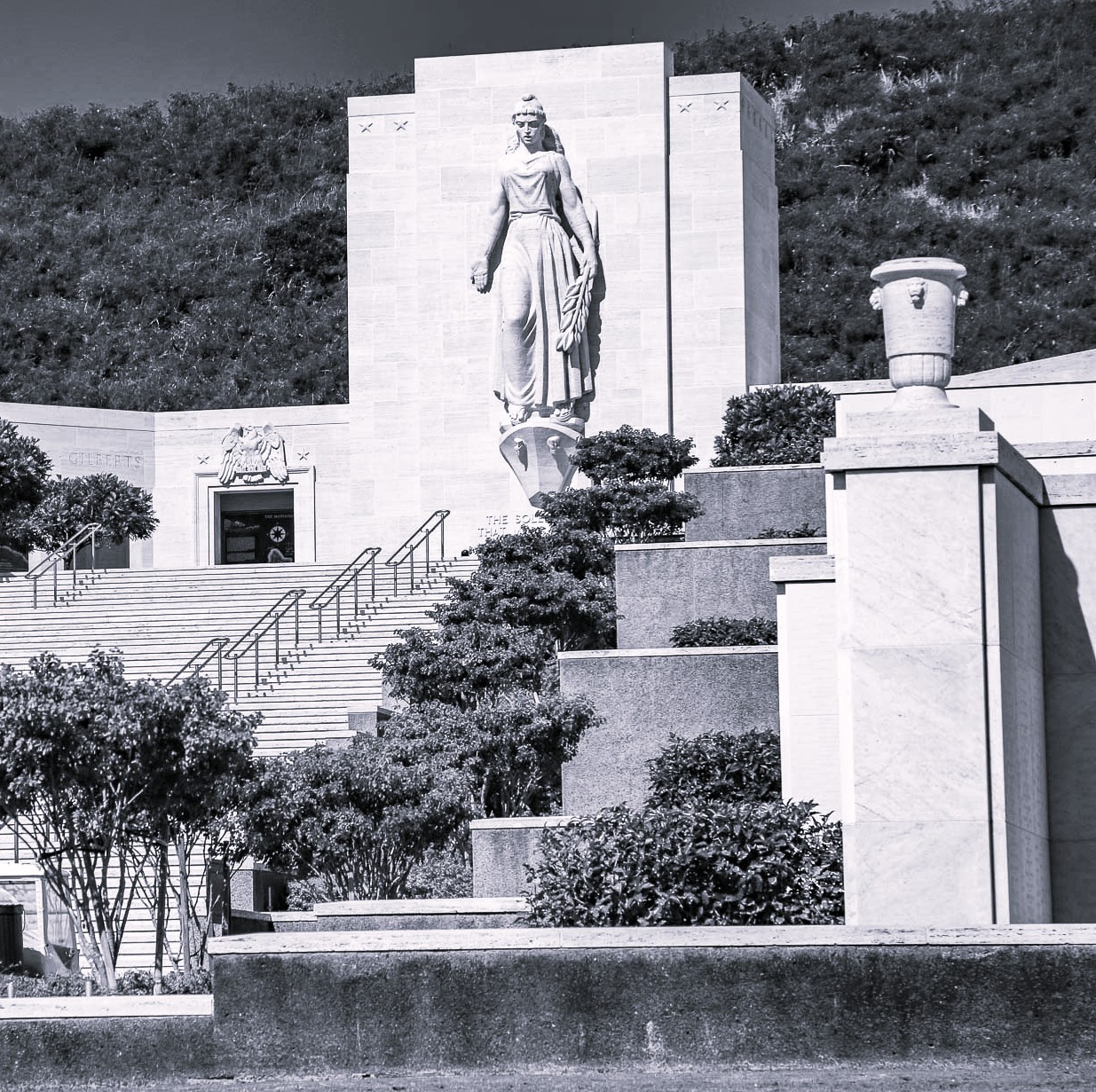
At the top of the staircase in the Court of Honor is a statue of Lady Columbia, also known as Lady Liberty. Here she is reported to represent all grieving mothers. She stands on the bow of a ship holding a laurel branch. The inscription below the statue, taken from Abraham Lincoln’s letter to Mrs. Bixby, reads:
THE SOLEMN PRIDE THAT MUST BE YOURS TO HAVE LAID SO COSTLY A SACRIFICE UPON THE ALTAR OF FREEDOM (Abraham Lincoln in a letter to a grieving mother)


