Editor’s note: This chapter is the one that was part of the primary reason one of my early supporters withdrew his support. I have only been to the academy a few times, but I remember the stately buildings and well-groomed landscapes. It is a place of honor in may ways but through the years it has had its share of blemishes. Hazing, the occasional cheating scandal and other human failures are no stranger to each of the service academies.
As I said in the beginning, if you are going to tell a story, include all of the elements, even if they are unpleasant.
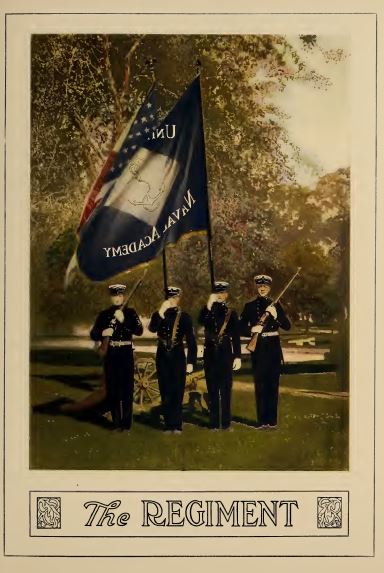
Chapter 3
Character is built one difficult lesson at a time
One of the lessons most military men and women learn at an early age is that the military is a microcosm of society. Throughout the ages, whatever is happening in society at large certainly has an influence on the people called to serve her. The service academies, for all of their benefits are no exception. Attempts to modify the traditional methods for growing a young plebe have been tried for nearly the length of the establishment. Conversations with graduates from all eras will reveal that there has been some success and of course there has been some continuation of the oldest traditions.
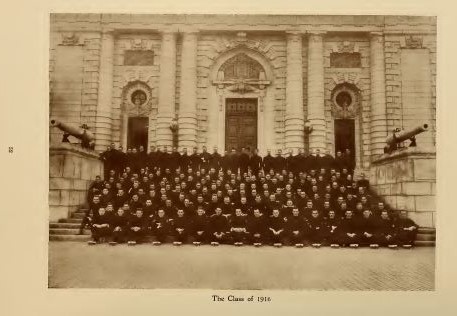
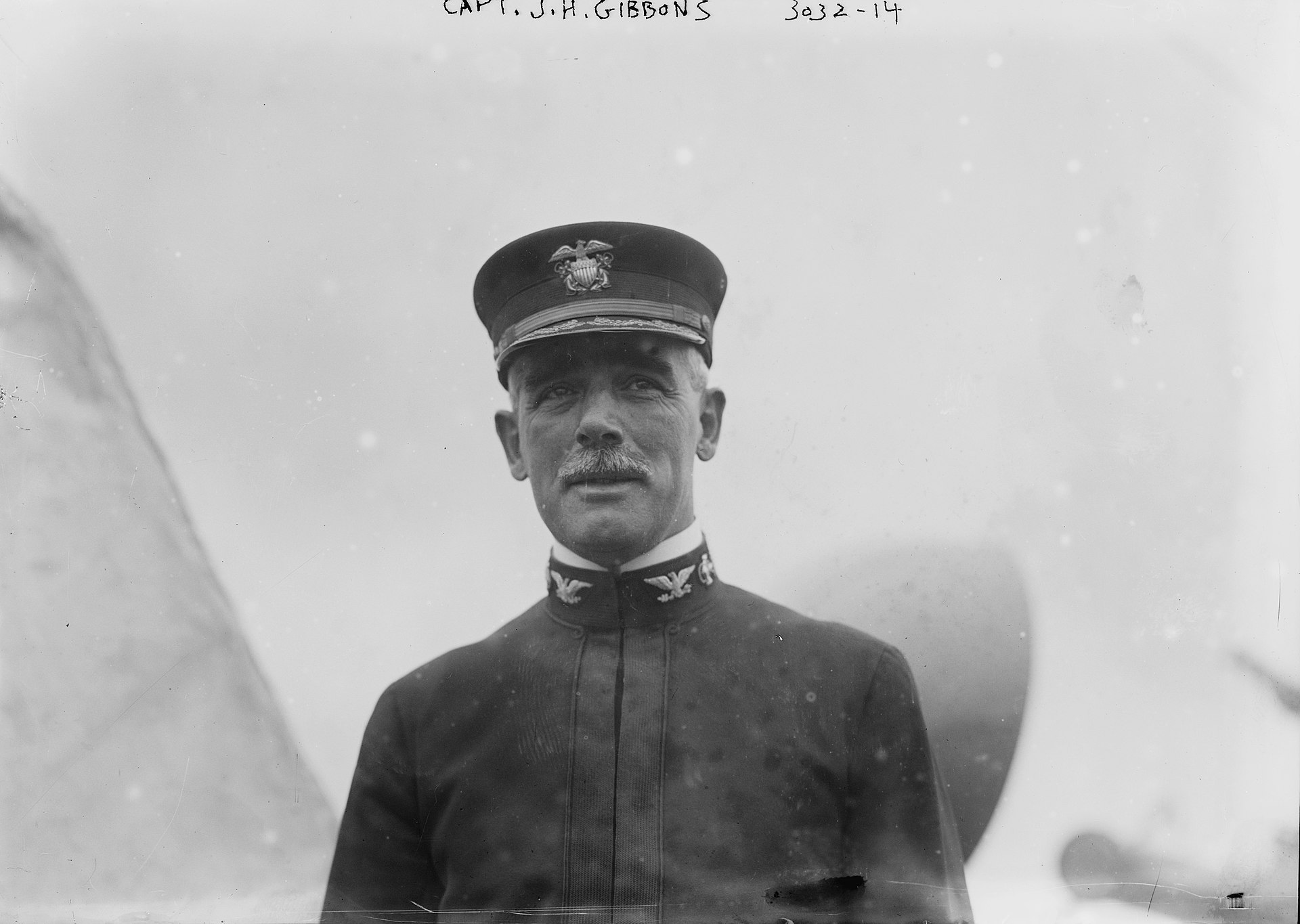
As fall began in 1912, roommates Young and Reinburg learned the lessons of a harsh life under the glare of the upper classmen and the men who were their teachers. Even though the new Commandant had decreed that a new wind was blowing in regards to hazing and initiation, there was still evidence that the old days were harder to eliminate than he may have thought. There were casualties. Congress had decreed that the institution of hazing would be eliminated from both of the service academies. Captain Gibbons had little toleration for those who did not take seriously the violation against the right of every midshipman to be treated with dignity. Discipline was swift and summary justice was given without mercy.
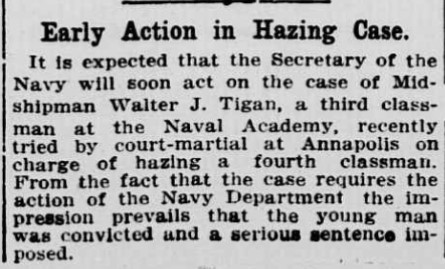
On October 31, Third Year Midshipman Walter Tigan of Illinois was dismissed form the academy for hazing a Plebe. His court martial was a strong message to the rest of the midshipmen and was upheld by Secretary of the Navy (Meyer). Instead of graduating with his class and going on to a potential career in the Navy, Tigan was sent home. He would not be the only one that year.
Fall was always a time of celebration at both of the nation’s military academy’s as they prepared for their annual struggle on the football grid iron. The Plebes were looking forward to a short reprieve from the narrow halls and the game offered a break from studies as well as a chance to get out into public (even if it were as a unit). The struggle on the field was a time when all four classes would join together as one. As a group, they would celebrate each score and suffer each time the enemy moved down the field. 1912 looked grim for the midshipmen as the sun stayed behind the clouds and Army kept going down the field. But 1912 would end up being a Navy victory in Philadelphia’s Franklin Field by two field goals to nothing for Army.
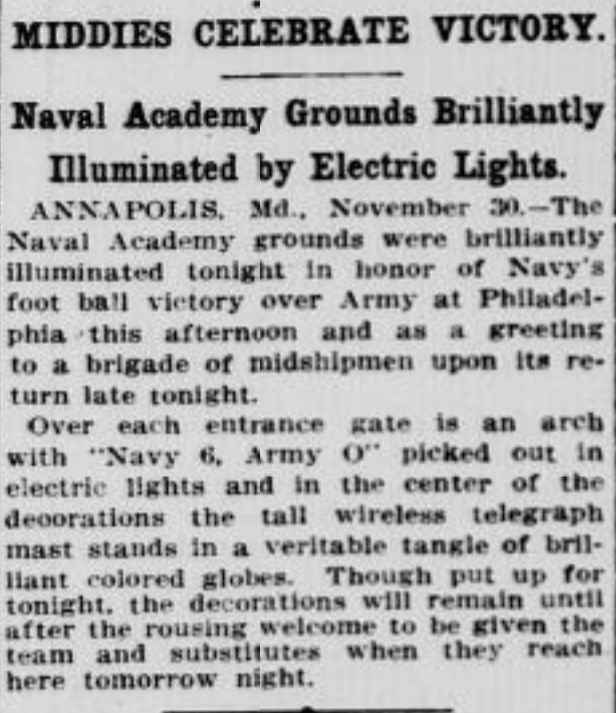
The Washington Evening Star reported that the Naval Academy grounds were lit up with multicolored electric lights over each entrance gate arch with the words “Navy 6, Army 0”. The tall telegraph mast was a “veritable tangle of brilliant colored globes.” The lights were put up for a great reception for the conquering heroes as they retuned the following day. The old academy had already started to see many technological changes with the introduction of electricity in all areas, modern propulsion laboratories that hastened the fading of sails to steam power and newer and more powerful guns that would project American power in the years to come. This was a joyous time and an exciting time to be at the naval academy.
The celebration would be short lived.
It should have been a great victory and a reason to celebrate all year. But one of the other unspoken traditions of the academy was that of collecting money in the form of a betting pool. Of course it was not authorized and the straight backed Gibbons (who also was adamantly against liquor of any kind) reacted just as swiftly as soon as he caught wind of the pool. Quietly before the game, the middies had defied orders and collected the sum of two thousand dollars. This was not quite half the sum raised in previous years and was more than likely influenced by the prohibition issued by Gibbons.
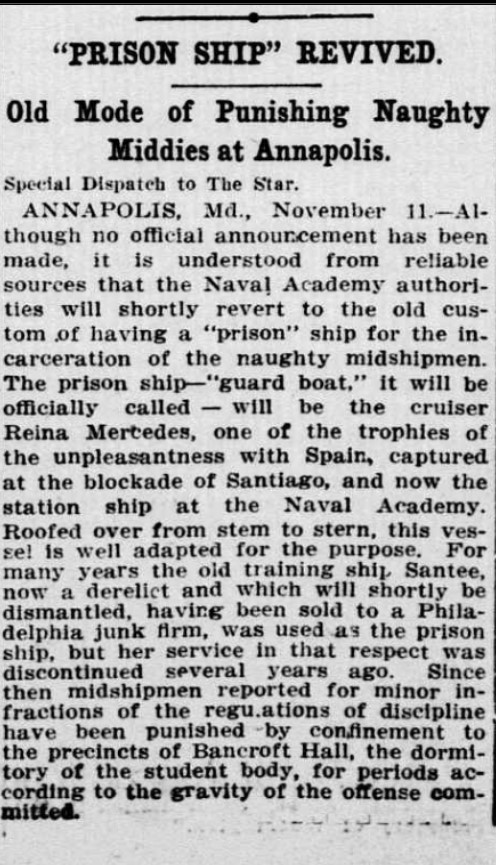
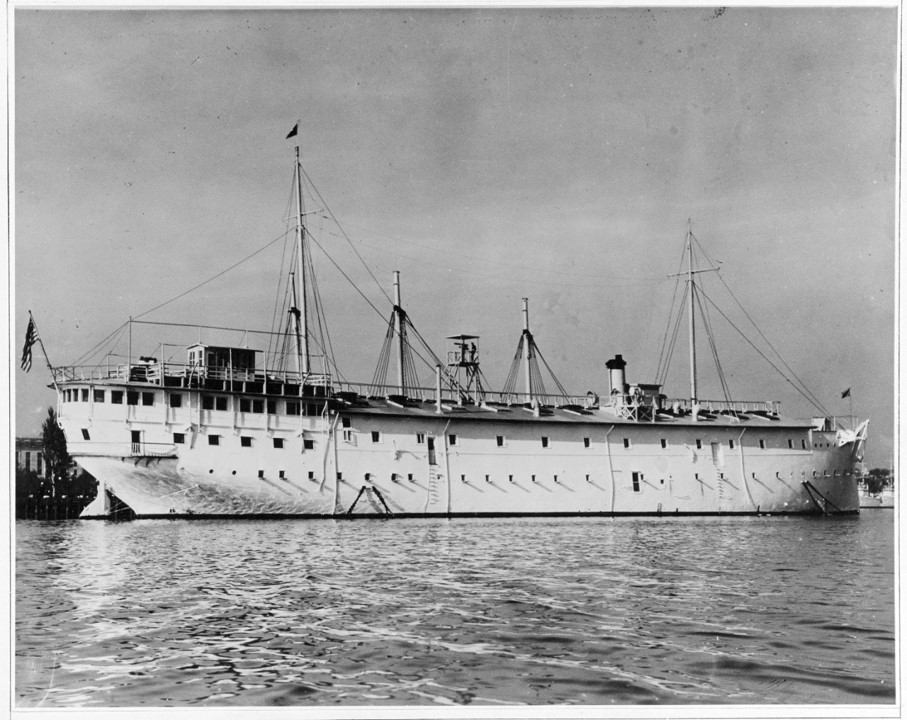
One of the additional “reforms” brought by Gibbons to the academy was the reestablishment of a “prison ship”. The Washington Evening Star reported on November 11, 1912 that even though no official announcement had been made, authorities had reverted to an “old custom” of having a prison ship for the holding of midshipmen that had violated the policies of the academy. This particular ship was the Reina Mercedes, one of the trophy ships from the Spanish American war that had been captured at the blockade of Santiago. The Reina Mercedes was the station ship at the academy that had replaced the ill-fated Hartford which left in October. There had been other ships at Annapolis which were used for the purpose of discipline, but the old training ship Santee had been the last, and the practice was discontinued several years before this decision was made. In the interim, midshipmen that had committed minor infractions were punished by confinement to Bancroft Hall, one of the dormitories the students were housed in for period’s equivalent to their offences. The use of the Reina Mercedes was a step back into time and a meant to be a clear signal that justice would be swift and meaningful.
The Betting Scandal Comes into the light
The scandal erupted in the newspapers in early December. On November 29th, the day of the Army Navy Game, one of the Midshipmen was trying to arrange the traditional bet between the two academies when he was discovered by authorities and arrested. Superintendent Gibbons had just a few days before the game warned the midshipmen that his reforms included a no betting policy and it would be enforced. He was determined to be the one who broke up the practice of betting on inter-service athletic competitions. The early discovery resulted in an investigation and board of inquiry. What followed was an avalanche that the Superintendent could not have anticipated. By the time the investigation was completed a few weeks later, over four hundred of the midshipmen were implicated.
The betting on this particular game had been an old custom that had gone on for many years. Just like hazing, some traditions were probably frowned upon officially but were still a large part of the organizational culture. Gibbon’s reforms were meant as part of his efforts to modernize and make the culture more professional. They were well minded but probably not well received once they were made known. None of the newspaper articles indicate all of the names of the four hundred men who were found guilty but the implications were clear. If a hard line was held, two things were obvious; first, there might be a gap in the number of officers needed to fill a growing Navy.
There had already been calls in the congress and the press for the need for more officers to fill the ships that were being built. In June of 1912, the need for building two battleships a year was established which would create a pull on the need for newly trained officers. Aircraft were also becoming important and their value to a modern navy was obvious even in the early stages of their development. The loss of four hundred men from the only source of naval officers at that time would have had a devastating operational impact.
In the Navy Secretary’s annual report, the need for trained fliers was highlighted for the first time:
AVIATION.
Although the aero plane has not yet arrived at the state of perfection required, it is sufficiently advanced to be of great service in many ways and its extensive use is expected at an early date.
The most serious phase of aviation is that of adequate instruction. It takes longer to produce a sufficient number of competent aerial navigators than to manufacture a sufficient number of aero planes.
The following statement will serve to show the comparative interest that is manifested in aviation today by some of the powers:
Government: Appropriations
France $ 6,000,000
Germany $ 1,500,000
Russia $ 5,000,000
Great Britain $ 2,100,000
Italy $2,000,000
Japan $600,000
United States $140,000
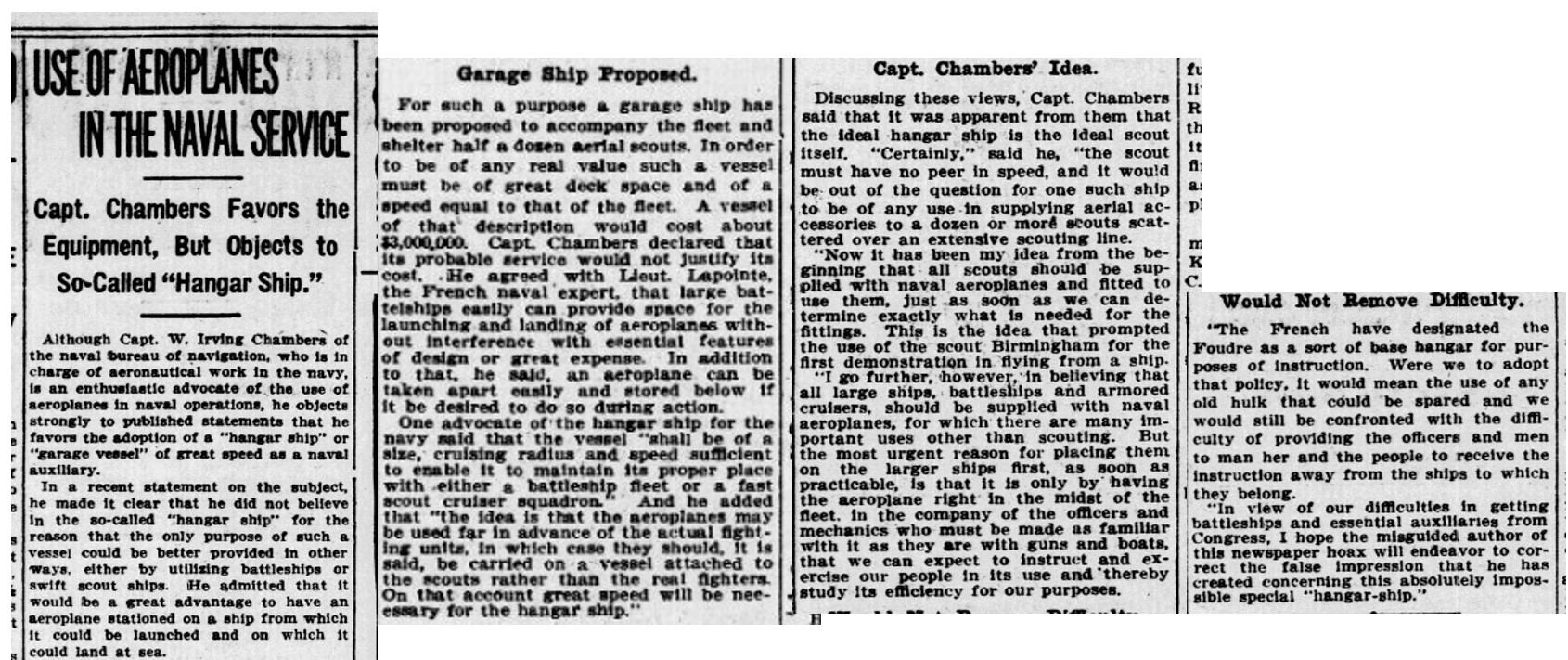
It is worth noting from that list of expenditures that the United States, which was really a pioneer in aviation because of the work of the Wright Brothers, was behind even Japan in training expenditures.
The second thing that was going to become obvious was the political impact. The men at the academy were often sons of politicians and sons of their influential supporters. Several of the key players in the betting scandals were members of that distinct social class. Many midshipmen also came from long lines of previous naval officers, some who were still on active duty. To be sure, many of these same people saw the need for modernization and reform. But after all, previous generations had done the same things or worse and it had not damaged their contributions to the navy and country.
Gibbons was in a pickle though.
He had personally gone to the midshipmen and set the “no gambling” standard. He even pointed to existing naval regulations which were very clear about the rules for gambling for naval members. The fact that so many had gone ahead and participated anyway was a direct challenge to his authority and to his position. One paper even called it a mass insubordination. The midshipmen were worried as well. Their fate as future naval officers hung in the balance and the possibility of spending time on the Reina Mercedes was looming largely in front of them at a minimum. Although with the large number who had “confessed” one young man pointed out “If they put us all on the Reina Mercedes, they will have to put another deck on her.”
History does not record what ultimately softened Captain Gibbons in his approach to the punishment of the men. Four of the worst offenders who were dual offenders (gambling and hazing) paid the price of dismissal. Each of the four had previously been before the mast so there was little recourse on their parts but to leave under disgrace. The remaining members of the four hundred were given a variety of restrictions and demerits based on their own severity. This resulted in their loss of privileges during the Christmas season including entertainment and not being able to go to their homes for the holidays.
The entire affair certainly left an impression on the Plebes that year. They had seen their first death, been exposed to many new and challenging physical and mental obstacles and come face to face with possible expulsion before they had even completed their first year.
It has been said that character develops through many things.
Early life brings a formative process that results from the sum of the learning and experiences a child has. Leaving one’s family and going off to school has much the same effect. Doing so as a member of an academy that is as intense as the naval or any other academy multiplies that character building process. These lessons would play a role in the life of Cassin Young many times throughout the next thirty years.
Mister Mac
Next Chapter: Chapter Three: Join the Navy and See the World

 theleansubmariner