 Where Are They Now?
Social media has really had an impact on the world. While some might argue that it has been mostly negative, there are some positive impacts that most of us would have never thought of fifty years ago. In previous generations, you had to meet face to face in a common space in order to develop relationships or catch up with old friends. If you were in the military, keeping in touch with old comrades or shipmates would have been challenging unless there was a robust system that allowed for reunions. Even then, only certain people could afford to attend or had the time. By the time many of those reunions would occur, Father Time had already claimed some of the participants and their presence was only felt through the stories and faded photographs others held close.
The same thing was true of the people you went to school with. Whether it was high school or college, time, distance or different life paths sent all of you in different directions. New relationships blurred old ones in many cases and marriage and divorce often caused even further separations. The old saying about “you can’t go home again” was all too often the case. I distinctly remember a feeling of being a foreigner when I came home to the place I was born after just four years in the navy. Old friends were busy with their new life without me being a part of it. There was some cordiality, but nothing like the old days when we were together day and night creating adventures and causing mischief. It was easy for me to go back into the navy and start all over again. Frankly, it was the best move I ever made since it brought me to Debbie and an amazing life.

As we moved through our early years as a couple, the navy moved us from Virginia to Hawaii to Washington State and back to Hawaii. Three more submarines with some great people and a lot of adventures. Then a quick jump to Scotland before one last trip to Virgina and retirement. So many more great crewmembers and friends. I have never sat down and tried to calculate how many friends and colleagues we interacted with. It has to be in the thousands.
The world was about to shrink exponentially
When we retired, we moved to McPherson Kansas where we met many new people. But there was a sense of loss in having said goodbye to so many people who had filled empty places in our lives. That was in 1994, and something was changing in the world that would have a profound impact on all of the world. The internet was coming of age.
When we first moved in to our new house, we had a telephone line. An actual telephone line that was our connection to family back in Pennsylvania and to our new friends and colleagues in Kansas. But something else came through that line. Our internet. You had to surrender the phone line so that the computer could send a signal to a distant POP that would allow you to connect to the world wide web. We used a service provided by AOL (America on Line). There was a distinct series of tones that indicated that your special device was trying to engage the receiver on the other end. If you were lucky (and the phone lines weren’t too busy) you got the success signal and if you had any “e” mail, you heard that famous voice saying “You’ve got mail”.
It was a very drawn-out process compared to today and the mail you got was pretty simple. During that time, it was also pretty expensive. If you lived in a place like McPherson Kansas, the nearest POP was in Wichita and that was considered a long-distance call. We found that out the hard way when we got some pretty outrageous phone bills. Needless to say, this whole internet thing was still in its infant stages.
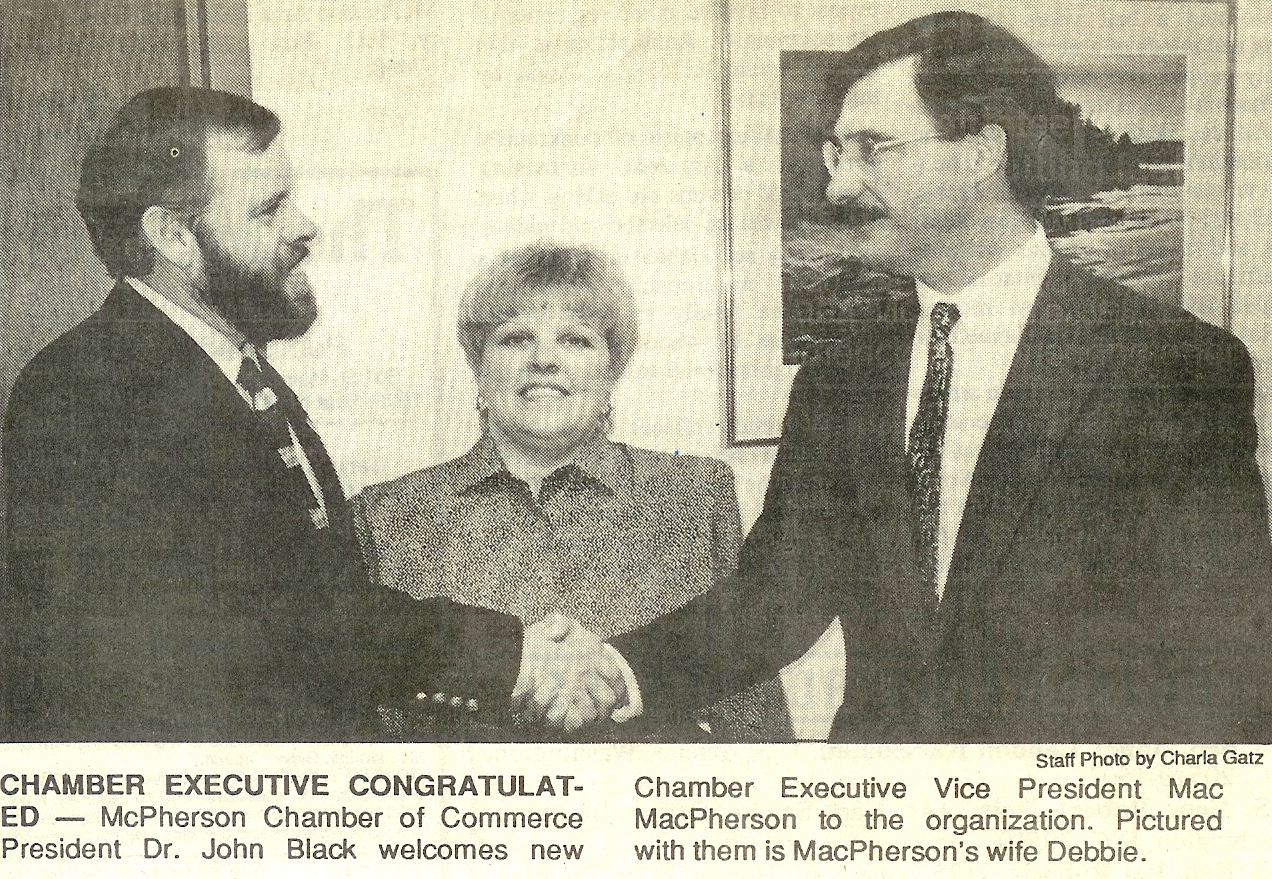
As time went by, some changes occurred. I was the Chamber of Commerce Executive VP for the town and I helped a couple of local providers build an alliance that created a local internet presence for our community. The days of long-distance bills and long wait times were over. The new programs that were coming online were designed to open up the world of information that the internet had promised. Plus, some fledgling social media outlets were starting to pop up. This was the way people could connect with friends and family over long distances. These services would also allow you to send pictures of special occasions and eventually even movies. Now if grandma was in Pittsburgh and the kids were having a special birthday party, she could see the party in pictures or reels. Eventually that would even extend to things like Face Time where you could interact.
The funny thing about developing a local on ramp for the internet had an interesting side effect. A local preacher decided to go on a rampage about this new tool since it would make access to pornography easier. The work of the devil! (I later wondered how he knew about that side of the internet.) Not long after that, I was fired from my job at the Chamber. I’m sure the two things were not related.
A powerful tool
For me, the internet has been a way to write so many stories and create a place to store both memories and history. I can research the Library of Congress, old newspaper, current events and so much more. The inclusion of AI is opening up a whole new world that will advance communications and interactions in ways I can barely imagine.
But social media has played a role for me too. When I first started writing the blog, sharing it was challenging. There are so many search engines on the web and gaining a recognition factor was very challenging. Unless you have a ton of money to spend in advertising, having people find you is one of the great challenges. My blog has key word searches and I have gotten better at using that tool. But social media has certainly been a blessing. Between the four aps I am subscribed to, I became more and more visible. Theleansubmariner has over a half a million visitors and over 891,000 views.
I use Facebook for much of my information sharing. It’s a pretty great tool since it allows me to develop online acquaintances (friends). As of today, I have over 4500 followers. This is the really cool thing for me. That includes family, actual friends from all phases of my life, people I went to school with starting in first grade, shipmates from every command I ever served on, people I worked with during my second and third career and thousands of people I have common interests with whether it was politics, church or just service connected. My other social media connections are fairly well developed also.
Facebook became my daily newspaper, an outlet for all of my many interests and certainly a way to share what I am working on now.
But I am sometimes frustrated with one thing: Despite all of this technology, there are still some people from my past that I can’t seem to find.
Where are they now?
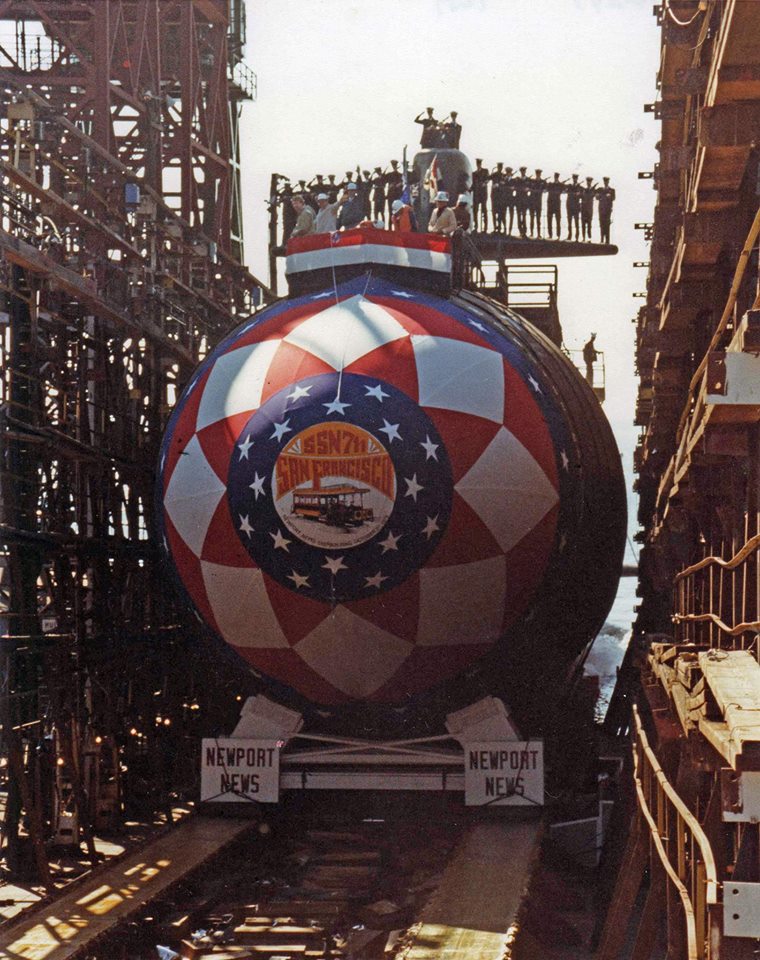
If you ask most service people, they will tell you that there was probably at least one duty station or command that stood out above the rest. My first two submarines left a decided impact on me, but it was my third that had the most influence on my life. In December of 1979, I reenlisted and was sent to a precommissioning submarine in Newport News Virginia. The San Francisco had just been launched and was in the process of completing the construction process. It was also rapidly manning up a new crew and I would be one of them. I was 26 years old and probably the oldest third-class petty officer on board. The difference was that I had learned so much since I left my last submarine and had learned that waiting for the navy to change to meet my expectations was a losing proposition. I dug in deep, asked for every collateral duty they would give me and learned every detail about the boat I could as it was being built.
Ther is no better way to qualify on a submarine than to see it being built and participating in the systems testing required to make the boat work. I knew where every valve and circuit were and could draw them in my sleep.
But what made the boat really special was the people who were also doing the same thing. The crew was one of the best I ever worked with. We did have a few rough spots in the beginning and saw some of the original crew not make it. The work was extremely hard and demanding. If you didn’t have the right mindset, you would find yourself falling behind and eventually out. But most of the crew that survived that crucible was as tight as any crew ever would be.
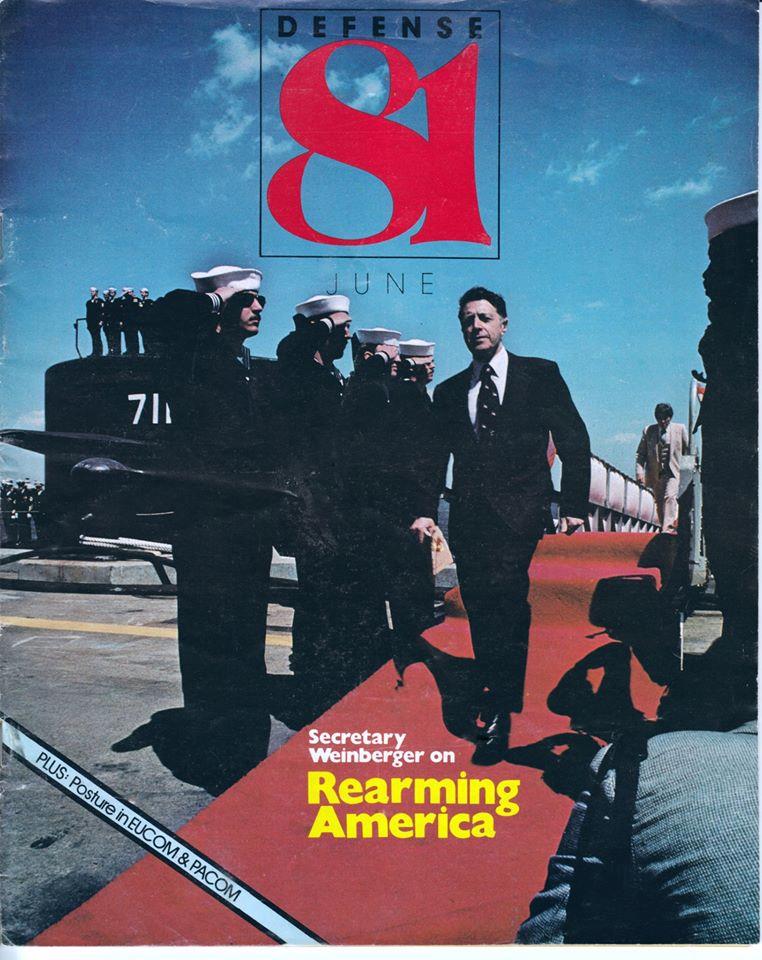

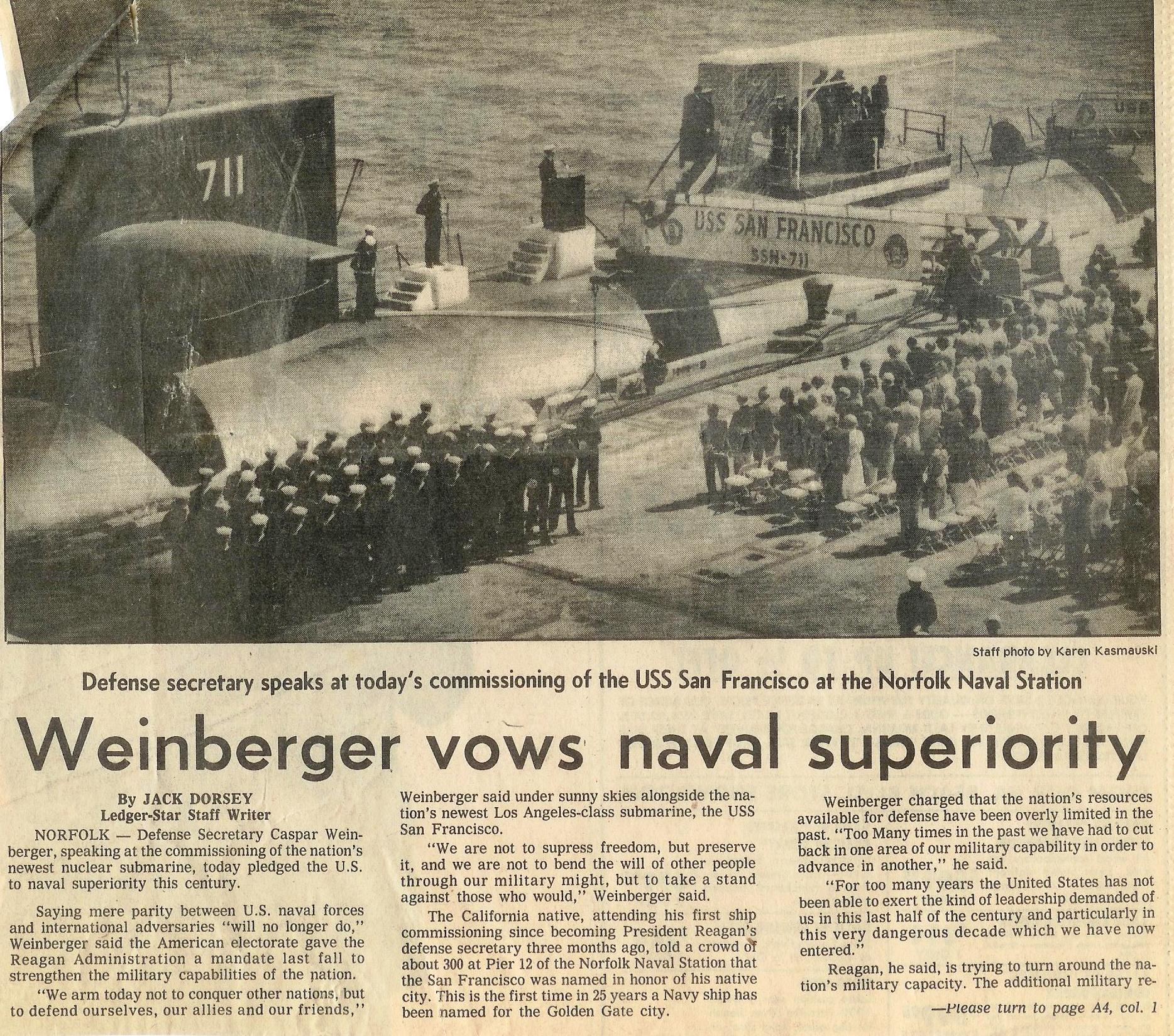
Our final tests were especially demanding, and sea trials tested every one of us. But commissioning day would come we would be on the front page of the world’s newspapers. Casper Weinberger was Ronald Reagan’s Secretary of Defense and he would announce the goal of a navy second to none on the back of the submarine during commissioning. After the parties were over, we went to work. We sailed west through the Panama Canal and the whole pacific (and beyond) was our playground.
Over the next few years, the plank owners would eventually begin to leave for new assignments. Some would stay in the navy and a few were done. I would make first class before I left the boat and haver many personal victories. But it was our shared achievements that mattered most.
Through the blessing of social media, I have reestablished so many friendships from those days. But like all of us, some of the ones we knew seemed to have vanished off the face of the earth. Through the various reunions we have held, some of the same names come up among the missing. Sometimes someone will have a vague memory of seeing them at other gatherings but some have just vanished. That may be by design or just a lack of interest in keeping in touch. We all make choices in life and choosing to not be seen may just be their choice.
Sadly, however, we also know that some probably just came to the end of their time.
The story I wrote yesterday was about one of those people. It brought up a lot of questions online from people about some of the others we have not heard from. I’m posting some of the pictures from the commissioning book. Who knows. Maybe one of the people who we can’t seem to locate will find this on an internet search and clear up the mystery.

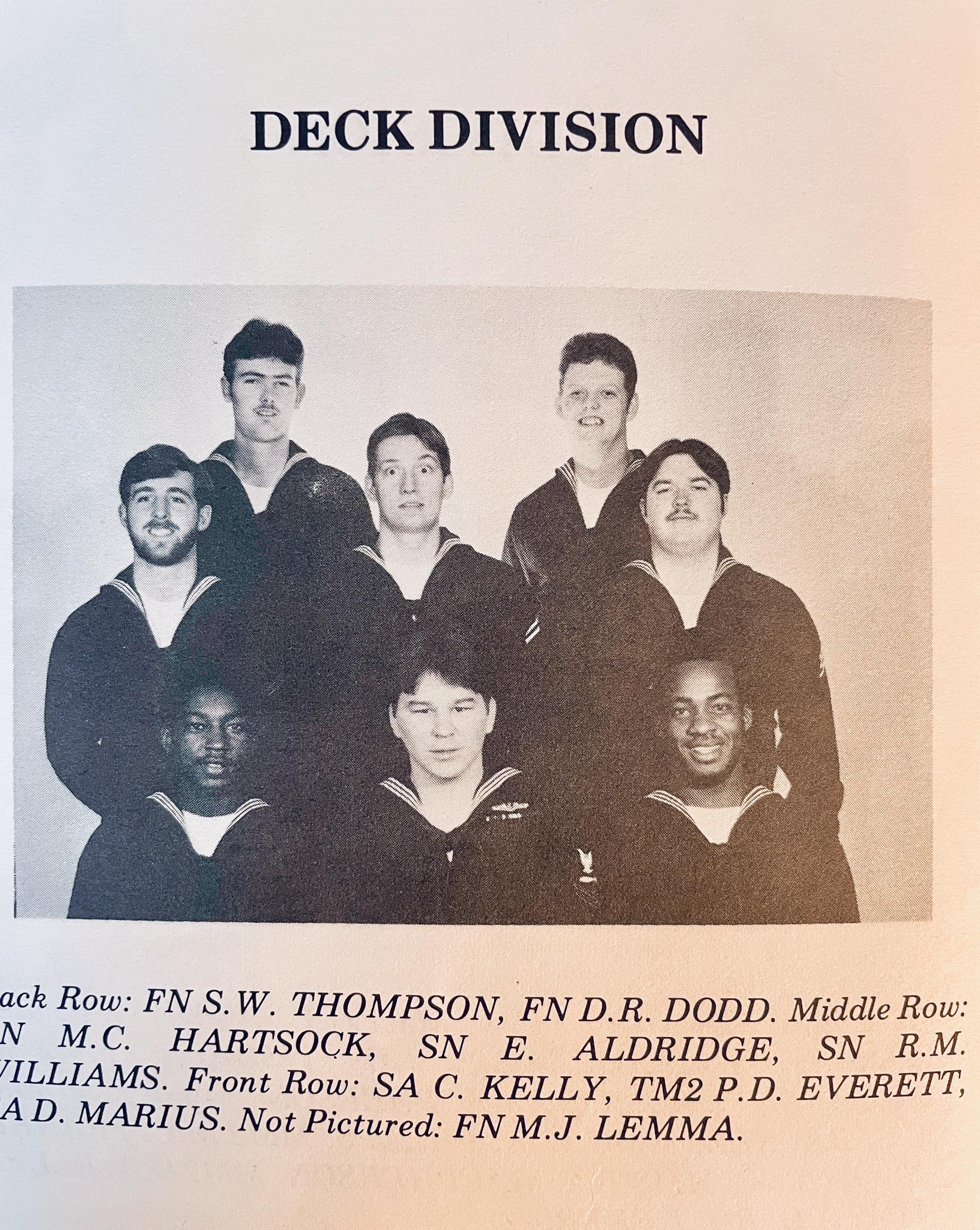
In the meantime, I am also reposting something I wrote a long time ago that seems appropriate to the subject.
The Submariner’s Lament: When you understand
When the hatch closes over your head, the OOD says last man down and the COW says green board, you understand the meaning of adventure.
When the only thing between you and millions of gallons of seawater is a steel hull and some closed valves, you understand the meaning of courage.
When sonar calls out to the conn “high speed screws in the water” in hostile waters, you understand the meaning of fear.
When the messenger passes out the only family grams the satellite could catch and yours isn’t one, you learn the meaning of loneliness.
When hissing water in the overhead turns from a slight annoyance to a terrifying rushing cascade bouncing off the hull and equipment, you understand the meaning of survival.
When you hear the quick sound that a curtain makes on your rack that indicates your watch is about to begin, you understand the meaning of irritation.
When you see a brother stand at attention while the Captain pins on the fish he worked so hard to earn, you understand the meaning of pride.
When you retire and they pipe you over the side for the very last time, you learn the meaning of great sadness.
When your eyes grow dim and your strength ebbs with age, you understand the meaning of envy every time you see a submarine getting underway.
When a shipmate from a time so long ago passes on and people say so many things they wish they had said before they departed, you understand regret.
Robert W. MacPherson, CWO2 USN (Retired)
Submarine Engineering Technician
(This last bit is copywritten so please use proper attribution if you borrow it)
Mister Mac

 theleansubmariner
I had a similar Plankowner experience on the Mariano G Vallejo SSBN-658 built at a fine yard, Mare Island builder of some of the finest ships the Navy ever received. My report date was almost two months before launch, while there were still some big holes in the hull that needed to be closed up before we hit the water As a Boomer we had two crews assembled and worked together to start the process of installation and testing of some very complex systems. I was the very first belowdecks watch after launch and took a flashlight (we had no power) and went from fore to aft looking for any leaks, even in the reactor vessel. Fortunately I stayed dry the whole trip. I took my whole watch to complete the inspection.
As a forward ET, I did not have all the Nuc stuff to do, but our Nav team was present before our systems were even installed and got to see lots of stuff covered up that the later crew members would never see. The only things in the NavCenter were the electrical panels on the outer parts of the upper level OPS. We were present for all the installs and the acceptance testing (much of which we performed), and seeing the systems come together was eye-opening and amazing. During this period we worked 24 hour shifts rotating every four days to a new shift with one four day off period in the sixteen day rotation. This lasted nearly a year. We got to see the welders closing up the hull, and the x-ray gang at night checking the welds. The machinists and the electricians and all the other trades putting our ship together, became friends as we formed relationships with the yard workers along with our two crews.
In our spare time we broke out the Piping Tabs and worked on quals, a lot different than the hand drawn diagrams that I still have from my diesel boat days. When the last holes were closed, the reactor went critical and we sailed down the Napa Riverand by the Carquinez Straights to the Golden Gate I had the good fortune of being the Bridge Phone Talker (thru four weeks of sea trials) and saw all the sights of the bay and the bottom of the Golden Gate as we sailed under and headed for the Farallones it was time to secure my watch station as we began to close up for the first dive, and another check for leaks. Fortunately there were none and we proceeded to the spot where we did the Teat Depth dive to prove Mare Island Workers had done their jobs, and they did. After it was assured the hull was good, we headed for Alcatraz to pick up a famous admiral and his team around midnight. After they were aboard we headed for the Farallones again and gave the Nucs hell for a week before Rickover said the Nucs could sit the ship as he was satisfied of their performance. We had the weekend off in Vallejo before we headed out four more times to complete the sea trial phase of the boats acceptance testing. Then came Commissioning and on to Cape Kennedy for our DASO and another 6 months before the Blue Crew did the first patrol in the Pacific and the cycle began. Lots more sea stories, but not enough space here to tell all.
Edwin Bills ET1(SS) USS Mariano G. Vallejo (Gold)
Great feedback Edwin. I decommissioned the Halibut in Mare Island and really hate that they closed it down. I think we will regrret that decision in the coming years
Mac