Retiring from any long-standing position is always a memorable event.
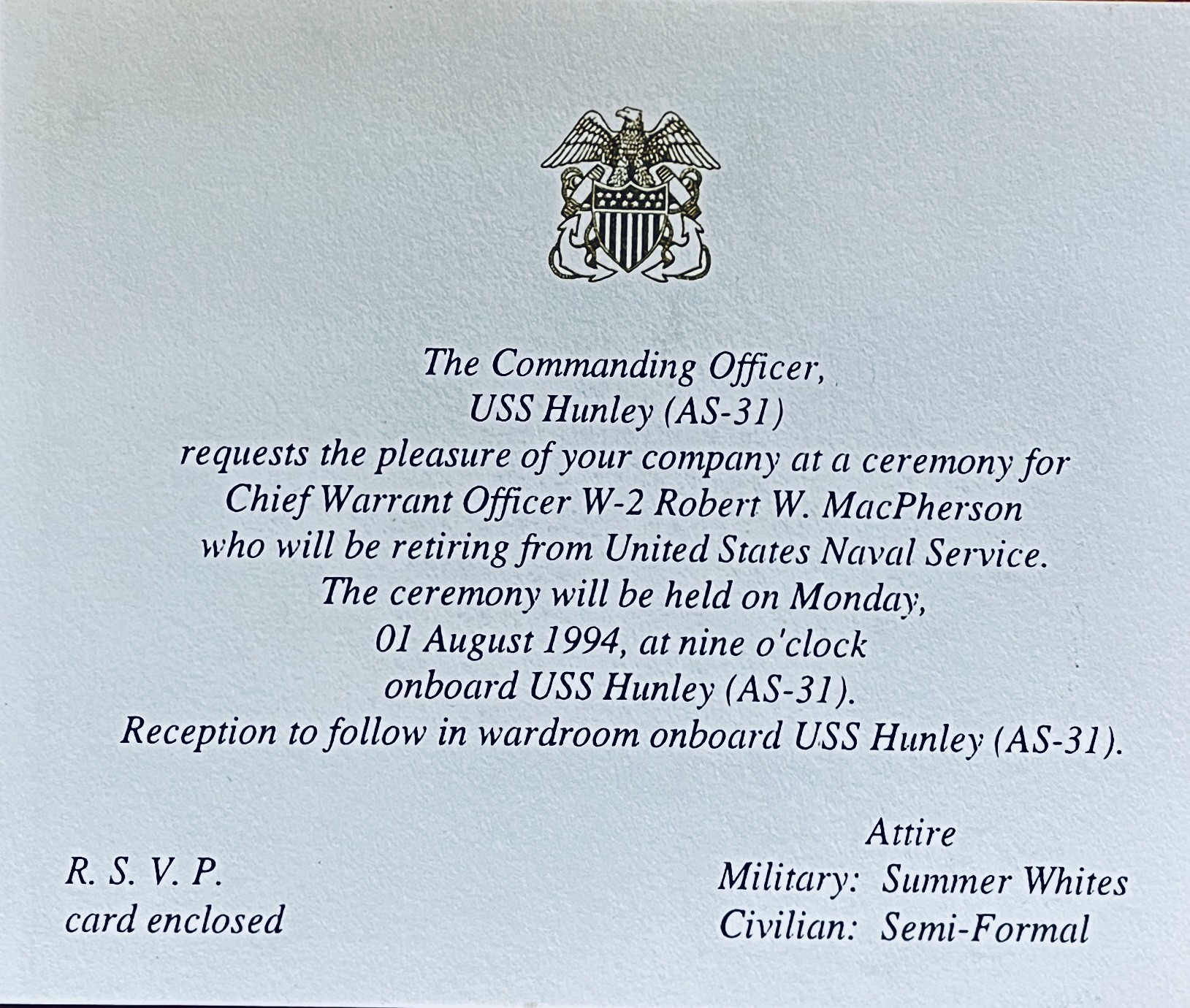
I retired the first time when I was forty years old. It was sooner than I had planned but circumstances made it a reality and I just went with the flow. It was a nice affair and even thirty years later, I remember how honored I felt that my crew came out in force and supported us as we made the transition.
I was doing a little research about legacy submarine stories from a hundred years ago today and came across this announcement for a gentleman who retired on this day in 1925. (March 4th)
To be honest, he was not a submariner. But the search engine I was using was set to submarines and his name and this announcement came up. Why it did will become obvious as we go through the story.
In the early 1900s, submarines were beginning to come of age.
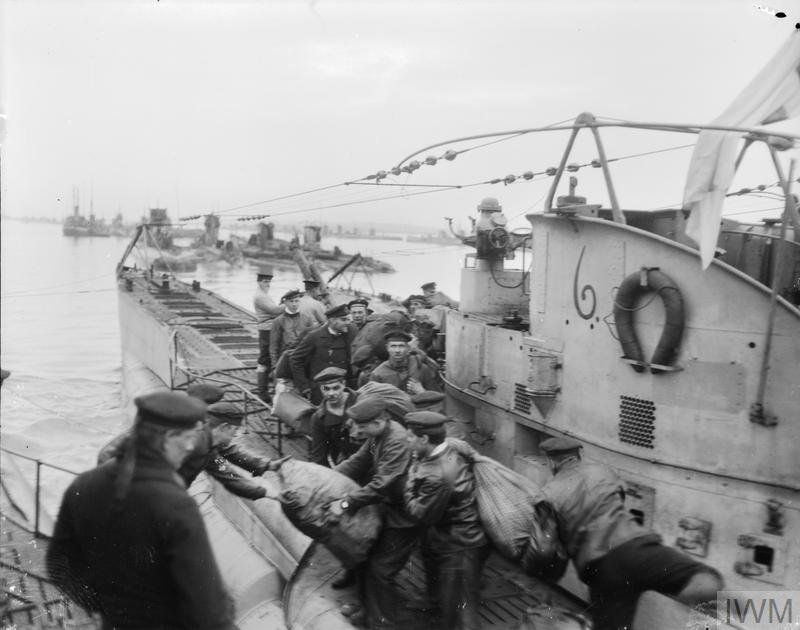
The Germans in particular sent a lot of time and money developing some of the finest and deadliest submarines in the world. They recognized that they did not have the capacity to overcome the British surface fleet which ruled the waves around the globe. So, they put their efforts into making the submarine fleet something to be feared.
Their results were shocking to the world. The U boats were responsible for waking every nation out of a self-imposed slumber when it came to battles at sea. No long were large guns and armor the worst thing to be concerned about in the oceans of the world. Fast moving torpedoes that came from the dark night were sending precious cargos and men to the bottom of the open with relative ease.
THE EVENING STAR, WASHINGTON, D. C„ TUESDAY, MARCH 3, 1925.
STOCKER, FAMED DESIGNER OF BATTLESHIPS, LEAVES NAVY
Rear Admiral Conceived Measures to Nullify Submarine Attack.
Distinguished Services Were Rewarded With Prized Navy Cross.
Invulnerability of battleships, particularly from underwater attack, will stand as a monument to the ability of Rear Admiral Robert Stocker, Construction Corps, U. S. N. who Saturday was relieved of all active duty In the Bureau of Construction and Repair of the Navy Department. The security of the capital ships of today is due. for the most part, to this officer, whose expert knowledge of construction and the effects of explosives which today are the pride of the American Navy. With none of the glamour of action that is found with the fleet, this officer has made it possible for such vessels to go out, secure in their construction to withstand outboard attack from the submarines.
About the time of his assignment to the Bureau of Construction and Repair as head of the design branch, the submarine was just becoming a menace to all types of surface ships. Due to his exhaustive studies and tests and his intimate practical, as well as theoretical knowledge, by interpreting the tests correctly, he developed the effective protection which the battleships now possess against all known forms of underwater attack.
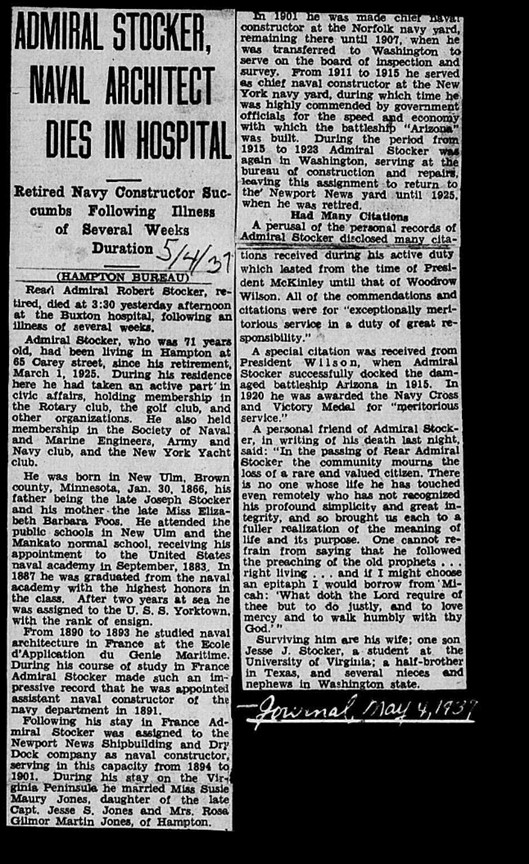
Admiral Stocker has been one of the outstanding figures of the Navy’s construction corps. He holds the Navy Cross for distinguished service. Admiral Stocker retired las November, but was kept in service until yesterday. He was born in New Ulm, Minn., January 1866.
(He would retire with over forty years of service at the highest rank possible in his field which was the Bureau of Construction and Repair)
Navy Cross
Service: United States Navy
Rank: Captain
Division: Bureau of Construction and Repair
Action Date: World War I
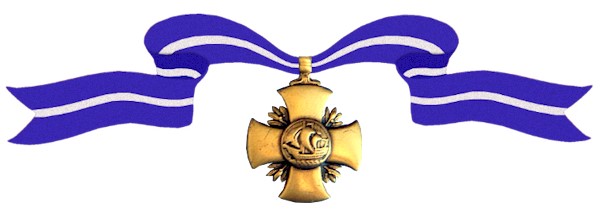
The President of the United States of America takes pleasure in presenting the Navy Cross to Captain Robert Stocker, United States Navy, for exceptionally meritorious service in a duty of great responsibility as Assistant Chief of Bureau of Construction and Repair, and in charge of the design division of that bureau; and, specifically, for the design of the Eagle class of vessels, the designs for which were completed in an unprecedented short time and contained many novel and original features.
From a sailor to a construction expert
Robert Stocker graduated from the U.S. Naval Academy at Annapolis, Class of 1887.
Stocker would serve with distinction at the Academy. He would spend two years at sea and after two years was assigned to the USS Yorktown as an Ensign. In those days, graduates remained a midshipman for two years before becoming an Ensign. The USS Yorktown was lead ship of her class of steel-hulled, twin-screw gunboats in the United States Navy in the late 19th and early 20th centuries. She was the second U.S. Navy ship named in honor of the American Revolutionary War’s Battle of Yorktown. Yorktown also had main masts for sails but she was a transition ship that was a bridge between the days of sail and the evolution of steam.
In 1890, he would be sent to France to study naval architecture. His studies resulted in the achievement of being the assistant naval constructor of the navy department in 1891. It was from this position that he came to be known for a number of achievements.
Torpedo Threat
Heavy ships of that age were designed with a focus on surviving attacks from other capital sips. The armor and guns were the primary focus in every navy and larger and larger ships were being constructed. In the period between 1911 and 1915, he served as chief naval constructor for the USS Arizona.
What was different about Arizona and the ships that would follow was the inclusion of a new type of defense. Large blisters in the area where potential attacks from torpedoes might occur became part of the construction. But there was pressure from Washington as the war drew nearer to build the ships with speed and efficiency. It was his vision and drive that made both happen. He was highly recommended by Washington for achieving the goals that were set.
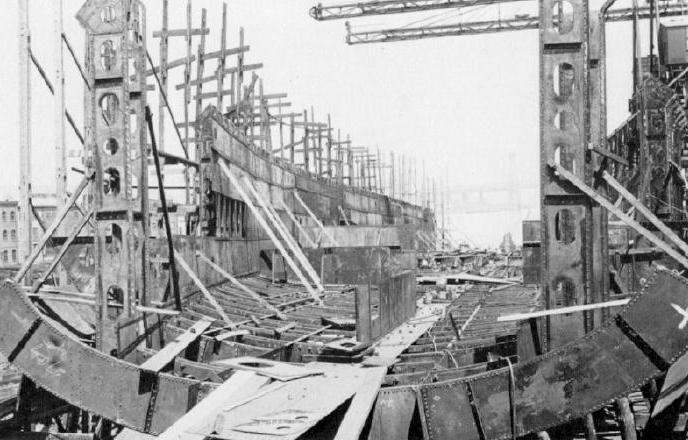
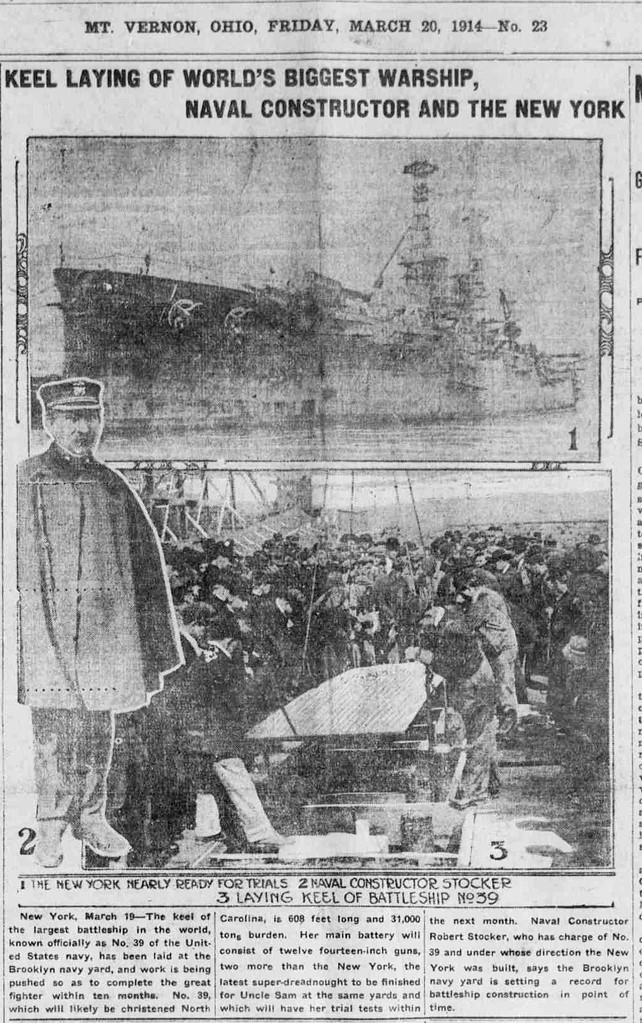
KEEL LAYING OF WORLD’S BIGGEST WARSHIP, NAVAL CONSTRUCTOR AND THE NEW YORK (BB-34).
The keel of the largest battleship in the world, known officially as No. 39 of the United States navy, has been laid at the Brooklyn navy yard, and work is being pushed so as to complete the great fighter within ten months. No. 39, which will likely be christened North Carolina, is 608 feet long and 31,000 tons burden. Her main battery will consist of twelve fourteen-inch guns, two more than the New York, the latest super-dreadnought to be finished for Uncle Sam at the same yards, and which will have her trial tests within the next month. Naval Constructor Robert Stocker, who has charge of No. 39 and under whose direction the New York was built, says the Brooklyn navy yard is setting a record for battleship construction in point of time. (USS Arizona with special torpedo protection design)
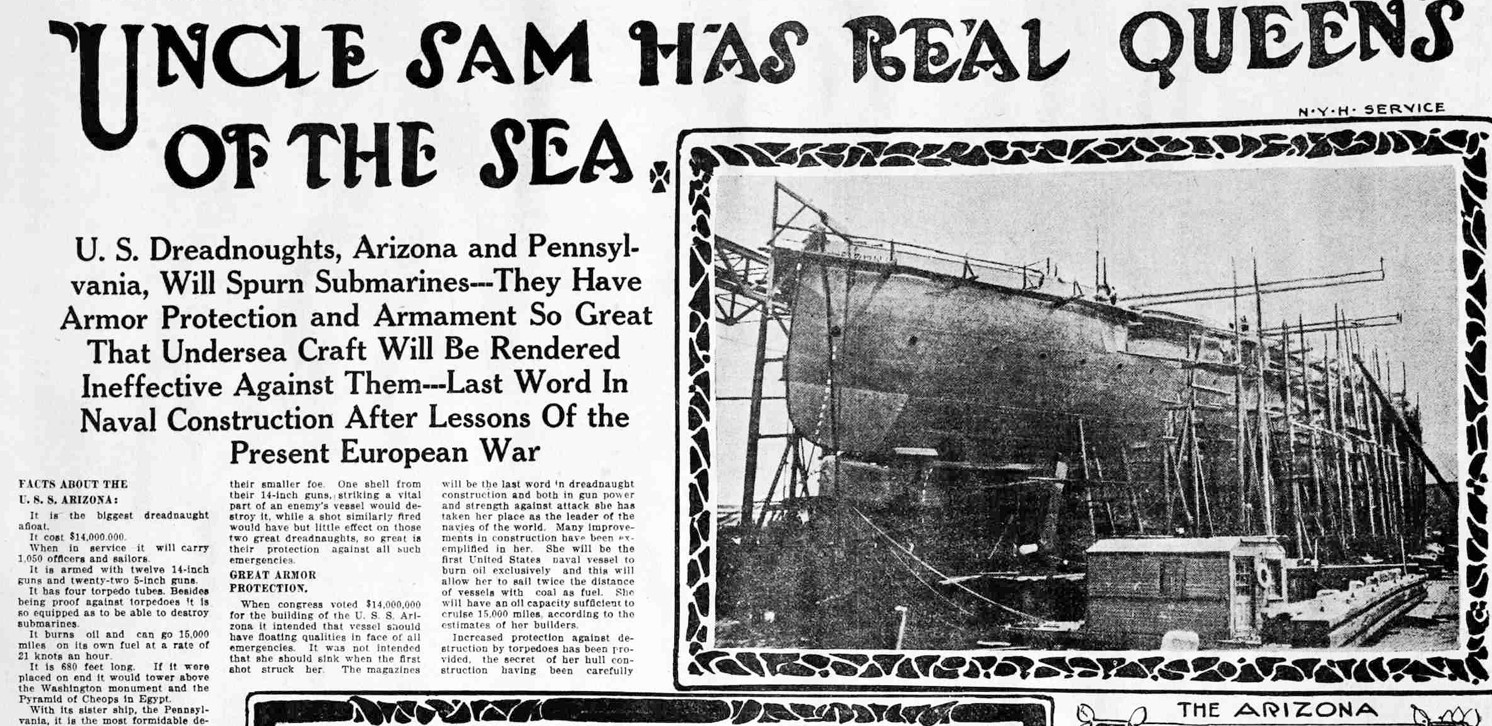
UNCLE SAM HAS REAL QUEENS’ OF THE SEA
S. Dreadnoughts, Arizona (BB-39) and Pennsylvania (BB-38) Will Spurn Submarines
They Have Armor Protection and Armament So Great That Undersea Craft Will Be Rendered Ineffective Against Them
Last Word In Naval Construction After Lessons Of the Present European War
Then the war came to America
https://askus.thehenryford.org/researchguides/faq/203168
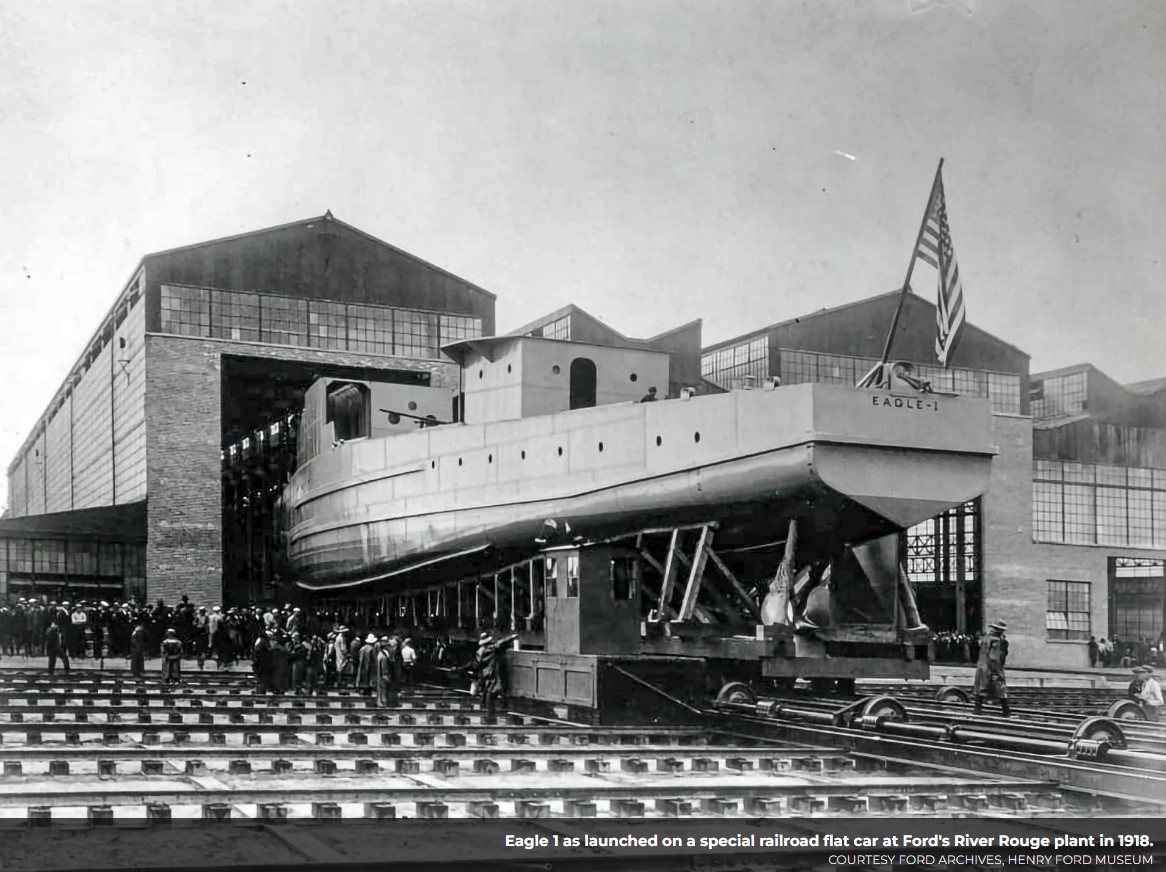
Eagle Class Boats
In the summer of 1917, Henry Ford was invited to Washington by President Woodrow Wilson who hoped to induce him to serve on the U. S. Shipping Board. Ford discussed with Edward N. Hurley, Chairman of the Board the possibility of applying his mass production knowledge to solving the ship shortage problem; he accepted membership on the board on 7 November 1917.
As losses to submarines increased, it was felt that a new design of ship other than destroyers, should be developed for antisubmarine detection and warfare.
Commander Robert Stocker, under the capable direction of Admiral P. W. Taylor, worked out the hull design, while Commander S. M. Robinson, in close association with Admiral R. S. Griffin and Admiral Dyson, designed the power plant. Henry Ford’s particular contribution to the design was limited to his suggestion that the Navy use steam turbines instead of reciprocating engines. He also suggested the use of flat hull plates so as to be able to take full advantage of mass production methods.
What is not in the article was the amount of credit that Admiral Taylor would take for the work that was done. Stocker would be a footnote in history despite his impressive record and contributions. I have found in my many years that this is more than often the case.
Praise for Robert Stocker.
“We were also told that Admiral Benson of the United States Navy who had been in Chicago during the millers’ national convention, spoke in the highest terms of Assistant Naval Constructor Robert Stocker, a former New Ulmite. Practically all the naval construction during- and immediately preceding the World war was under the supervision of our Robert Stocker, but the man above him in rank got the credit. Robert is another one of our New Ulm boys who hides his light under a bushel.
New Ulm review., July 13, 1921, Page 8
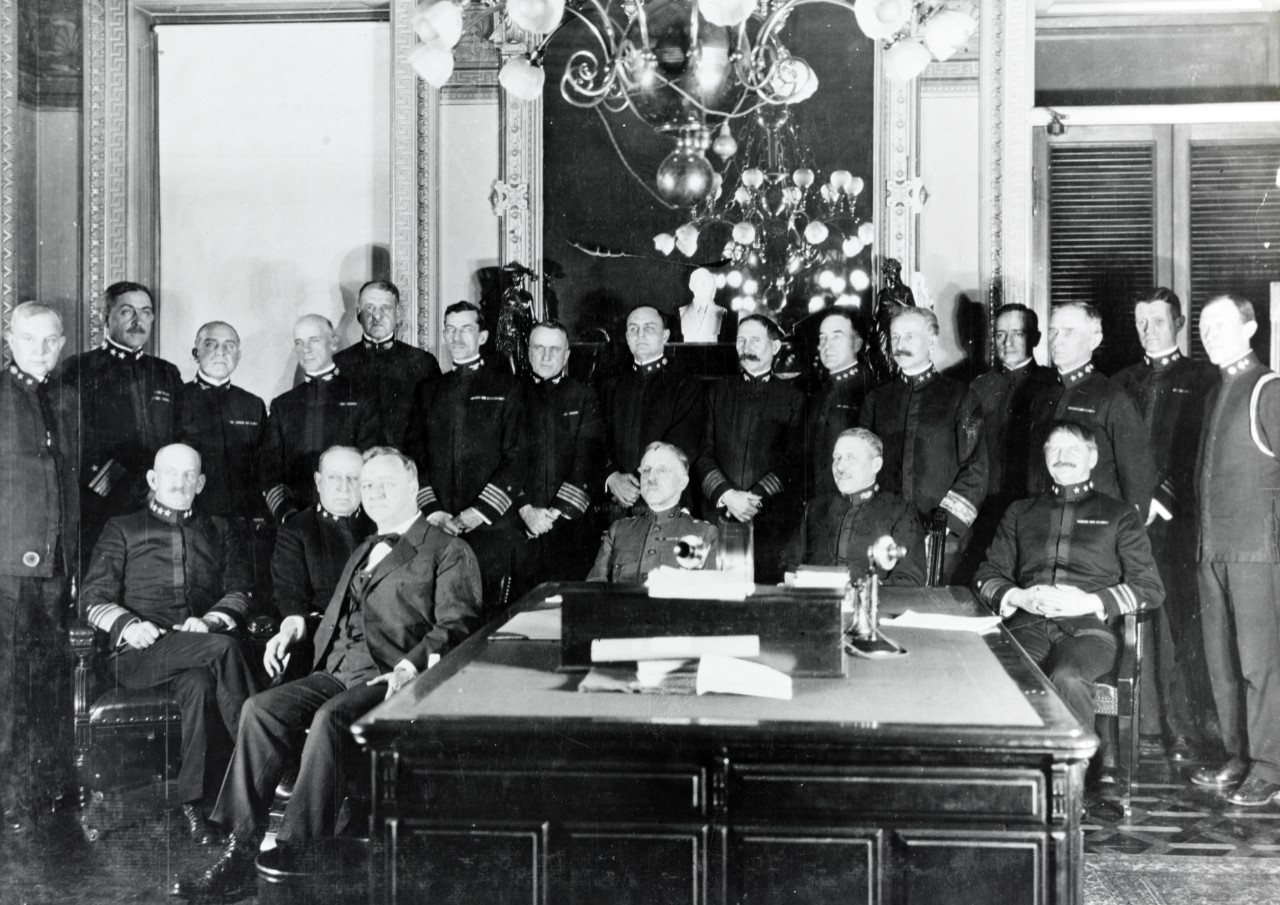
Title: Council Meeting held in Army and Navy building, Washington, D.C.
Caption: Seated left to right: Admiral Henry T. Mayo, Admiral Hugh Rodman, Honorable Josephus Daniels, Secretary of the Navy, Major General George Barnett USMC, Captain William V. Pratt, Admiral Robert E. Coontz. Standing left to right: Rear Admiral William C. Braisted, Rear Admiral Victor Blue, Captain H.H. Christy, Captain Frederic B. Bassett, Captain Charles B. McVay, Jr., Captain Louis M. Nulton, Captain James H. Dayton, Rear Admiral Samuel J. McGowan, Captain Robert Stocker, Rear Admiral Ralph Earle, Rear Admiral Charles W. Parks, Captain Elisha Theall, Rear Admiral J.S. McKean, Commander Percy W. Foote, and Commander Frank B. Freyer.
Description:
Catalog #: NH 57303
Copyright Owner: Naval History and Heritage Command
November 25, 1919, Tragedy strikes the family.
FLIER DROPS TO DEATH WHILE TESTING PLANE
Lieut. Robert Stocker of Washington is Killed at Philadelphia. PHILADELPHIA,
Lieut. Robert Stocker, of Washington, and Fred Thompson, of Dover, Maine, a civilian aeronautic inspector, were drowned yesterday when a naval airplane, piloted by Stocker, dropped fifty feet into the Delaware river below Chester. Pa.
The cause of the accident has not been determined, as the navy officials who visited the scene of the accident were unable to ascertain whether the airplane had struck an air pocket or whether some part of the machine had failed to function properly, thereby causing the crash. The men were testing the machine. The bodies have not yet been recovered. Mrs. Roberts, wife of Capt. Robert Stocker, of the Bureau of Construction and Repair, Navy Department, and mother of Lieutenant Stocker, was informed of her son’s death soon after the accident. Captain Stocker, who left Washington recently for a Western trip, will return immediately to make arrangements for the funeral following the recovery or the bodies.
Lieutenant Stocker, who was twenty-two years old, was known as one of the premier fliers of the United States navy because of the excellent record he made as aerial patrolman over the North Sea during the war.
During the war Lieutenant Stocker nearly lost his life in a seaplane crash while on coast patrol duty over the North Sea. Both his arms were broken in this accident, and he was confined to a naval hospital in England for several weeks. He was able to resume his flying before the close of hostilities and returned to this country soon after the signing of the armistice. He had been in active service up to the time of bis death and had done a good deal of test work. He was one of the most widely known of the United States naval aviators on foreign duty. Lieutenant Stocker Is survived by His parents and a younger brother. Jesse Stocker.
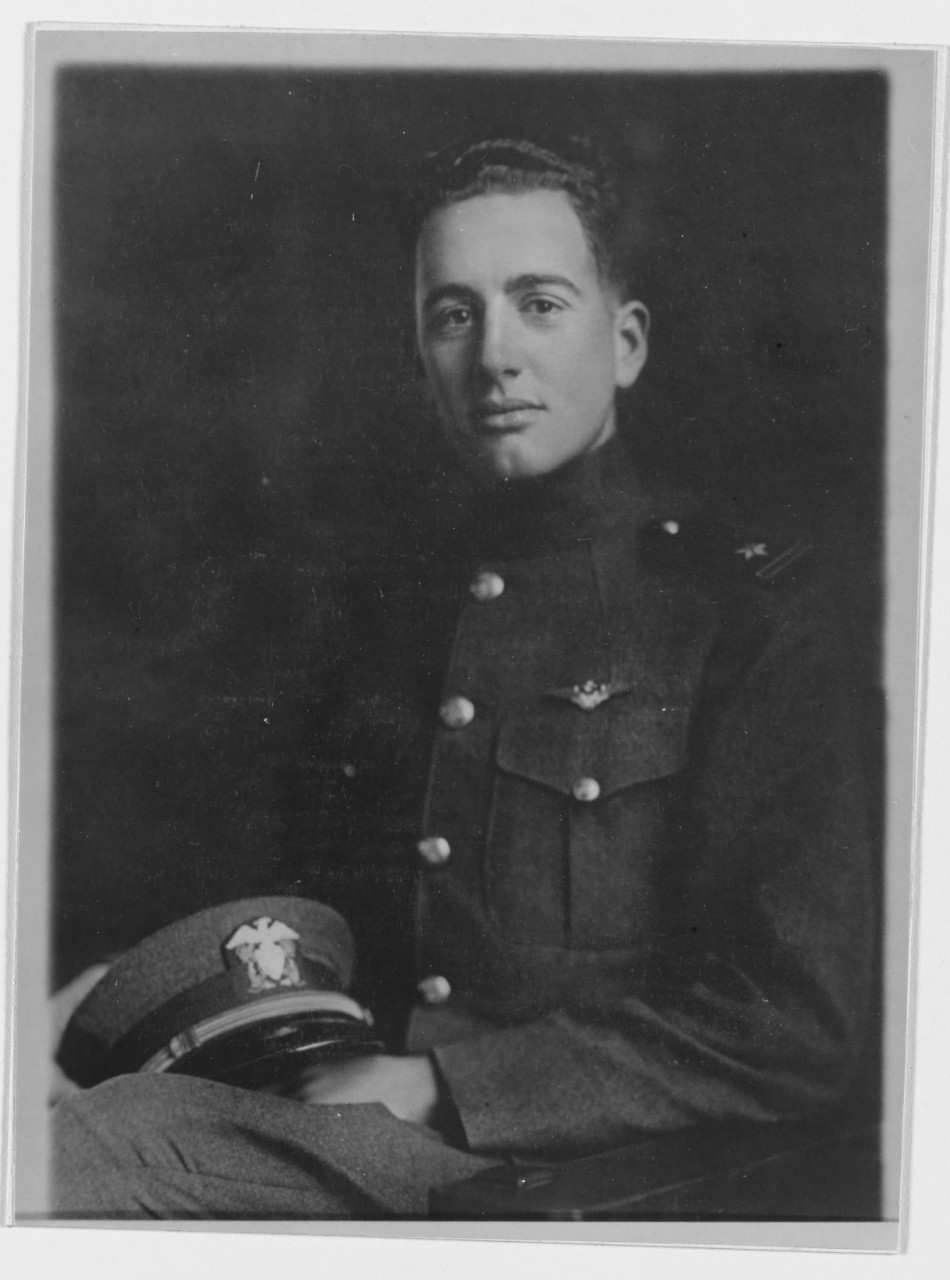
NH 44393 Ensign Robert M. Stocker USN Reserve Force
Ensign Robert Maury Stocker Junior.
United States Naval Air Service 20th September 1897 – 24th November 1919 on attachment to No. 214 Sqn RAF 8th-23rd July 1918 Members of the United States Naval Air Service (USNAS) were attached to No 214 Squadron in June and July of 1918. Ensign Stocker was one of those American personnel. He was attached to No. 214 Squadron for less than two weeks. According to the Weekly Returns of 5th Group Officers and Pilots, Ensign Stocker arrived between the 8th and the 15th July and had been posted out by the 23rd July. USNAS personnel were attached to No 214 Squadron because the Americans were planning to set up their own strategic bombing force during WW1, called the Northern Bombing Group, flying DH4s as day bombers and Italian Capronis as night bombers.
On the 17th July 1918 Ensign Stocker was flying in the rear cockpit of HP 0/400 C9646 on a day time training mission. The pilot was Lt. D. R. Tullis and the Observer was Lt. R. Binckes. C9646 started its take- off run but failed to leave the ground properly and crashed nose first, almost turning over on it’s back, and completely destroying the front cockpits of the plane. Tullis and Binckes were thrown out of the plane. Binckes broke his spine but fortunately Tullis was uninjured. Stocker may have been injured in the crash and suffered concussion.
Ensign Robert Maury Stocker Jr of the United States Navy Air Service (USNAS) was born on 20th September 1897. He was born into a naval family and his father was a Captain in the US Navy who would retire as a Rear Admiral in 1937. Robert Stocker qualified as a naval pilot at Hampton Roads in Virginia in November 1917.
Robert Maury Stocker was US Naval Aviator No 141 and his aero certificate is dated 18th December 1917 and signed by the then Secretary of State for the US Navy, a certain Franklin D Roosevelt.
Very shortly after the crash of C9646 Stocker appears to have transferred from No 214 Squadron to a US Navy bombing unit that was part of the Northern Bombing Group. Binckes and Stocker probably already knew each other before transferring to No 214 Squadron. Both men had previously been at Stonehenge at the No. 1 School of Aerial Navigation and Bomb Dropping, possibly at the same time. They had a mutual friend in Lt. Leslie Semple who was also a Handley Page pilot with No. 207 Sqn. Leslie Semple kept a diary and was a keen photographer. His diary, log book and some photos are now part of the IWM collection. Semple’s diary entry for July 23rd 1918 mentions the crash of C9646… ‘
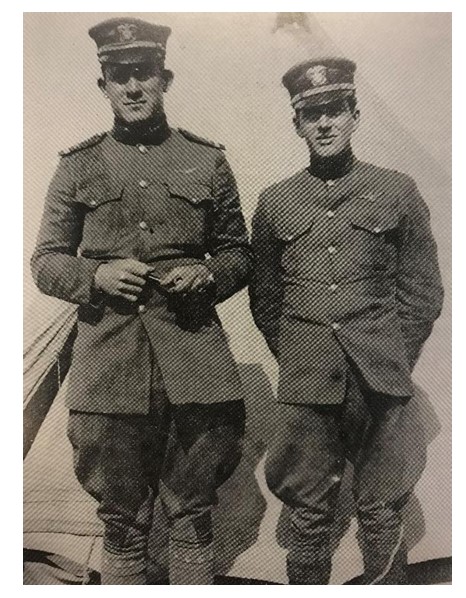
Ensign Stocker, another chum of mine, was also in the bus and he received concussion’ Ensigns Taylor (left) and Stocker (right) of the USNAS. The photo was taken in the tented night flying camp on the Stonehenge Airfield. IWM HU 38995. The only Northern Bombing Group night raid was made on 15 August 1918 by a single Ca.5 bomber, B-5, to Ostend; but seven United States Navy pilots and about 40 enlisted men participated in several raids flying two No. 214 Squadron RAF Handley Page bombers from St Inglevert.
Robert Stocker served with distinction until the Armistice and was awarded the Naval Cross. His medal citation reads….‘The President of the United States of America takes pleasure in presenting the Navy Cross to Ensign Robert M. Stocker, United States Navy (Reserve Force), for distinguished and heroic service as an Aviator of land planes attached to the Northern Bombing Group in active operations co-operating with the Allied Armies on the Belgian front during September, October and November, 1918, bombing enemy bases, aerodromes, submarine bases, ammunition dumps, railroad junctions, etc.’
Tragically, having survived the dangers of active service in France, Robert Maury Stocker was to die in a flying accident only a year later on November 24th 1919. His plane, a Briggs F Boat, A5255, crashed into the Delaware River. Stocker and the other crew man died. Unfortunately, Stocker’s body was not found for a further four months on 19th March 1920.
Funeral of Robert Stocker Jr. ‘Remains of young aviator were found yesterday in the Delaware River’ ………..Lieutenant Stocker, who distinguished himself by saving two men after his arms were broken in France, was a naval aviator at the time of his tragic death. He was making an exhibition flight when the big seaplane fell into the water, killing Lieutenant Stocker and his companion. Although a search has been constantly made for the body the remains were only found yesterday. ………Lieutenant Stocker graduated from the Hampton high school and had joined the aviation corps when the call came for troops. He went to France and was in the flying corps about a year, when his machine fell and his arms were broken. Two of his companions were badly hurt, and the machine caught fire. Lieutenant Stocker heroically saved his companions by pulling them from the burning machine. He was 22 years old.
Extracts from Robert Stocker’s Funeral Notice and Obituary. The Daily Press March 20th 1920
A Visionary Again
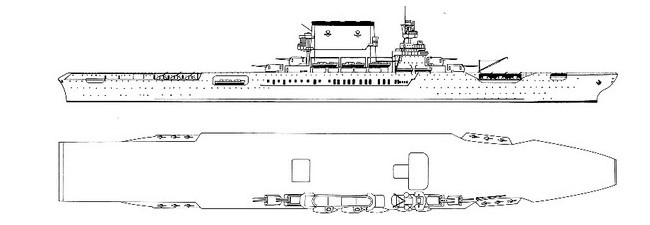
With the Washington Naval Treaty limiting the size and number of battleships and Battle Cruisers, a need to adapt to other resources was needed. One idea that came about was shift some of the battle cruisers to aircraft carriers. Aircraft at sea was becoming a reality even amongst the harshest of the old-line critics. Battles of the future would need to have eyes in the skies which would project the power of the battle fleets. So, Stocker’s skills would once more pave a pathway to a unique answer to a problem.
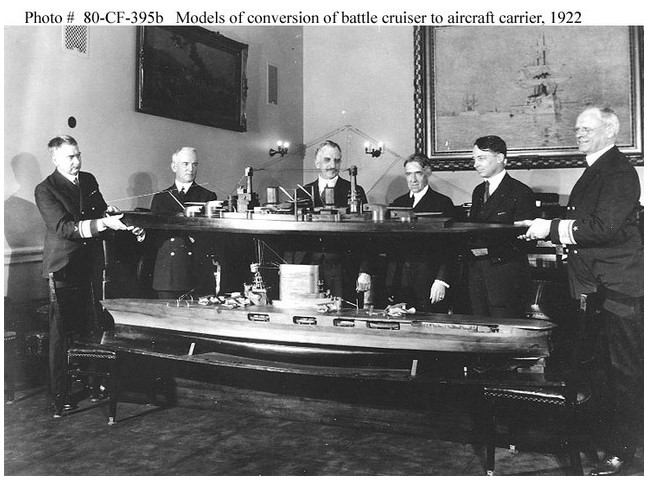
Robert Stocker, Chief of Preliminary Design, ordered a study of the conversion of one of the battle cruisers into an aircraft carrier. Preliminary carrier designs had become ever larger during 1919-1920 until they were close to the size of the battle cruisers which had just been laid down: as a design exercise, Stocker’s order was timely. Lexington (CC-1) had her keel laid Jan.8, 1921 and was 33% complete when the change to the carrier design was authorized; Saratoga (CC-3) had her keel laid Sept.25, 1920 and was 34.5% complete when taken in hand for conversion to a carrier. When they emerged five years later, they were unlike any other warships on earth, their turbine-electric machinery being only one of their unique features.
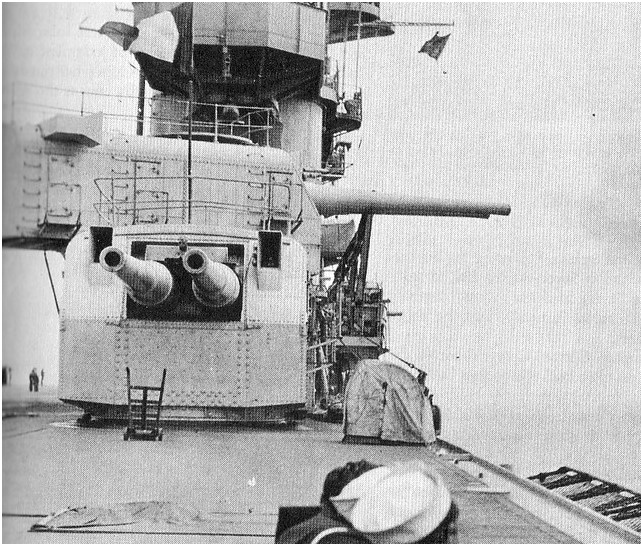
December 7, 1941 – Pearl Harbor
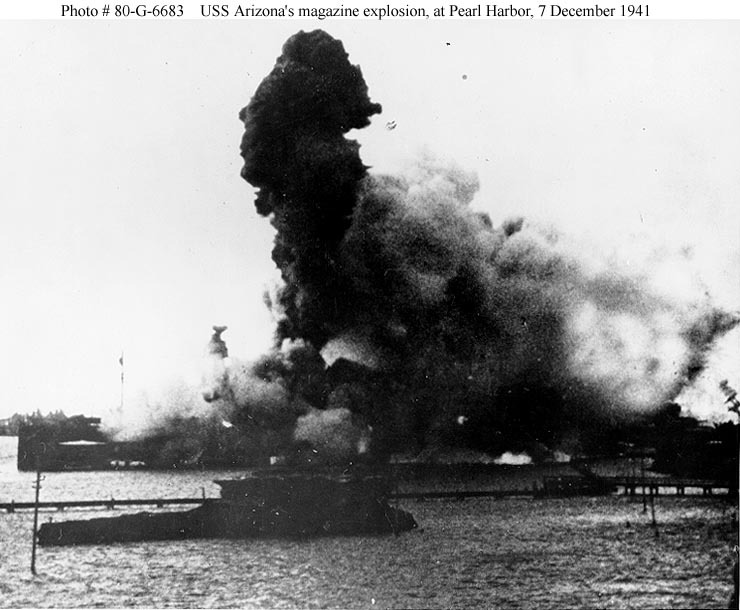
The death of the Arizona (BB-39), 0805, 7 December 1941. The forward magazines of Arizona explode after she was hit by a Japanese bomb, 7 December 1941. Black and white photo from a picture taken from on board Solace (AH-5).
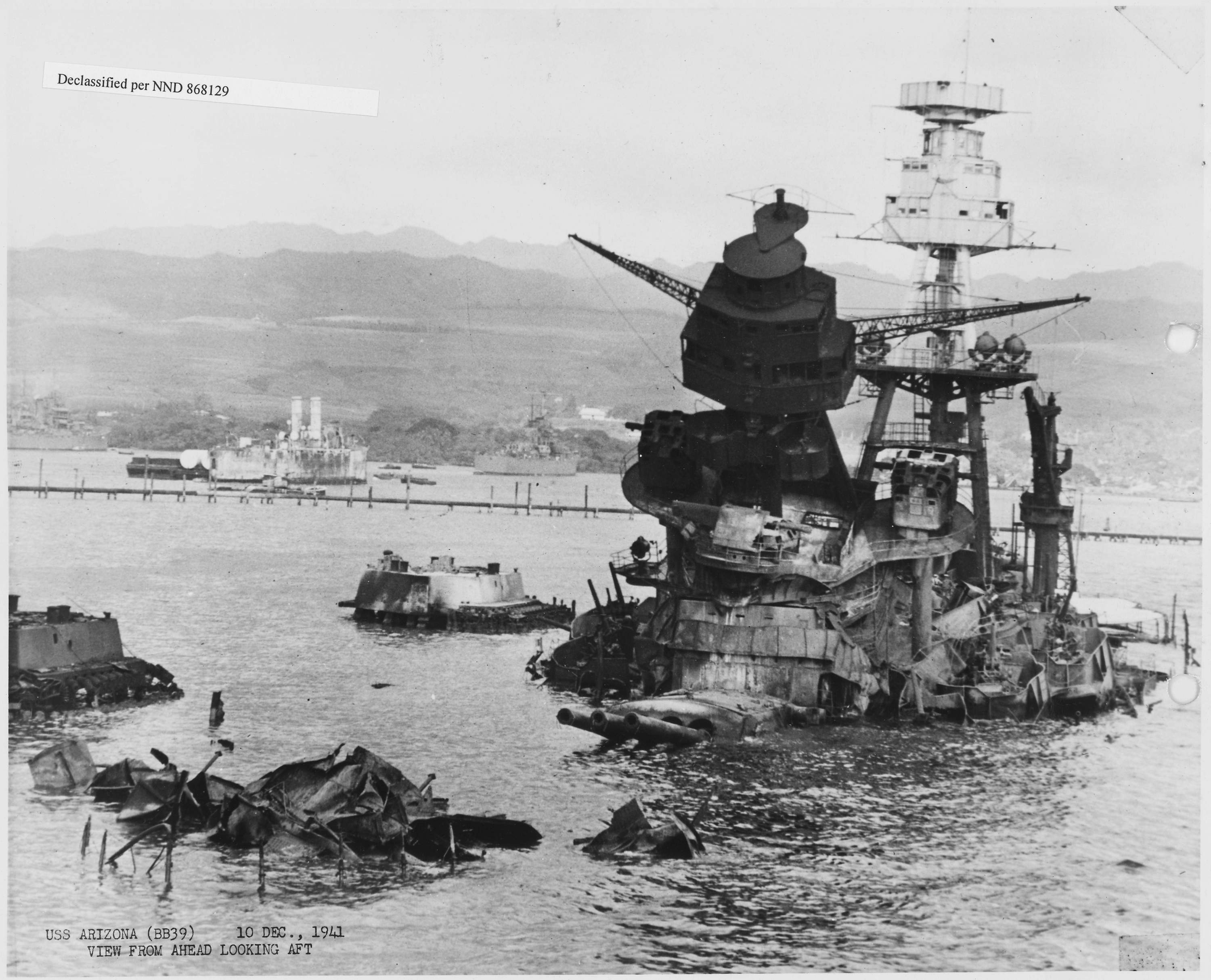
Without most of the battleships, the need for a new type of warfare would be needed.
The most influential ships in the coming months would be the aircraft carriers. Without the vision that Robert had in the 1920’s the successes of the early 1940’s would have possibly had a different outcome.
With the exception of the Arizona (which was pt out of commission by bombing and not torpedoes) most of the rest of the fleet was able to be brought back to life and fight again. But Stocker’s contribution should never be forgotten.
He died before he could see the war to come. But his inputs were surely felt as the country fought its way back from Pearl.

 theleansubmariner