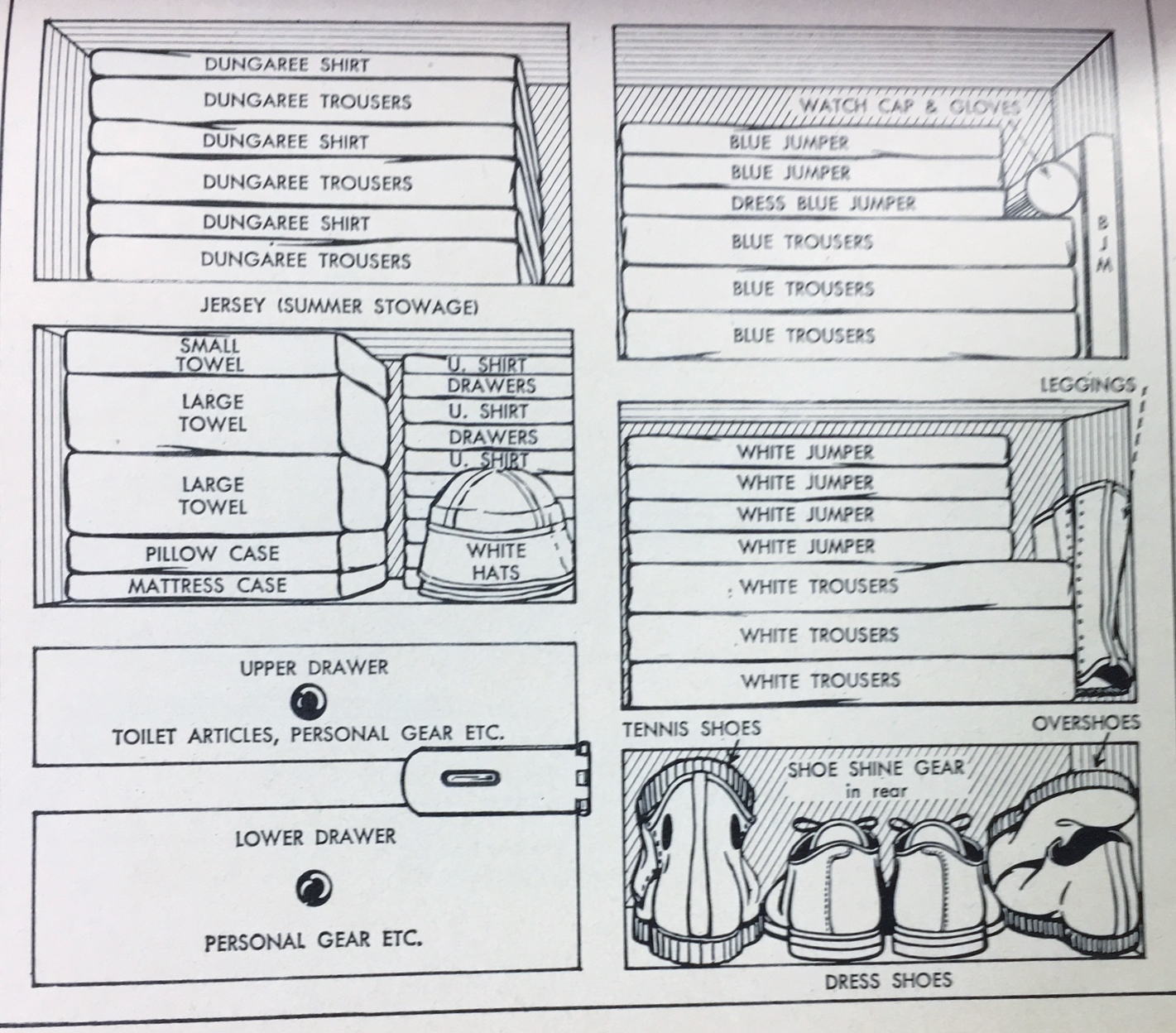
In 1972, one of the first things that happened after getting my first official navy haircut, I stood in a long line of civilians that was about to be issued their first seabag. It was the third week of June and Great Lakes was unseasonably cold. Living next to one of the Great Lakes was a sure-fire way to get an early exposure to Lake effect anything. I seem to remember saying some unkind words about my recruiter who promised me I would go to either Orlando or San Diego for Boot Camp. Imagine my surprise when they issued me a ticket to Great Lakes Illinois.

But here we were in line to receive what would be the necessary items for the next few months and beyond. We were first issued a green bag that rumor had it would actually be able to contain four seasons worth of government issued apparel. I was a bit skeptical but down the line we went, piling blue, white and black items into the bag. The white hats went on top of our heads (all of them at once) and a ditty bag filled with all manner of toiletries that would keep us squared away and clean.

The last thing we were issued (or at least near the end) was the Bluejackets Manual, Eighteenth Edition, copyright 1969.
Master Chief Petty Officer of the Navy Delbert D. Black (Master Chief Gunners Mate) informed us in the very first few pages that:
“The Navy is a man’s job. It requires courage, dedication and daring. Navymen have a proud tradition of heroism in all conflicts. As Navymen today, you have an unparalleled opportunity for service to our country. Our nation’s security depends in large part on you – the American Bluejacket. You don’t have to carry a placard or poster to show courage or dedication to your cause. Your uniform is evidence of your dedication and sacrifice. Wear it proudly, for you are the Navy’s greatest single asset and it’s most valuable weapons system.”
Sorry to my female friends. I’m sure the Master Chief meant no harm.
Now I will admit, I probably did not read and understand those words at the time the book was given to me. There were many chores to accomplish in those early days. All of my life up to that time, I was not aware that there was a proper way to stand and a proper way for all of us to answer the questions of the Chief who was in charge of our unit. But in very short order, I began the lessons that would help me to understand that now that I was becoming a Bluejacket, I had to understand my place in line.
The discipline of lines and other things
Back in those days, in addition to the seamanship and technical classes we attended, they also taught us naval history and traditions. We were taught that those traditions had helped former bluejackets to overcome tremendous odds. The country fought for independence from Great Britain with a very limited presence on the high seas. John Paul Jones took the opportunity to teach a more powerful British force a lesson that resonates to this day. But the unspoken part of those early battles was the part of the common sailor. As important as it was to have a man of great courage like John Paul Jones, it was equally important for there to be men willing to do their part to ensure the guns were able to be brough to bear when needed.
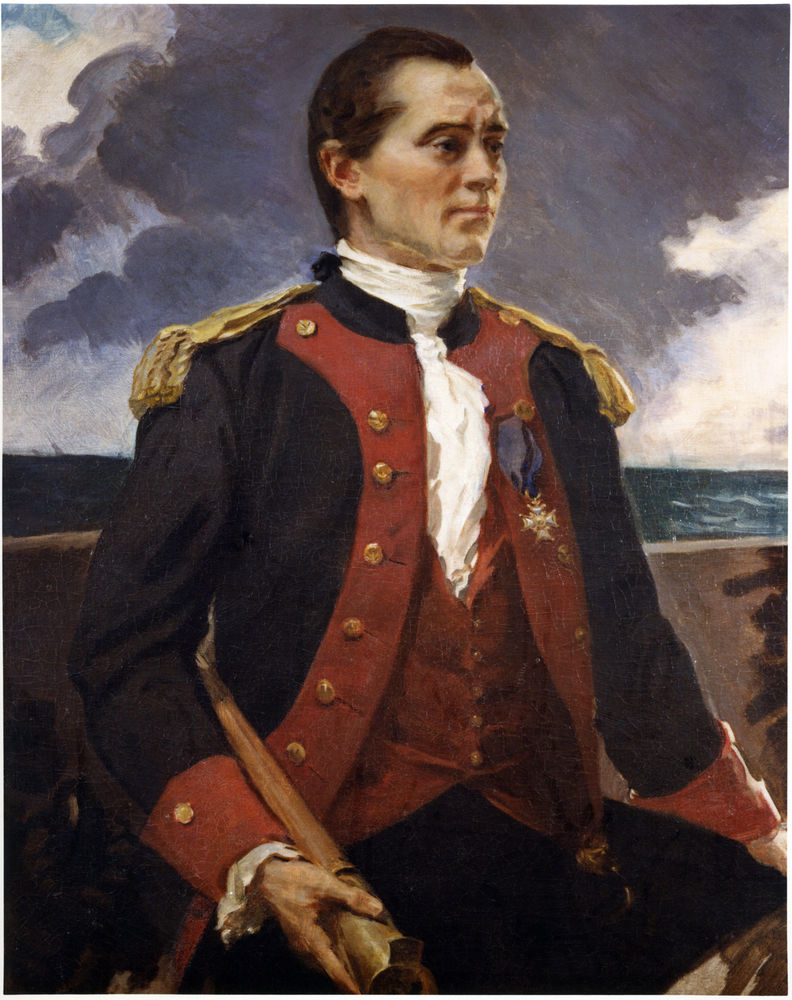
The bluejacket had to understand the discipline of battle but also the discipline of being ready for the battle. The decks needed to be kept as clear and clean as possible so as not to impede the gunners when the action began. And by clean, I mean spotless and free from any gear adrift. Anything not in its place cold spell disaster on a rolling deck in a battle.

Later battles would teach the importance of hygiene and proper uniforms. Wounds in battles are common and those wounds could lead to infections. Infections in a day when there was limited medicine and virtually no antibiotics could compound the casualty and lower the amount of fighting resources when they were needed most. Clean uniforms were also important since they could also carry disease and infections in a chaotic situation. This tradition began early in the navy’s long life and with each passing generation the importance of even the most trivial detail became exaggerated. It all had a purpose.
Another long tradition with the navy as with all of the services is standing in line.
Everywhere we went from the first day, we were taught that there was a line, and we had our place in that line. Whether it was receiving our first uniform issue or waiting to receive our delicious meals, you quickly learned that there was a process, and you were just one part of the line.
The line had to be straight and uniform. There was a vulgar phrase that we heard more than once in boot camp that described how tight the line should be. The expression “nuts to butts” was the rallying cry. Although I do not remember being that physically close Seaman recruit MacMann, the point was not lost on us that we were supposed to maximize the us of space in the Petty Officer’s line. Within a short period of time, it became clear that every person in the line would be fed and that the navy had a seemingly endless supply of food. The ominous sign and warning by the cooks were ever present though: “Take all you want but eat all you take” was another one of the navy’s learning points. I can honestly say that besides some really unpleasant mid-rats on one submarine, I never threw food away. To this day I still refuse to eat Pork Adobo.
My favorite old serviceman’s joke had to do with lines:
A grisly old Master Chief (insert Sergeant Major here) had just finished chewing out his crew for the fifty-nine millionth time. They had failed to meet his expectations once more and he had them repeat the five-mile run once again. At the end of the run, he went over to a bent over Seaman Schmucatelly and said, “I’ll bet you can’t wait for me to die so you can come and piss on my grave.” Seaman Schmucatelly looked up and him and said, “Not a chance Master Chief”. The Master Chief was surprised but brief idea that maybe Schmucatelly , out of all the lads, was finally going to be thank him for instilling pride and discipline in the boys. Quizzically, he asked “And why is that Schmucatelly?” The lad responded “well, I’ve been standing in line for my entire time in the Navy and I’ll be damned if I’ll stand in that long of a line after I’m a civilian.”
Throughout the rest of my enlisted career, there would be many more lines. On board the submarine, the discipline of understanding one’s place in line became obvious. Space onboard a ship or submarine is limited, and situations can change quickly. More than once, a casualty or drill would happen during mealtime and the need to move quickly to confront the casualty was greatly aided by the structured way we had been positioned. Loading stores required the use of lines too and that internal discipline was important for an orderly execution. I had my place in line. Although on a submarine, there were places in the line that were not always easy, you did your best to not let the team down. I particularly did not like being in the middle of the truck leading down to the galley. But we shared and rotated to make sure no one got too tired.
But in all of those years, I never really questioned my place in line.
Okay, I might have grumbled a little bit. Especially on the nights they served shrimp and lobster.
I took some time to make Petty Officer. A short break in service taught me that rank was a better way to gain better conditions so my climb through Petty Officer to Chief was much quicker. I earned as I learned. I took on some additional work and collatable duties. I volunteered for back-to-back sea tours. And when the day came that I put on my Commissioned Chief Warrant Officer uniform, I was grateful for all of the discipline that I had learned over the years. It was nice to be nearer the front of the line.
Society today
Having lived through a structured organization like the navy, I am not as patient with what I see around me today. People have grown tired of being patient and waiting their turn in lines of any kind. Our culture encourages everyone to abhor lines of any kind. Everything needs to be “right now” and have no preconditions. Someone close to me received a fine education and had endless opportunities in front of them. But when faced with a menial assignment and a long path to the corner office, they chose a path that led to the most tragic consequence. The shock then and the long-term effects on those left behind has resonated for a very long time.
This is happening too often in this day and age.
In 2021, suicide was among the top 9 leading causes of death for people ages 10-64. Suicide was the second leading cause of death for people ages 10-14 and 20-34. Contributing to this number is the large number of men and women who have returned from the decades long wars we have been involved with. I can only imagine the contributing factors for this large number, but I would suggest that as a society, we need to place more emphasis on this calamity than any real or imagined problem with DEI.
Maybe one of the things we need to bring back is the value in learning that there is no place to understanding that there is value to every life whether you are in the front, middle or back of the line. Maybe the old-fashioned notion that we all have to start someplace needs to be reintroduced. Maybe the thought that teaching our kids that they can be anything and everything can be tempered a but with some realistic goal settings and introduction to self-discipline as a way to advance.
I’m glad I lived in a day and age where structure was still taught. I’m also glad I’m at the portal of my seventh decade and will not have to see the deterioration for that much longer. Maybe, just maybe, we will have a collective epiphany and stem the slide into a Romanesque ending. I do believe that the barbarians are at the gate waiting for that day.


 theleansubmariner
SIR, YES SIR!!! 64 and a wake up!
I had to laugh out loud at your comment about Pork Adobo. One time it was pink. Not sure how the cook did that…
But yep, learning how to stand in line (and it being OK to wait) was definitely one of the many great things I learned as a younger man than I am now. And something too many people don’t seem to get now.