A new era
In 1959, the United States was about to fast forward its submarine program. The nuclear program was well under way and the ballistic missile submarine program called Polaris was in full swing. Congressional reports at the time talked about the mounting Soviet threat. The Soviets had also developed a number of shipyards and were trying to become a blue water navy. In 1959, both sides of the Cold War were heating up. Even though the Soviets were still primarily building diesel submarines, they were also making a strong entry into the nuclear power race. Their main advantage was sheer volumes of boats they could put to sea. They also had invested in a lot of shipyards. So America relied on quality and technological advances. This would continue for the next sixty years.
One of the most important things for our military was recognizing how to recognize submarines and catalogue them. I spend a lot of time researching submarine history so was pretty excited to find this little gem at the Hathi Trust on-line collection. I’ve used the collection for years to reference unique submarine stories and they certainly have some of the best materials possible.
Today’s find was the Submarine Recognition Manual (approximately 1959). It’s a pictorial way to show the progression the US Navy was undergoing at the time. Using screen shots, we can walk through what was going on in that progression.
https://babel.hathitrust.org/cgi/pt?id=uc1.a0005487343&seq=1
Washington, D.C. : U.S. Govt. Print. Off., 1959
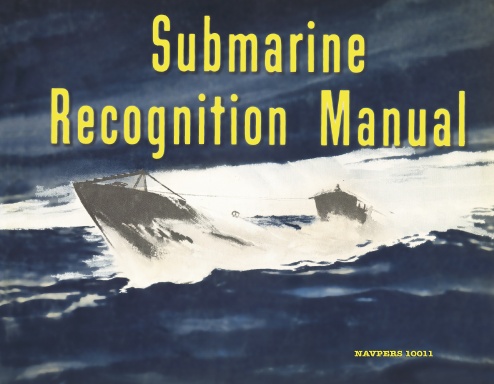
NAVPERS 10011
I have been writing about submarines for more than 12 years so trust me when I tell you that I have seen a lot of pictures of boats of all generations. What struck me first about this manual was the appearance of the submarine coming out of the ocean or maybe just riding on the top in a heavy sea. The picture looks an awful lot like a WW2 German submarine. The bridge looks like it came right out of Das Boot although the artist did a good job at obscuring the deck gun. If I am wrong, let me know. I just thought it was odd to see that on a NAVPERS Manual cover.
By the way, if you do a title search online, you can actually find copies of this for sale. One that I saw was about $55.00 in pretty good condition. I have been told by CMO (Chief of Mister Mac Operations) that I need to begin downsizing so I won’t be purchasing too many more books. None of my nephews have expressed much interest in the library I have so the books will probably end up in a pawn shop or antique store in Western Pennsylvania.
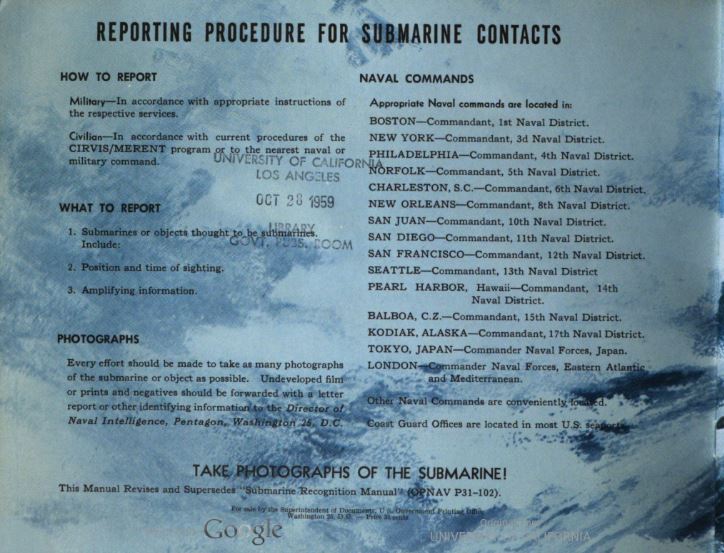
How to report
The first paragraph about military reporting was pretty understanable meaning use the appropriate chain of command. But the second paragraph talked about civilians using the CIRVIS/MERRENT Program. Those required a bit of searhing. From a declassified docuent published by the NSA:
GENERAL DESCRIPTION AND PURPOSE OF COMUNICATION INSTRUCTIONS FOR REPORTING VITAL INTELLIGENCE SIGHTINGS (CIRVIS)
- PURPOSE
The purpose of this publication is to provide uniform instructions for reporting of vital intelligence sightings and to provide communication instructions for the passing of these intelligence reports to appropriate military authorities.
- Scope
a. This publication is limited to the reporting of information of vital importance to the security of the United States of America and Canada and their forces, which in the opinion of the observer, requires prompt defensive and/or investigative action by the US and/or Canadian Armed Forces.
The following are part of the lists of things rising to the level of interest of the military:
(a) Single aircraft or formations of aircraft which appear to be directed against the United States or Canada or their forces.
(b) Missiles.
(c) Unidentified flying objects.
(d) Hostile or unidentified submarines.
(e) Hostile or unidentified group or groups of military surface vessels.
(f) Individual surface vessels, submarines, or aircraft of unconventional design, or engaged in suspicious activity or observed in an unusual location or following an unusual course.
(g) Unlisted airfields or facilities, weather stations, or air navigation aids.
(h) Any unexplained or unusual activity which may indicate a possible attack against or through Canada or the United States, including the presence of any unidentified or other suspicious ground parties in the Polar region or other remote or sparsely populated areas.
I found it intersting that even as far back at the late 1950’s they were already starting to look for item (c)…

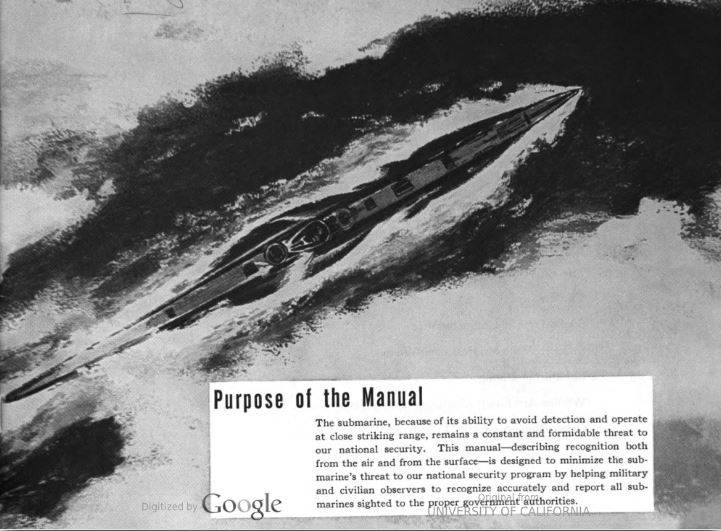
It was already becoming apparent that submarines operating around the coasts of the United States were problematic. Not only did the United States import and export many products and raw materials, but the vital military bases were exposed to surveilance from potential enemies. Finding and identifying potential bad actors was important for many reasons. This booklet would play a role in the ever expanding civilian air operations as well as shipping. Its hard to believe but we still had a large mechant marine presence that had not yet been bargained away by multi-national entities eager to squeeze out every dollar of profit, mostly at the expense of American flagged vessels. Good luck finding too many of those today.
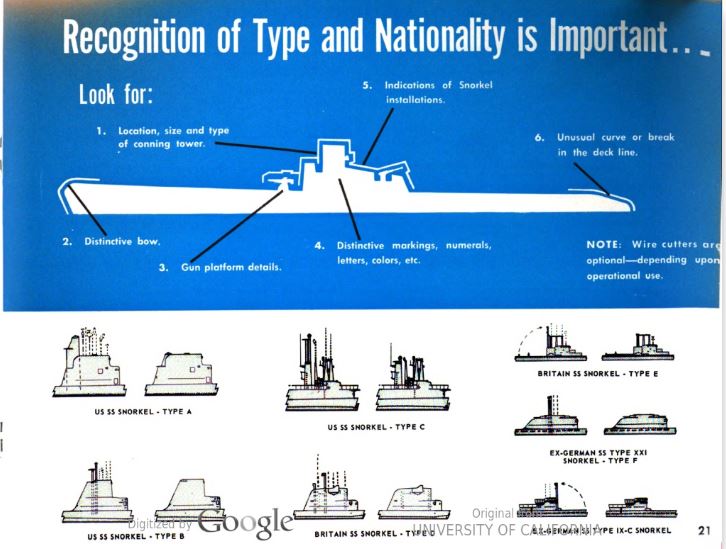
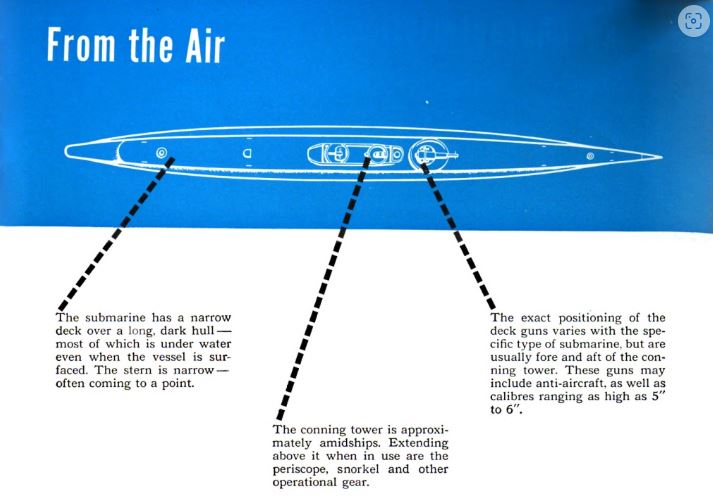
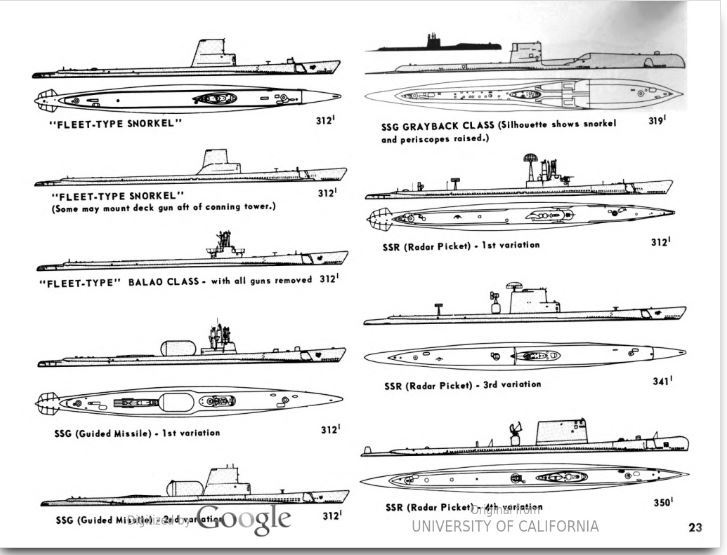
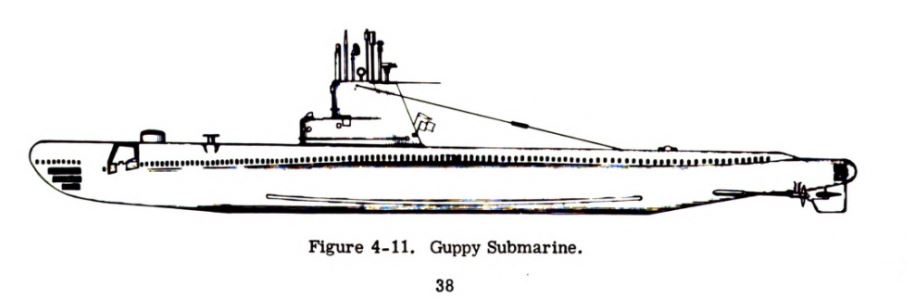
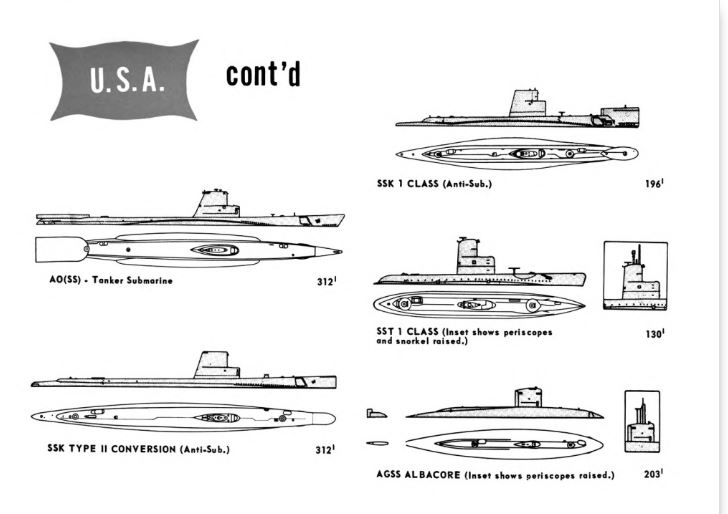
The line drawings show the transition of the types of submarines that were in our inventory in 57-59. The first picture in blue shows what a submarine with a gun on its deck would look like. This is certainly an older drawing since the guns had long since been removed from most US Boats. With the advent of the jet powered aircraft and missiles, the gun would actually be a very bad thing for a modern submarine. So would being on the surface in a major combat operation. While they were useful in World Wars 1 and 2, they would be bery useless. in the new age.

Here come the Nucs
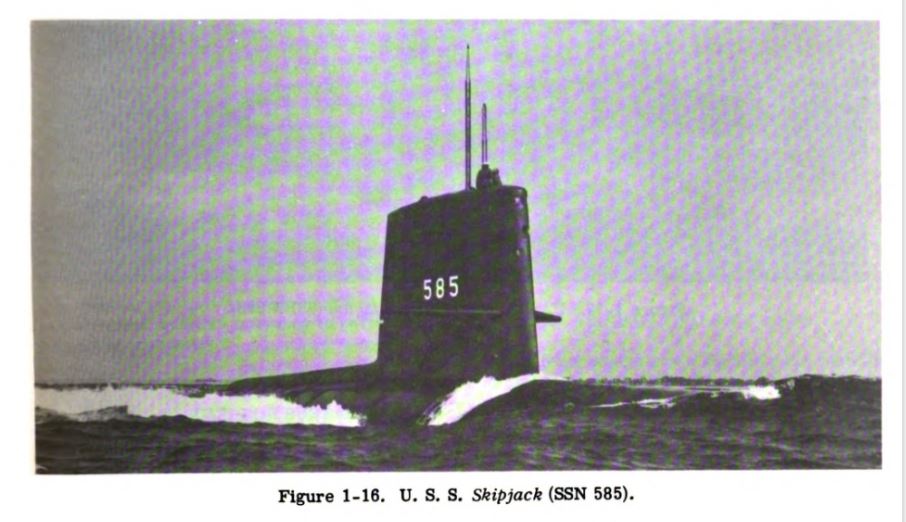
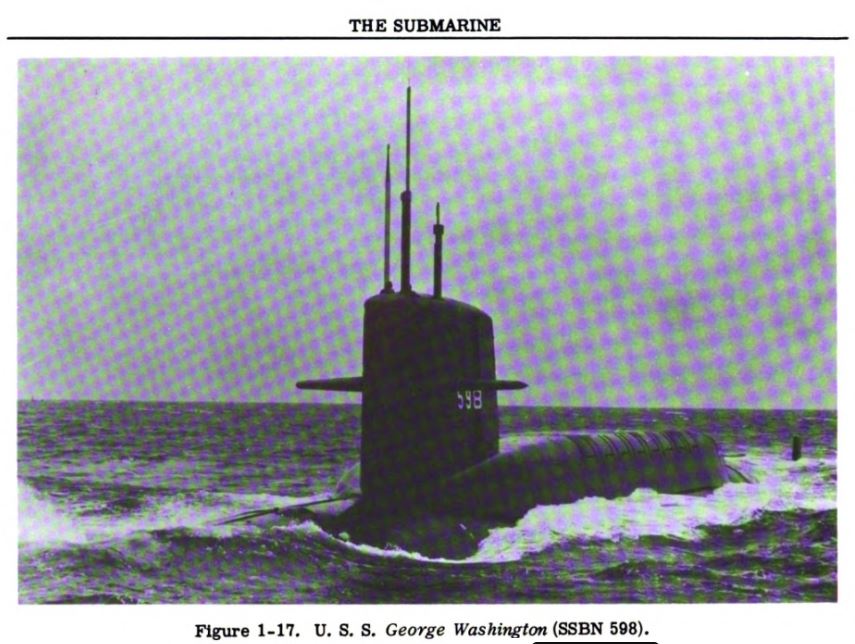
The 1957 version included the fledgling nuclear power boats. While most of the fleet still relied on diesel and stored power for their propulsion, the Navy was already expanding into the new age. Submarines with nuclear power became true submarines and could travel deeper and farther than most of their predecessors. By 1972, Ballistic missile submarines were one of the major forces in the navy if not the world. Their collective firepower rendered most of the traditional methods of delivering nuclear weapons nearly redundant. Missile silos could be easily found and heavier and more accurate missiles on both sides made them very expensive targets. Even the third leg of the triad (jet aircraft) proved increasingly vulnerable from advances in missiles and radar.
The coming of the more modern 688 and Virginia class submarines changed the game for large scale conflicts. The Ohio class with its advanced weapons eclipsed anything else in the ocean for their original purpose. Columbia will do so again when she comes on line.
But the real question now is will we have the right mix for the next major competitors? If a series of bad actors such as China, North Korea and Russia can unite the other rogue nations together, will we have the right counter to them?
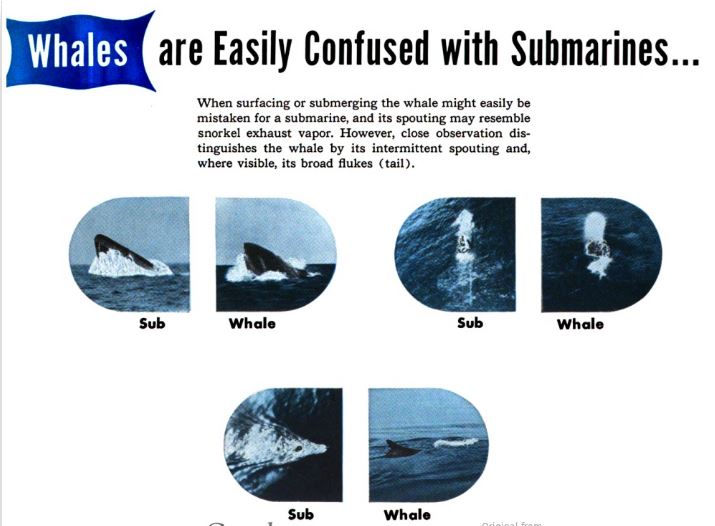
I included this last slide because it kind of struck me as funny. But I suppose if I was a fisherman off the coast of California, I might want to make sure of my sighting before I got the Pentagon all riled up.
Well, its been a while since I did a strictly submarine post. I hope you got something out of it. Make sure you let me know if you did.
Mister Mac


 theleansubmariner
As far as the US merchant Marine goes, much like everything else the government gets it’s hands on, the fees and taxes got so high nobody wanted to do business in the U.S.
good point as always my friend. I believe that will be part of our undoing
Mac