Hide and Seek at Sea
Ever since the launch of the Nautilus, advances in nuclear propulsion helped catapult the American naval efforts ahead of the rest of the world. Adding the technology surrounding the Polaris program was critical in answering a growing Soviet land and space program. From 1961-1962, the explosive growth of the fleet meant that the United States could enjoy a comfortable lead in this new technology.
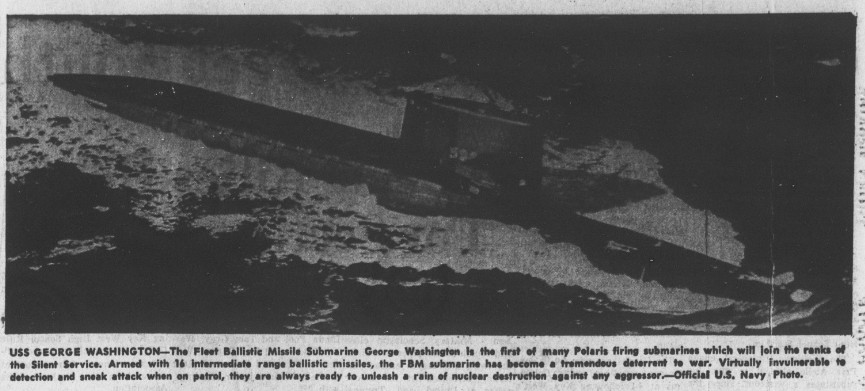
USS GEORGE WASHINGTON—The Fleet Ballistic Missile Submarine George Washington Is the first of many Polaris firing submarines which will join the ranks of the Silent Service. Armed with 16 intermediate range ballistic missiles, the FBM submarine has become a tremendous deterrent to war. Virtually invulnerable to detection and sneak attack when on patrol, they are always ready to unleash a rain of nuclear destruction against any aggressor. —Official U.S. Navy Photo.
LATEST STEP IN SUBMARINE PLANNING
POLARIS WILL GIVE US POWER FOR PEACE
If John Philip Holland, who gave the Navy its first submarine, could see the George Washington or any of her sister Fleet Ballistic Missile submarines, he would probably stare in disbelief.
Over seven times as long and displacing nearly 75 times as much water as the Holland, the Fleet Ballistic Missile submarine is an engineering marvel. Propelled by nuclear power and incorporating all of the finest features of her predecessors, the FBM is so advanced that it takes the Navy as much as 18 months to train the crews that man them.
The George Washington’s principal weapon is the intermediate range ballistic missile Polaris, and she is capable of launching this weapon, of which she carries 16, while hidden far below the surface of the ocean. The capabilities of this submarine and her weapons have presented a new concept in global warfare.
Capable of remaining always submerged and undetected while she moves in the far reaches of the oceans, the FBM submarine can strike any place and anytime from anywhere.
It may seem strange to some to consider as a power for peace a submarine that is capable of delivering single handed more destructive power than all the bombs dropped during World War 11, but the Polaris firing submarine is just that.
With the ability to remain on station for extended periods of time, safe from detection and because of their mobility, virtually immune from surprise attack, the Fleet Ballistic Missile submarine stands ever ready to strike back at any aggressor.
The 1,500-mile range of her nuclear tipped Polaris missiles puts every major target in the world within her reach. To start a war is to invite destruction and so the FBM submarine and the Polaris missile may have given our nation the edge that will preserve the peace.
Sixty-one years of history have seen the Submarine Service develop from a small group with an experiment to a mighty group with mighty submarines and mighty weapons. Their submarines have grown from a small sightless object to the: perfect submersible.
The Key West citizen (Key West, Fla.), April 10, 1961

It wouldn’t take long for the Soviets to increase their efforts to counter the new weapons systems. They had long maintained a diesel-powered fleet in large numbers, but evidence was mounting that they were quickly learning and developing their own missile and nuclear threat.
This reality was not lost on the Americans and their allies. While the other naval services made most of the headlines, advances in an older type of warfare were being made.
In both of the World Wars, submarines could have and in fact did tip the balance in global warfare. Not being able to find the enemy proved costly and in the Atlantic almost cost the war. In the Pacific, the new methods and tactics for submarine warfare did have an enormous impact on Japan.
By 1962, the gap was evident. This story from a famous Admiral in charge of ASW warfare in the late 1950’s explains the challenge.
24-HOUR WATCH ON RED SUBS KEPT FROM PEARL HARBOR
EDITOR’S NOTE A 24-hour watch on Communist submarines is masterminded from headquarters of the Pacific Anti-submarine Warfare Command in Pearl Harbor. It’s tedious work, but any daydreaming sailor can easily get his mind back on the job. All he has to do is look across the harbor to the sunken battleship Arizona, America’s monument to unpreparedness.
By ROBERT MYERS
PEARL HARBOR. Hawaii AP
The old salts of the U.S. Navy squirm uncomfortably when they hear antisubmarine warfare described as “hide and seek at sea.”
“Sure, that’s part of our job,” says Vice Adm. John S. (Jimmy) Thach, commander of Antisubmarine Warfare Forces ASW in the Pacific. But it’s comparable to saying a successful quarterback in football needs to know how to throw the ball.”
The admiral’s point is well taken. By the very nature of its organization, ASW encompasses the spectrum of the navy: planes, helicopters, ships, shore stations, and the submarine itself in tight team operations.
The recent firing of a submarine-launched Polaris missile with a nuclear warhead in the Christmas Island nuclear series demonstrated the threat of submarines, American and Soviet.
(In May 1962, the U.S. Navy conducted the only complete proof test of a nuclear‑armed ballistic missile from launch through detonation. The test, code‑named Frigate Bird, involved the submerged USS Ethan Allen (SSBN‑608) firing a Polaris A‑2 missile with a live nuclear warhead toward Christmas Island in the South Pacific, about 1,700 miles (2,700 km) away)

It showed that the Polaris can do its job. U.S. Naval authorities know the Soviet Union has the same sub potential, if not as refined as the Polaris. They predict it is only a matter of time before the Russians have something comparable. Thach, who helped develop modern antisubmarine tactics, sees the 85 million square miles of the Pacific and eastern Indian Ocean as the key to ASW. The Soviet Union, with 430 subs at latest count, for the biggest fleet in the world, has several ports kept open the year round. Its neighbor Communist China has built the fourth largest submarine armada, starting from scratch 10 years age.
“If China had had subs during the Korean war,” Thach said, “the whole story there might have been different. Our job certainly would have been magnified many times.”
Thach believes if trouble comes from beneath the seas, the warning signal will be sounded in the Pacific.
“The Pacific Is a larger and more uninhabited area,” the admiral said, “without the expanses of ice. rough water and difficult underseas terrain of the Atlantic.”
This Navy operates more freely in the Pacific than in the Atlantic. The reason is politics. The Atlantic problem is compounded by split commands and overlapping authorities involved in NATO.
The Navy declined to comment officially, but high-ranking officers nod in agreement when the subject is raised.
How is ASW doing its job and what improvements are needed?
From Thach, one answer: “Were making progress. Our problem requires major advances in techniques and equipment to keep up with the advances achieved in modern submarines. Maybe we’ve improved the past 5 or 10 years by 400 per cent.
“But with the fantastic development of the submarine, our advance has not been enough. We still have a long way to go to be able to neutralize nuclear and missile-firing subs. We are fighting today’s battles with yesterday’s weapons.”
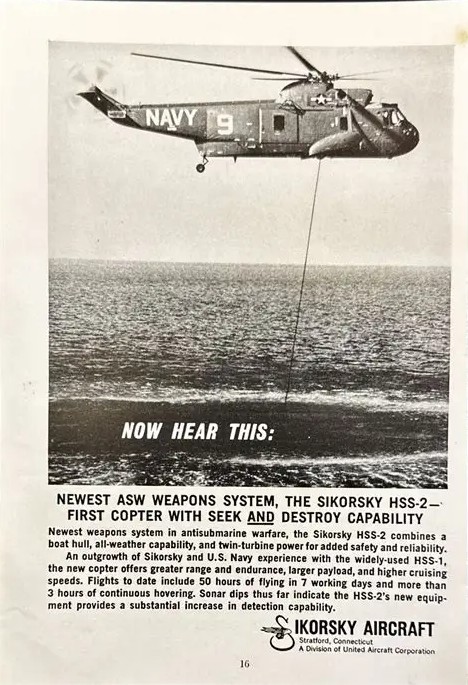
U.S. attack submarines have a marked superiority over Soviet boats, a statement verified by almost every authority outside the Iron Curtain. But these same authorities add: “There is no reason to doubt that before long they (the Russians’) will have reached the same standards of excellence the United States has attained.”
The American Polaris, with 16 missiles each, can fire from beneath the surface and remain submerged indefinitely. Each missile carries a half-megaton nuclear warhead with a destructive power of 500,000 tons of TNT.
With its range of up to 1,725 miles, the Polaris missile could hit any target In the Soviet Union or Communist China.
Intelligence sources estimate the Soviet submarine fleet in-dudes about 30 missile-launching subs of which 10 are nuclear-powered. The Soviet missiles are of shorter range—about 350 miles and only two to four can be mounted on each sub.
The Pacific ASW command maintains a 24-hour watch over millions of miles with some 100 combat ships, 500 aircraft, nearly 40 submarines and 24 shore coordinating centers. Its headquarters is at Pearl Harbor’s Ford Island, hard by the sunken battleship U.S.S. Arizona, America’s monument to unpreparedness.
ASW forces are broken into hunter-killer or HUK groups operating through specified zones. Key area in this ocean is the Western Pacific from Soviet Kamchatka Peninsula past Formosa and the Philippines to Viet Nam and Thailand.
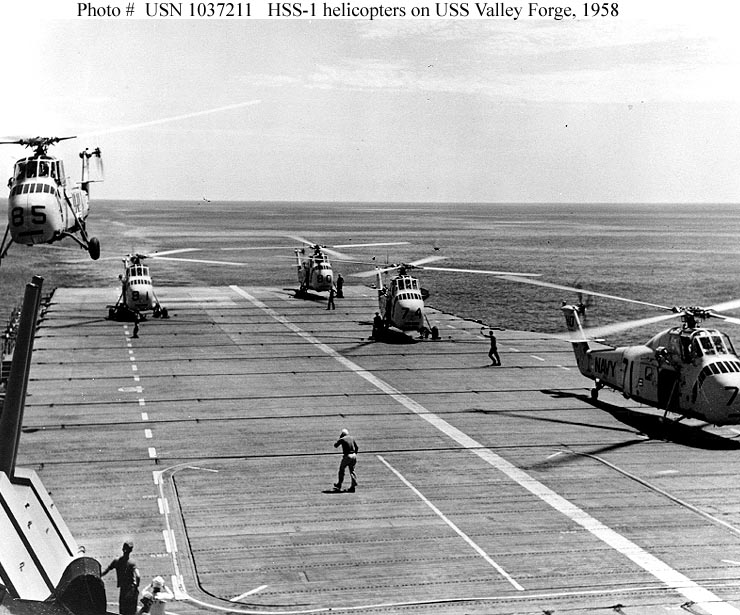
A Huk group submarines, land-based and carrier planes, helicopters, destroyers–is highly mobile and plays on the strength and weakness of its components.
Using an aircraft carrier as a nerve center, a HUK group can cover a wide area and move in on an enemy using the weapons and specific skills of each of its parts.
Weather and sea channels stand as natural allies of the West against the submarine. Soviet subs must move to the outer sea through narrow straits which can be closely watched—and are. And many Soviet ports, notably Petropavlovsk, are kept operational part of the year through use of icebreakers.
It’s no coincidence hunter-killer groups do a lot of their work in the North Pacific along Kamchatka, for Petropavlovsk, the Japan Sea for Vladivostok, the Iceland-Faeroes gap from the Norwegian Sea for Murmansk and the Denmark Strait for ports near Leningrad.
Nuclear submarines have complicated ASW because of their faster speeds and ability to remain submerged for long periods of time.

On land ASW’s problems are twofold: lack of public interest and too little money. The operation doesn’t have the glamour of air war or the pioneering of space development. ASW is a grimy, messy job but one that has to be done.
Thach asserted that the same study and priority and money should be given to ASW as to development of modern killer submarines.
“The defense facilities are really the key to this thing,” he said. “What we come down to, with both sides having the same potential, is the ballistic balance resting with the side with the best ASW team.”
Thach insists there is no escaping the conclusion the Navy needs more ships, planes and submarines to handle ASW chores. Most hunter-killer groups are undermanned; there is much obsolete equipment; there is no fighter cover.
“We can meet the threat in the Pacific within the present state of the art,” Thach said. “But we will have to develop our resources as the enemy develops his. The price is not exorbitant when you relate it to the threat.
“We are improving and I am encouraged. But I am impatient.”
Sunday, June 24, 1962 THE KEY WEST CITIZEN
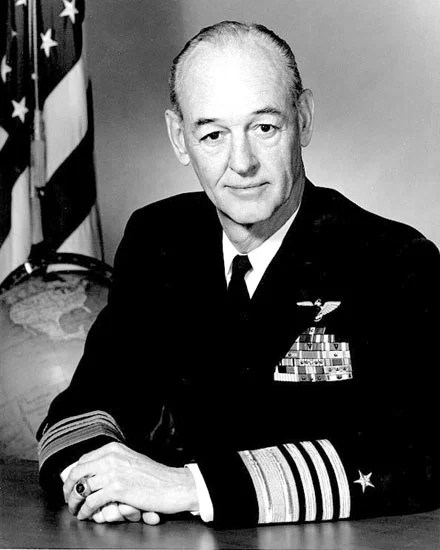
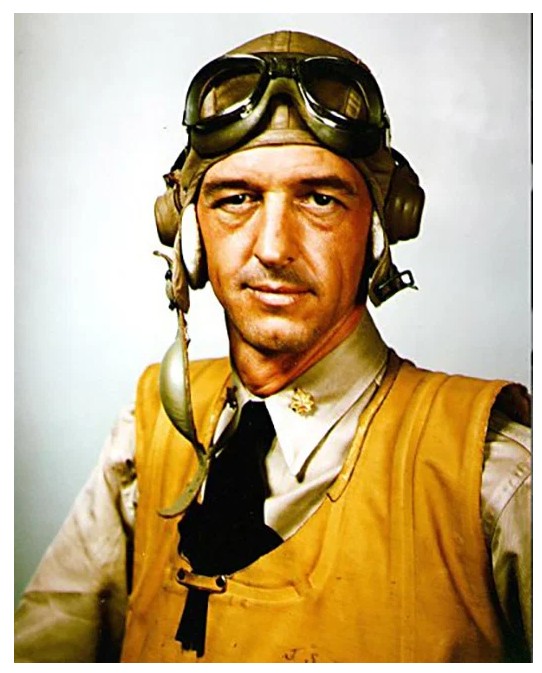
John Smith “Jimmie” Thach was a U.S. Navy admiral, World War II flying ace, and pioneering air combat tactician renowned for creating the “Thach Weave” maneuver, which helped U.S. pilots counter superior Japanese Zeros. Serving from 1927–1967, he commanded carriers in the Korean War, led antisubmarine warfare innovation, and ended his career as Commander in Chief, U.S. Naval Forces Europe. His 40-year service earned two Navy Crosses, the Distinguished Service Medal, and lasting honors, including USS Thach (FFG-43).
John S. Thach was born in Pine Bluff, Arkansas, on 19 April 1905. After graduation from the U.S. Naval Academy in 1927, he spent two years serving in battleships before entering flight training in 1929. Designated a Naval Aviator early in 1930, he received several flight assignments over the next decade and gained a reputation as an expert in aerial gunnery, test pilot and instructor. During the early 1940s, while commanding Fighting Squadron Three, Thach developed the fighter combat technique that came to be known as the “Thach Weave”, a tactic that enabled the generally mediocre performing U.S. fighters of the day to hold their own against the Japanese “Zero”.
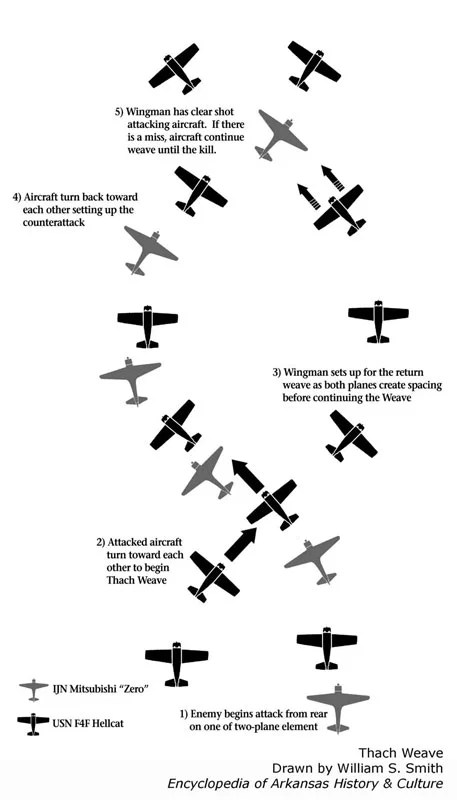
Lieutenant Commander Thach led “Fighting Three” from USS Lexington (CV-2) in early Pacific actions, and from USS Yorktown (CV-5) during the June 1942 Battle of Midway. After a period of instructing other pilots in combat tactics, Commander Thach became Operations Officer to Vice Admiral John S. McCain’s fast carrier task forces, and was present at the Formal Japanese Surrender on 2 September 1945.
https://encyclopediaofarkansas.net/entries/john-smith-thach-1780/
Promoted to rear admiral in 1955, he evolved as a fleet officer into one of the navy’s top antisubmarine warfare experts and advocate of nuclear power. Today, in recognition of his career, the Admiral Thach Award is annually presented to the most outstanding antisubmarine warfare squadron.
The Soviets would indeed catch up before the Cold War came to a halt. Technology spirited from several international companies along with spies within the US Department of Defense would allow the Soviet to quieten their submarines to such an extent that they closed the gap.
Larger and faster submarines on both sides of the conflict would challenge ASW warfare advocates. Not that other navies around the world have learned from the United States and their former adversaries, the threat is growing once more. The biggest common thread between the early 1960’s and today is the location of the greatest threat. The Pacific Ocean remains as the great opportunity and the great threat.
Hopefully the race to master new technologies will ensure continued success.
But it should be noted that the current adversaries are racing as quickly as we are.
Mister Mac


