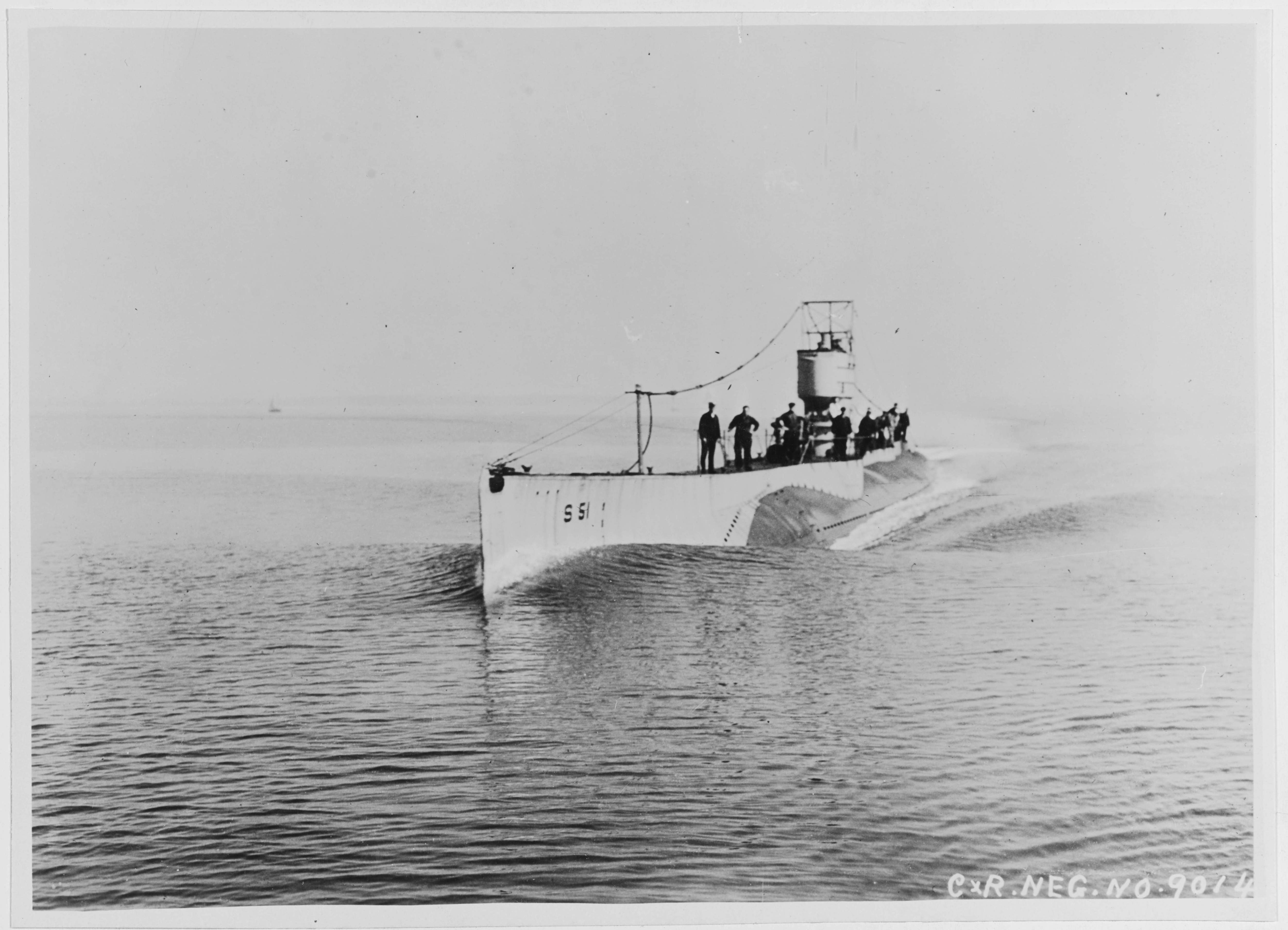
Every man seen was at his station – The tragic lass of the S-51
Caution – The descriptions are pretty graphic.
I have written about the sinking of the S-51 before but today is the hundredth anniversary of the beginning of her recovery and restoration. In their day, the U. S. submarines S-50 and S-51 were the latest and largest type of undersea craft, built by the Lake Torpedo Boat Company. The boats were 248 feet long and of the most modern type. They were doubled hulled, differing in many particulars from other craft of the new S-class. The plans on which they were built were drawn after a careful study of German U-boat construction had been made and some German practices proved in the war were adopted.
The S class boats were certainly an advance in submarine design for their day but like all early boats, they were not equipped with the types of electronic equipment that is taken for granted today. Neither was the vessel City of Rome which had the misfortune of colliding with her on that dark night.
1925 – Cold Shivers Run Down The Spines From the Undersea Monsters
This article comes from the Daily Kennebec journal (Augusta, Me.), July 9, 1926.
Reading the article today, I could feel myself back on the drydock I once served on. I can only imagine the emotions that went through the docking crew and those navy personnel that had been assigned to complete the gruesome task of identifying the sailors who were still entombed. Of the 36 crew members aboard, only three survived, having swum away from the sinking vessel. The remaining crew members were trapped inside the submarine or lost on the seafloor
Submarine warfare in the US had officially begun in 1900 but the training had continued to advance over the 25 years before the accident. Submarine service was still an all-volunteer endeavor and the men who chose that lifestyle were well aware of the dangers. The S-51 boat was not the first boat that experienced a casualty and certainly would not be the last. But the efforts to raise the boat were somewhat of a revolution in themselves.
Salvage Operations: The recovery of the S-51 was unprecedented, as no submarine had ever been raised from such depths before. The U.S. Navy, determined to demonstrate its capabilities, initiated a complex salvage operation led by Lieutenant Commander Edward Ellsberg. Divers faced numerous challenges, including dangerous conditions and the need to seal the submarine to prevent further flooding.
Com. Elsberg Reveals for First Time What Divers Saw as Craft Lay on Bed of Ocean
Body of Radio Operator Rigid Over Keys of Instrument Others with Hands Stretched Toward Levers
Craft Will Be Opened Today
New York, July 8. 1926
The dead members of the crew of the submarine S-51 died at their posts, Lieutenant Commander Elsberg said tonight.
As the rusty, torn hulk of the submarine lay in dry dock at the Brooklyn Navy Yard, Lieutenant Commander Elsberg, for the first time told what the divers working under him saw in the vessel as it lay on the ocean bed off Block Island where she sank after being rammed by the City of Rome last fall.
“The men who were saved were off watch,” he said. “While the S-51 was at the bottom divers entered through the hatches and explored her. Every man seen was at his station. Some of them had their hands on valves.
“We saw one man in the engine room, but he was jammed against some controls and we couldn’t reach him. He seemed to be sticking to his job to the last. We saw J. M. Schofield, radio operator, at his post, his body rigid in a chair, his head and shoulders bobbing up and down in the green water over the keys of his instrument.
“We saw the body of another seaman in the engine room, who was stretching his arm out toward a lever as if in an attempt to close an emergency valve.”
Lieutenant Elsberg expressed the opinion that the submarine was trying to avoid the City of Rome when she was struck. The periscope was pointed aft, he said, which showed the crew was watching the City of Rome which was corning up behind the port side.
The helm of the S-51, he said, was hard to the right, showing that the submarine at the moment of collision was swinging the craft to the starboard to avoid the ship bearing down on them. Examination of the mechanism showed that the vessel was in readiness to dive.
New Silk Flag
At Half Mast Is Placed on Submersible
New York, July 8
The dead of the S-51 still slept beneath the water tonight.
The submarine that rested on the floor of the ocean off Block Island for more than nine months was warped into dry dock at Brooklyn Navy Yard today. A touching ceremony marked the end of her 135-mile journey, which was delayed when she grounded on a reef in the East River yesterday.
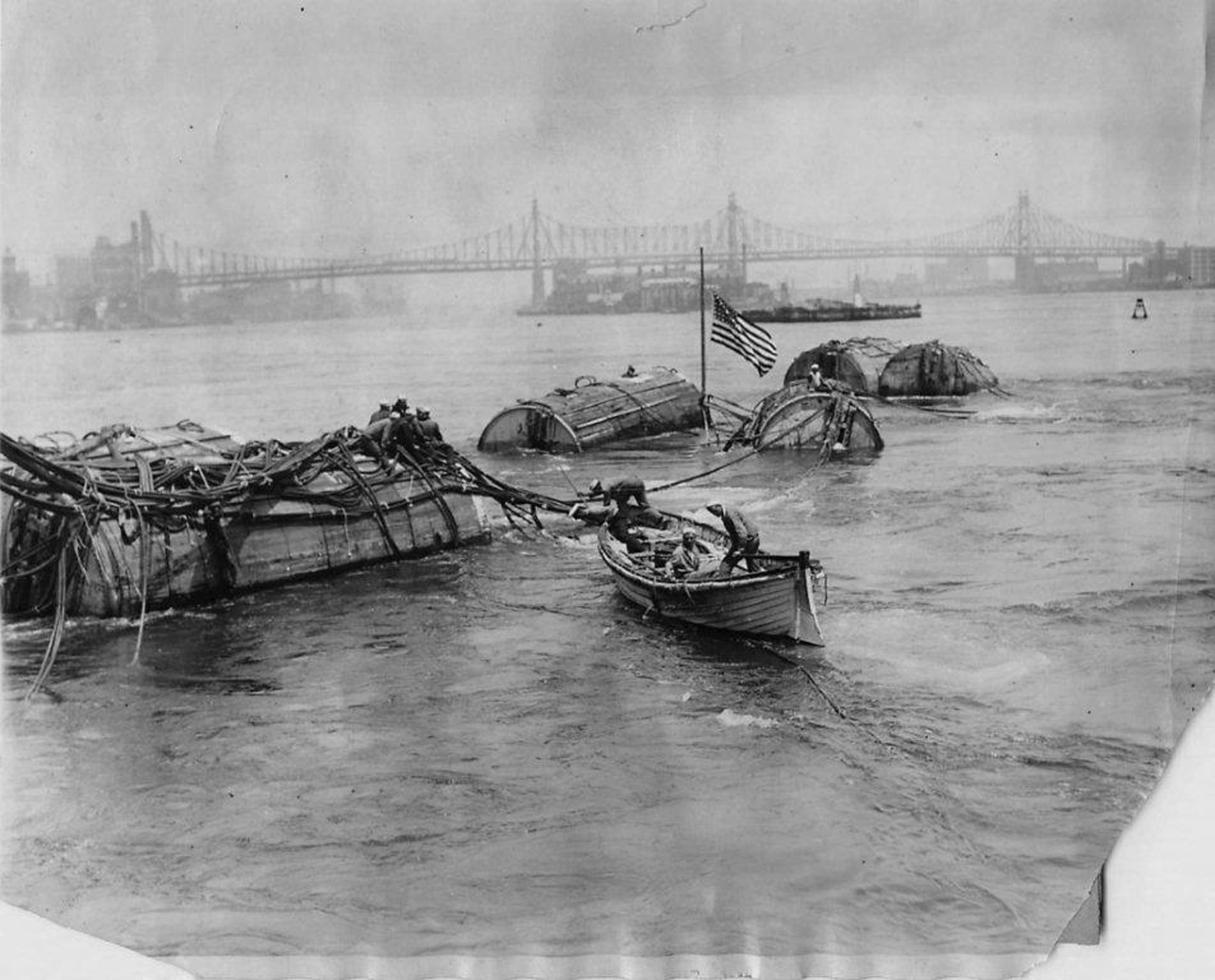
A new silk flag was hoisted to the top of the mast that had been fitted to her battered bridge. Lieutenant Commander Ellsberg, who directed the salvage work, stood at attention on a pontoon. All ranks stood at attention. Relatives of the dead mingled with a small crowd that had been permitted to enter the yard. At a signal the flag was lowered to half-mast.
Immediately the ceremony was over divers went below the 34 feet of water in the dock and adjusted blocks. Derricks lifted the submarine to even keel. Great pumps were set to pumping out the water of the dock.
As the water gradually went down more of the bridge became visible, as if in a theatre where the curtain went downward instead of up those in the navy yard saw slowly revealed to them the tragedy the sea had wrought. The large “S-51” on the conning tower was coated with rust. On one side of the conning tower was a life belt, still white and secure in its stays. The lights that were seen last by the watch on the bridge of the City of Rome just before the S-51 was rammed and sunk last September were salt in place.
At five o’clock Rear Admiral Plunkett, commander of the navy yard, ordered all work stopped. At that time the gun of the S-51 was out of water. The decks were still awash. Five of the pontoons that raised her from the sea bottom were still bobbing in the water, but the S-51 rested on the ways.
“No divers have entered the S-51 since her hatches were sealed while she lay at the bottom of Block Island about a month ago,” Lieutenant Commander Ellsberg said as he quit work for the day. “We are going to leave her under water tonight. In the morning we will finish draining the dock and then we will search for the dead.”
At the time divers entered the S-51 while she lay under the Atlantic Ocean, they reported that one member of the crew had been seen wedged behind a bunk in the battery room. Lieutenant Commander Ellsberg said he believed there were about 12 or 14 dead inside.
“The ship is to be re-fitted and put into service,” Lieutenant Commander Ellsberg said.


Ellsberg’s prediction would not be fulfilled. The S-51 would eventually be sold for scrap.
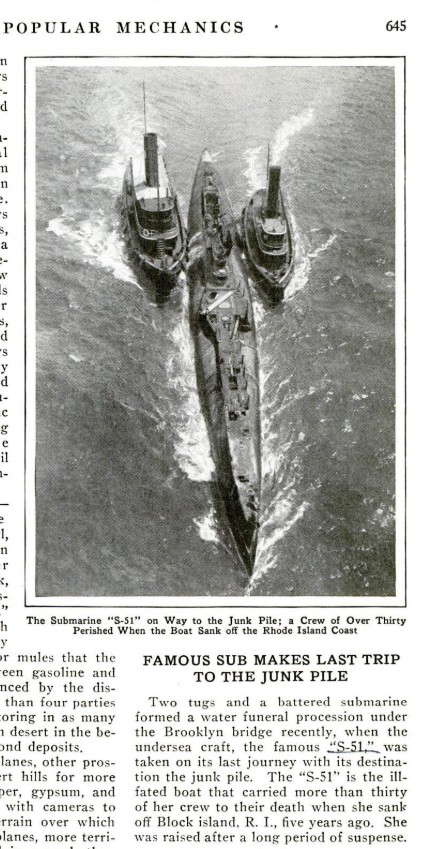
The tragedy of the S-51 led to many significant advancements in submarine rescue techniques and protocols, influencing future naval operations and safety measures. Submarining was never free of risks, but as time and technology advanced, the chances for survival and recovery would certainly be improved.


