General Omar Bradley is known for saying, “Ours is a world of nuclear giants and ethical infants. We know more about war than about peace, more about killing than we know about living.”
Bradley would go on to become the head of the joint chiefs before retiring from the Army. The turbulent times after the second world war included the planting of the seeds which would grow into a full-fledged arms race. The scientists that developed the bomb were already concerned that only one country possessing such a terrible weapon would grow in power and potentially use the weapon for nefarious purpose. That translated into discussions about sharing the secrets with the major countries that had been allies during the last war.
Evidence now proves that spies were active in many countries but particularly in the Soviet Union. The soviets were still recovering from a costly war and their doctrine of world domination had never really diminished. The desire to protect themselves from external forces added to their distrust of all things western and developing their own nuclear program was a strong driving force.
Behind the scenes, fear of unbridled nuclear power was growing
Searching through the newspaper archives of the postwar period, articles were being written about what could happen in a world where atomic weapons could be used with impunity. One of those was written by a writer named Margedant Peters. She has an interesting background including a relationship with Stalin’s estranged daughter. But that is a story for another day.
This article is typical of what many people saw as a dark future. Frankly, as I read it the first time, I could actually see this as something that would make for an apocalyptic screenplay for a movie.
Midland cooperator (Minneapolis, Minn.), June 5, 1946
Atomic Age Here To Stay; Are We?
World Is Periled By Stupidity and One-Minute War
Old Relationships Between Nations Outmoded by Bomb
By MARGEDANT PETERS
“The atomic age is here to stay. The question is: Are we?”
More than a wisecrack, this is the shadow that hangs over the United Nations and should hang over every one of us.
All of us need to keep remembering that it is quite possible that one of these days in the not-too-distant future we shall find ourselves vaporized in a surprise atomic bomb attack.
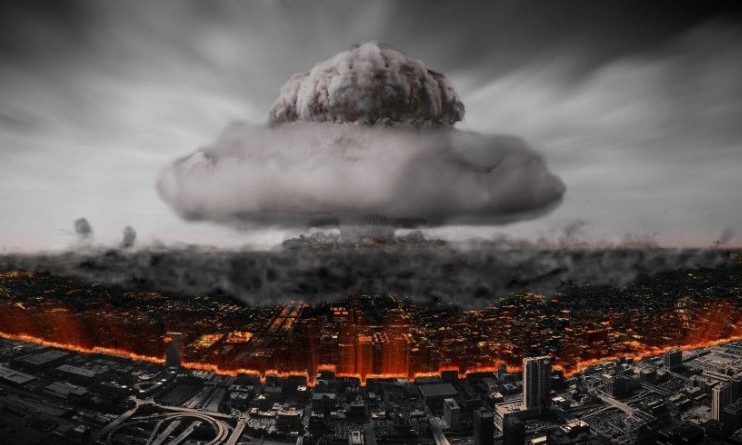
How It Happened
The survivors would explain how it happened:
We thought we had the secret all to ourselves and so we figured no world control was necessary. Nationalism won out—and nationalism led once again, in its inevitable way, to war. Only this was a “one-minute war” which was something new—and final. Too late to second-guess.
The horrors of such a war are vividly imagined by an atomic scientist of the Oak Ridge project, who writes, “Suppose that we try to visualize a probable war of the future—which might come 15 or 20 years from now. The nations are fully armed with the latest type of weapons. A dissention arises between our nation and another. Our diplomats are trying to settle it. Our military machine is put in order —all outlying bases are alerted. But in spite of this preparation, some of us who live on farms see a number of blinding flashes of light, hear the thunderous roar of mighty explosions. And where our cities once stood there are only piles of rubble covered with smoke and dust.
Wiped Out in Toto
“Our government is gone – wiped out in toto in the first huge explosion. Our industrial plants are wrecked, our large supplies of food and manufactured goods destroyed. Few hospitals are left for the millions of injured, almost no doctors or nurses to care for them.
Transportation and communications are completely disrupted. Wholesale starvation develops. Hordes of survivors from suburban localities pour out to the farms. They demand food and shelter. If it is not given freely, they take it by force.
Utter anarchy rules. Utter destruction is our reward. Does it matter much whether our military men were able to identify the aggressor and retaliate in kind Would destruction of the enemy furnish food for tens of millions of starving citizens, medical care for millions of injured? There is not sufficient food for all. Starvation takes a larger toll than the original attack.
“What a price to pay for stupidity!
“This is, indeed, not an attractive future to consider.
But shall we follow the example of the ostrich? This will not eliminate the problem —only ourselves.”
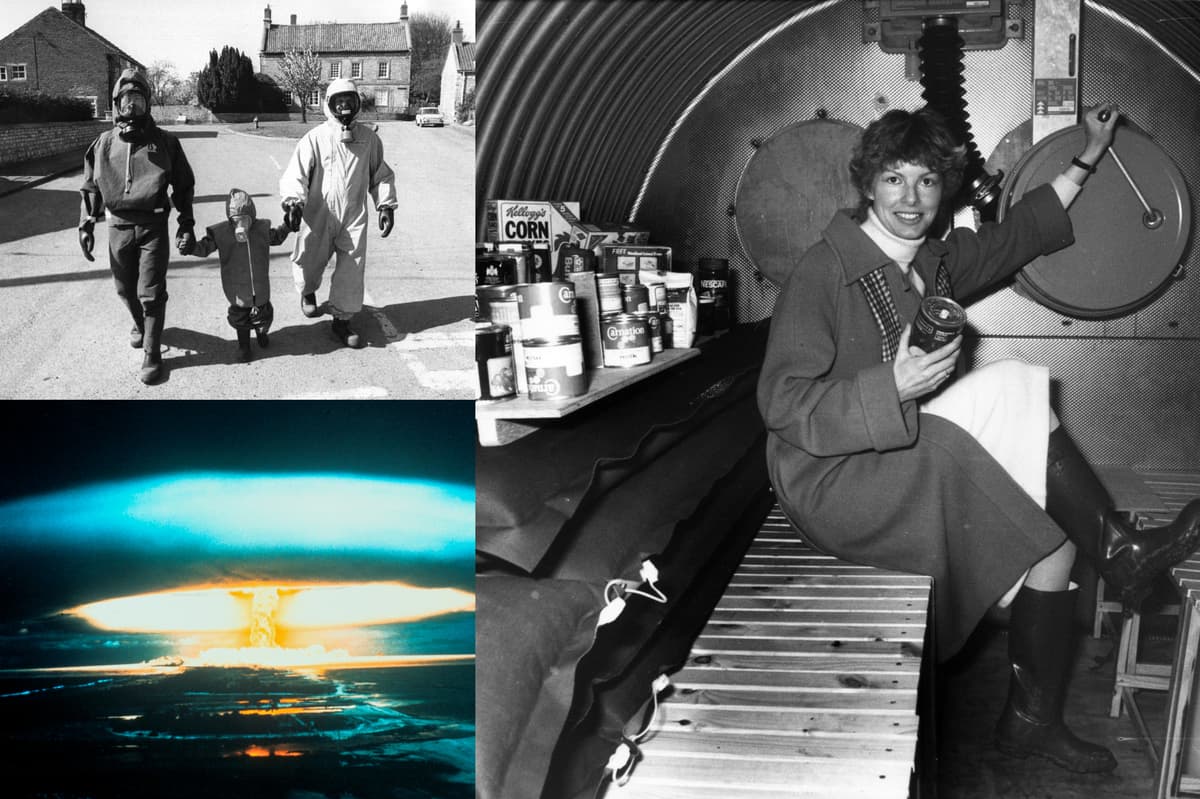
Scientists Federate
Scientists who have been working on the development of the atomic bomb have been thinking this time of ways to control this new and terrible kind of power.
Formed into the Federation of Atomic Scientists, representing 90% of those engaged in the scientific project, they have agreed on certain main principles:
- There are no longer any fundamental secrets about the atomic bomb. The U. S. government, in publishing the Smyth report, has made public the broad outline of the discovery and the engineering details. Scientists of other countries need find no magic formula to split the atom. Whenever enough U 235 (a form of uranium) or plutonium is brought together, the atomic explosion takes place automatically. The tasks are to separate the U 235, or to make the plutonium, and to prevent the explosion until the proper moment.
- There can be no defense against atomic bombs. Only one atomic bomb out of 100 needs to get through our defenses to do the damage of 2,000 bombing planes. They can be carried by planes or shot by radar-directed rockets —and remember, none of the German V 2 rockets was ever shot down.
But more likely the atomic bombs will be planted in our cities by saboteurs.
Numerical superiority in bombs is meaningless. If a country is destroyed by 1,000 atomic bombs in one night, it does not matter that the day before it had 100,000 stored away.
Dr. J. R. Oppenheimer, leading scientist of the Los Alamos, N. M., project, has testified that 50,000,000 people could be killed in a single surprise attack which would destroy all our principal cities and industries.
The only defense against the bomb is to attack first with devastating effect any potential enemy. We would of course find such a course of action for ourselves unthinkable. But do other nations believe us incapable of it?
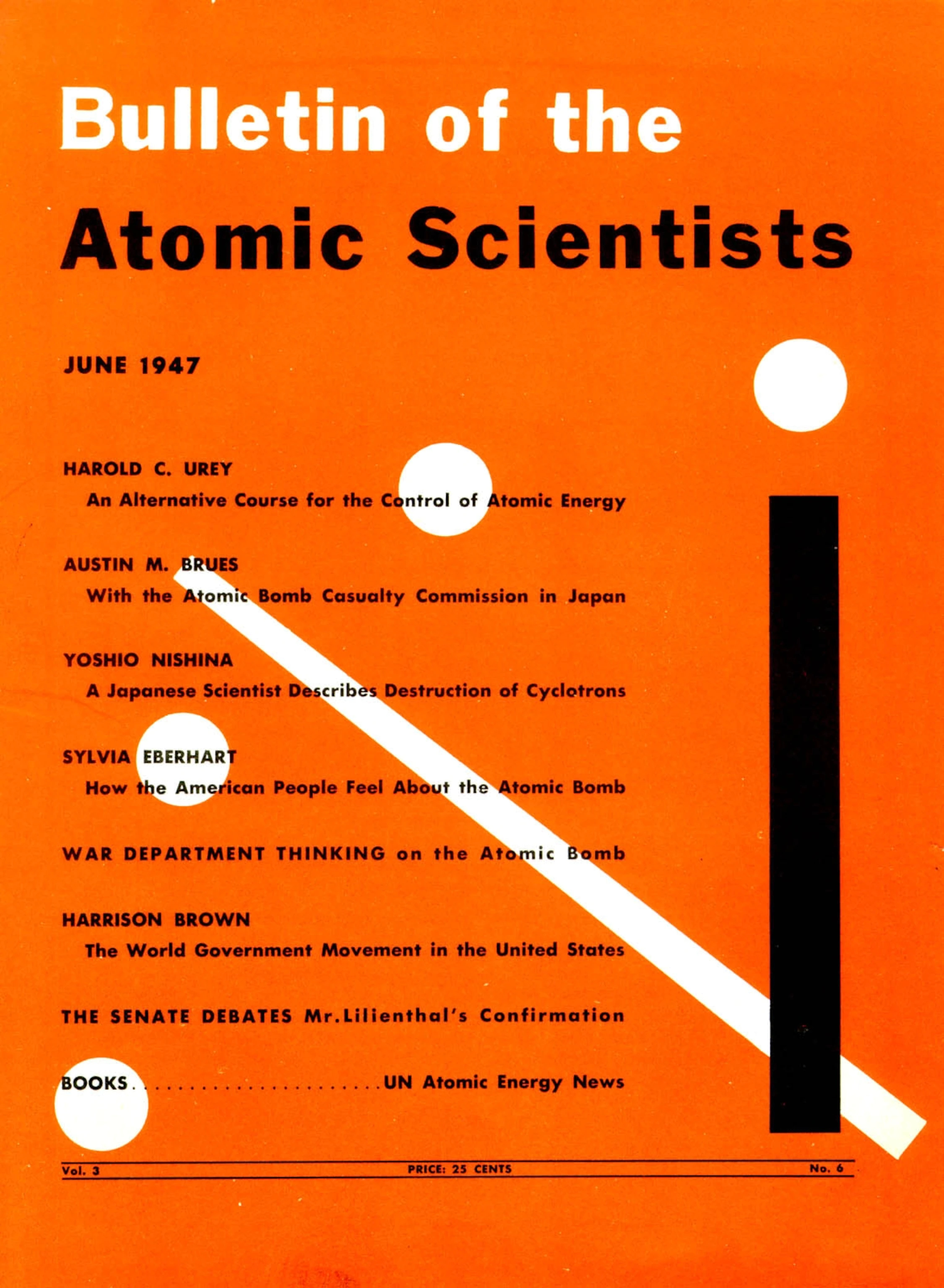
Need More Than Treaty
The use of the bomb must be prevented—and by a more effective means than a “treaty.” The United Nations has made one step, in setting up a 12-nation atomic energy commission.
The Federation of Atomic Scientists is calling for an international commission with the sole right to manufacture atomic weapons and with the right to inspect plants and laboratories in any country in the world. To give a body such powers would mean giving up many notions of national sovereignty which nations now cling to.
Will the UN be strong enough to cope with the major problem which was tossed in its lap on the day of the first meeting of the UN assembly? Does adequate control require a more basic form of world government? These are topics for the forums of the people of the world to discuss. It is clear however, that they cannot be discussed in the framework of outmoded ways of thinking about the relationships between nations – ways that were outdated already before Aug.5,1945. The explosion of that first bomb made clear that we must have a world based on mutual cooperation—if we are to have a world at all.
So where do we stand in 2026?
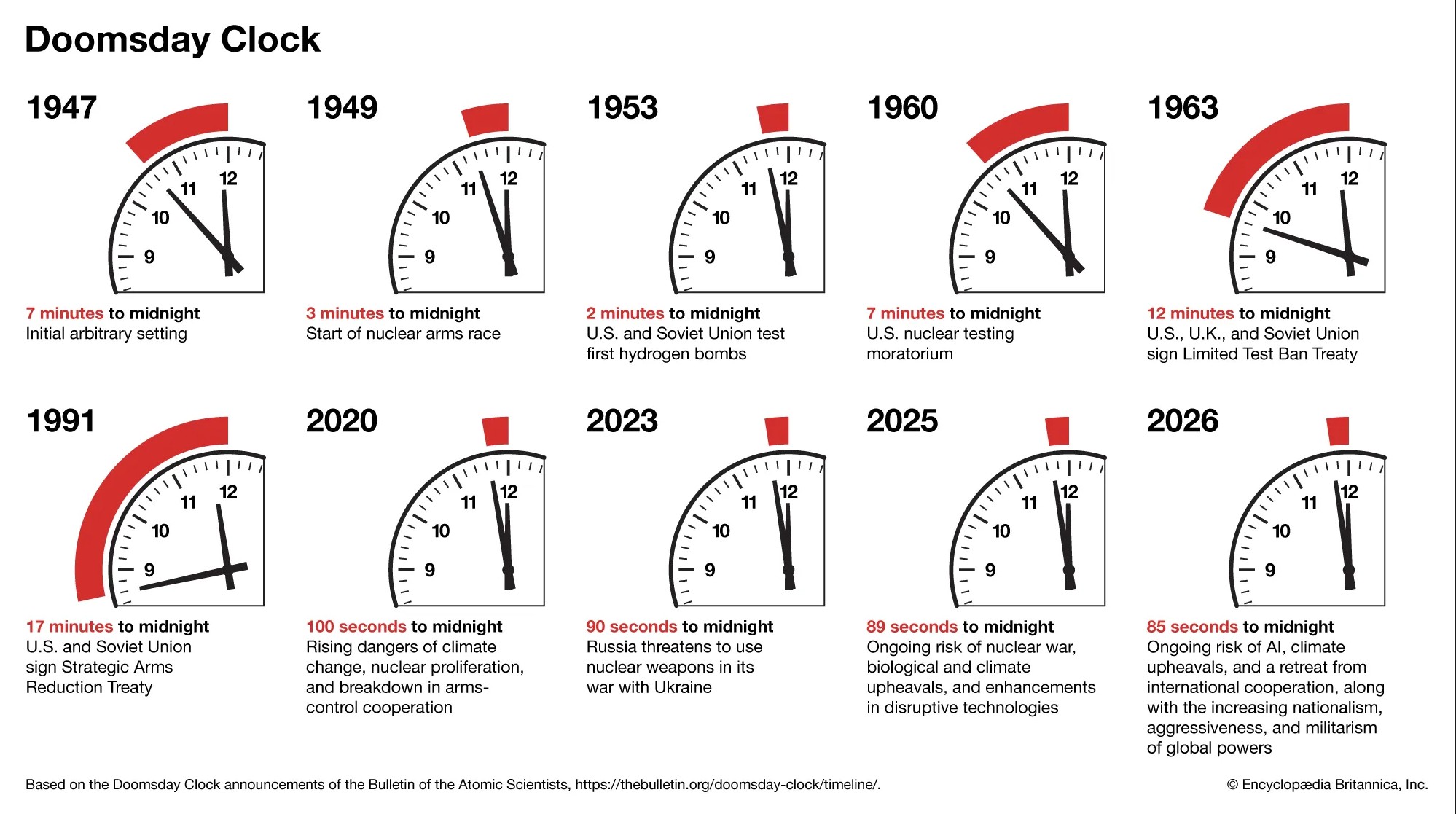
In January 2026 the nuclear clock was set to 85 seconds before midnight, the closest it has ever been to doomsday.
First a confirmation of what Omar Bradley said at the beginning of the nuclear arms race in the nineteen forties. We continue to get better at making more weapons without a clear plan for how to keep from using them.
China rejects joining a new treaty for nuclear arms control – February 5 2026 AP report
For the first time in decades, the world is left without a framework limiting the nuclear deployment of the two powers that hold nearly 90% of the world’s arsenal. The immediate consequence is uncertainty as the threat of a new global arms race looms.
In this context, China’s role becomes central. Beijing has increased its nuclear arsenal faster than any other country since the end of the Cold War, challenging the narrative of strategic stability that has prevailed since then. While Washington and Moscow have occasionally sat down to negotiate numbers, Beijing has maintained a lower profile, always refusing to participate in trilateral talks.
According to the Stockholm International Peace Research Institute (SIPRI), in 2024 China had around 600 nuclear warheads, compared to over 3,700 for the United States and 4,300 for Russia.
This figure marks a significant increase: in 2012, when Xi Jinping came to power, China had only 240 warheads. If current trends continue, the Asian country could reach 1,000 warheads or more by 2030, according to Pentagon estimates and international analysts.
And on February 6, 2026
The US has accused China of conducting secret nuclear weapons tests and risking a new nuclear arms race.
“Today, I can reveal that the US government is aware that China has conducted nuclear explosive tests, including preparing for tests with designated yields in the hundreds of tons,” said Thomas DiNanno, undersecretary of state for arms control and international security, at a conference in Geneva on Friday.
Some positive news (?)
WASHINGTON, Feb 5 2026 (Reuters) – The U.S. military said that Washington and Moscow on Thursday agreed to reestablish high level military-to-military dialogue, following talks in Abu Dhabi, a move which could signal a move towards normalizing some ties between the United States and Russia.
The United States halted military-to-military communication with Moscow just before Russia invaded Ukraine. The conflict, which began in 2022, is the deadliest war in Europe since World War Two and the biggest confrontation between Moscow and the West since the depths of the Cold War.
In a statement, the U.S. military said the aim of reestablishing the mechanism was to avoid miscalculation and escalation by either side.
“Maintaining dialogue between militaries is an important factor in global stability and peace, which can only be achieved through strength, and provides a means for increased transparency and de-escalation,” the statement added.
Somehow, I do not feel very confident that these high-level talks will turn the atomic clock back one bit.
With all of the focus on growth on both of our flanks, I think we would do well to be as prepared as we can for the potential dangers that already exist. The first Cold War did not result in mushroom clouds over the length and breath of the globe. I pray that the trend will continue into the next one.
13 The sixth angel sounded his trumpet, and I heard a voice coming from the four horns of the golden altar that is before God. 14 It said to the sixth angel who had the trumpet, “Release the four angels who are bound at the great river Euphrates.” 15 And the four angels who had been kept ready for this very hour and day and month and year were released to kill a third of mankind. 16 The number of the mounted troops was twice ten thousand times ten thousand. I heard their number.

 theleansubmariner