Cold War Stories – The Importance of Greenland is Magnified
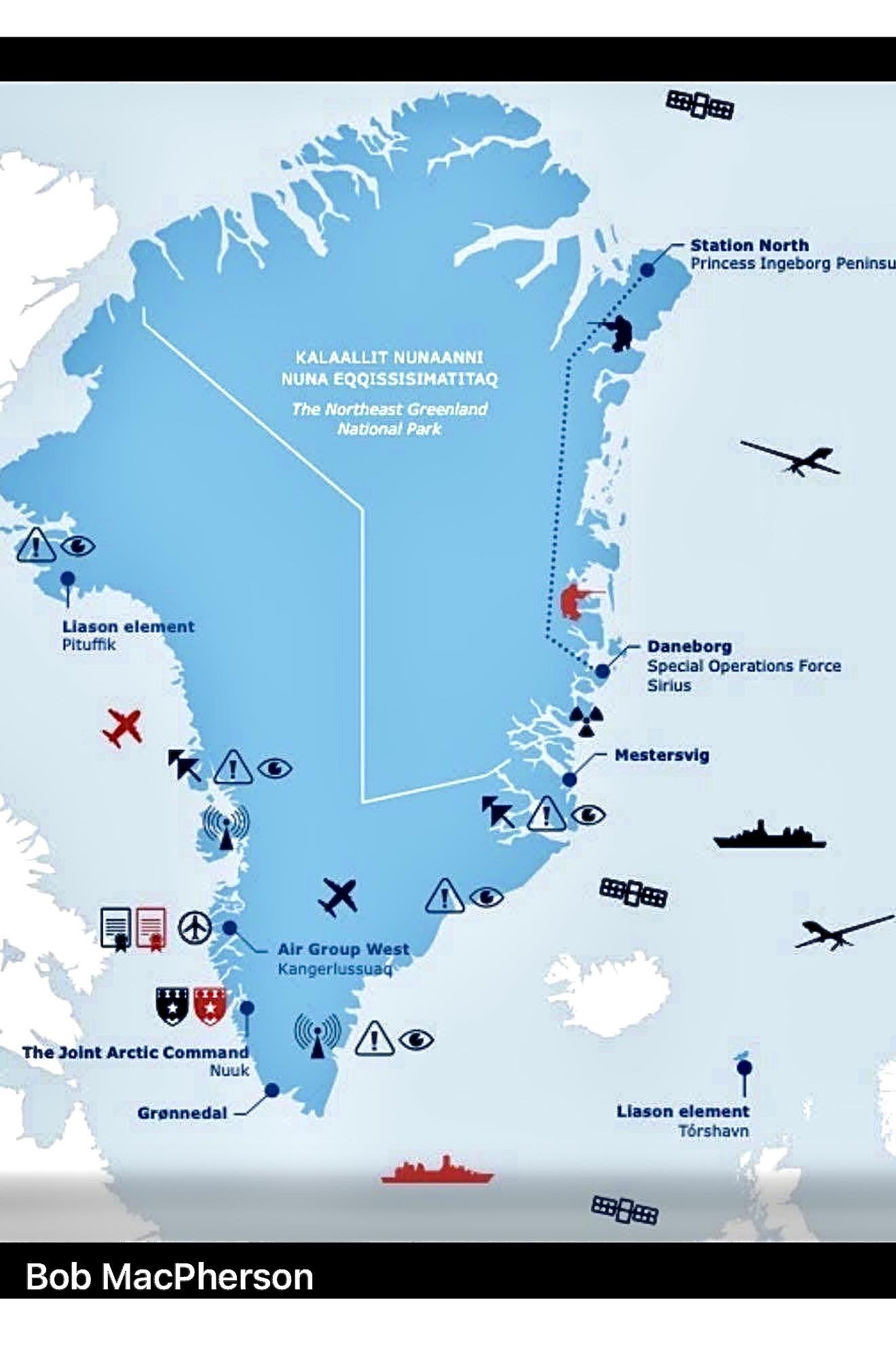
With all of the recent attention given to Greenland, it is important to note that Greenland has been a central focal point for more than a hundred years to the United States. What was once described as a giant iceberg with little value to America, has suddenly regained its place in discussions around the world. No matter what your personal feelings about the discussion, some facts cannot be ignored.
- Fact number one is that we live in a world that is filled with people who want to extend their influence for political and ideological purposes. The desire is for them to gain strategic advantages over our country and any countries that are aligned with freedom loving principles.
- Fact number two is that technology has changed so radically in the past 126 years as to make America more vulnerable than ever before. When the century started in 1900, manned sustained flight was still something only imagined, submarines were limited to ranging near coastal bases, satellites and space travel belonged to novelist’s imaginations and sailing ships still plied the oceans next to coal powered vessels that had limited ranges. A casual look around the globe shows that none of those limits exist any longer.
- Additional advances include a greater understanding of the natural resources that exist in once previously unknown areas and our ability to use them for the common good of mankind has grown exponentially. The need for rare earth minerals is no longer a convenience; it is a strategic necessity. Controlling access to those minerals will mean the path forward in our need to dominate AI and communications. If our opponents control those minerals, they control the future.
The potential that exists today in Greenland is immeasurable.
Not only does the geographic location of Greenland at the crossroads of the Arctic make it valuable, but the possibility that the raw materials under the surface creates a critical reason for access. Ever since the early part of the 1900’s, strategic planning has recognized that out entire naval influence in the Atlantic could be hindered if an unfriendly force gained control. Newer technology in shipping and submarine operations makes access to the Arctic even more critical.
That is the reason that China is trying so desperately to establish a presence there now. With recent moves by Canadian leadership to bow to Chinese desires, we will face an entirely new challenge in the years to come. Make no mistake, China does not befriend countries out of the goodness of their hearts. The Belt and Road initiative is littered with initiatives around the world that are meant to gain strategic advantages. That will have huge consequences once China plays the Taiwan gambit.
(Update from DAVOS 1/21/2026 – Canadian Prime Minister:
“For Canada, Carney said, the implications are sobering. Long-held beliefs that geography and alliances alone would guarantee prosperity and security are no longer valid. “You cannot live within the lie of mutual benefit through integration when integration becomes the source of your subordination,” he warned.
The prime minister said Canada must now pursue a “principled and pragmatic” strategy — strengthening domestic capacity while diversifying trade ties to reduce reliance on any single partner. He acknowledged that multilateral institutions such as the World Trade Organization and the United Nations have been weakened, forcing countries to operate more independently.
“A country that cannot feed itself, fuel itself or defend itself has few options,” Carney said. “When the rules no longer protect you, you must protect yourself.”
While warning that a “world of fortresses” would make nations poorer and more fragile, Carney argued that middle powers must build flexible coalitions with like-minded partners. “If you are not at the table, you are on the menu,” he said.
Closing his speech, Carney rejected nostalgia for the past. “The old order is not coming back. We should not mourn it,” he said. “From the fracture, we can build something better, stronger and more just.”
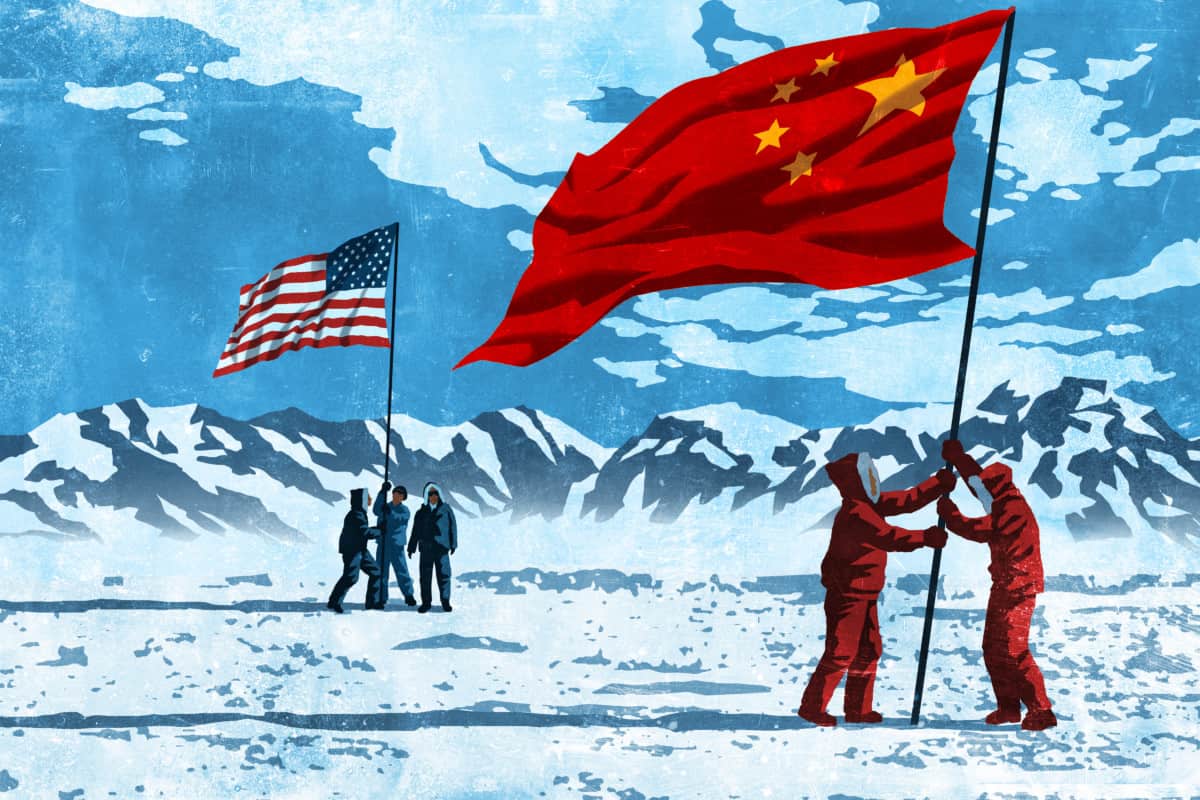
Additionally, Russian operations in the Arctic give them a strategic advantage in any potential conflict.
They have a proven track record throughout the first Cold War and remain a significant threat for the new Cold War we are entering.
The History of Greenland
It’s good to step back for a moment and just look at the history of Greenland. So many “facts” are pushed out by the various sides, getting pure data seems challenging.
Like any large mass of territories around the globe, its “ownership” if you will, is checkered and not as clean as one would imagine.
The early inhabitants were various Inuit cultures that inhabited Greenland for thousands of years, arriving from Canada to the west. These indigenous people learned to live off of the limited resources available in their time. They had not experienced any industrial revolution and certainly did not have any vision of what we see as a “country”. Someday a more comprehensive examination may show that they were more advanced than what our current understanding believes. But I have found little evidence that they were more than a subsistence society that probably had a tribal basis.
Vikings, under the leadership of Erik the Red, sailed from Iceland to Greenland and settled southern portions of the island in the 10th century, before eventually disappearing. Many explorations have been made to determine what happened to them. But they ceased to exist long before any formal claim could be made.
Modern Danish-Greenlandic relations began in 1721 with the arrival of missionary Hans Egede, who was sent to search for the lost Vikings, but instead found the indigenous Inuit inhabitants and established a colony in an attempt to convert them to Christianity. He establishes a colony near what is now the capital, Nuuk.
1775: Greenland is officially proclaimed as a colony by Denmark-Norway.
Denmark monopolizes trade and restricts foreign access to the island.
1814: The union between Denmark and Norway dissolves. As part of the Treaty of Kiel, Denmark retains control of Greenland (along with the Faroe Islands and Iceland), cementing it as a Danish colony.
Early U.S. Interest (1823–1917)
1823: American president James Monroe articulates what becomes known as the Monroe Doctrine.
Inspired by European colonial interests in Central and South America, as well as recent Russian settlements in what would become Alaska, the doctrine established an American foreign policy position that European powers should stay out of the Western Hemisphere, leaving it under the United States’ sphere of influence.
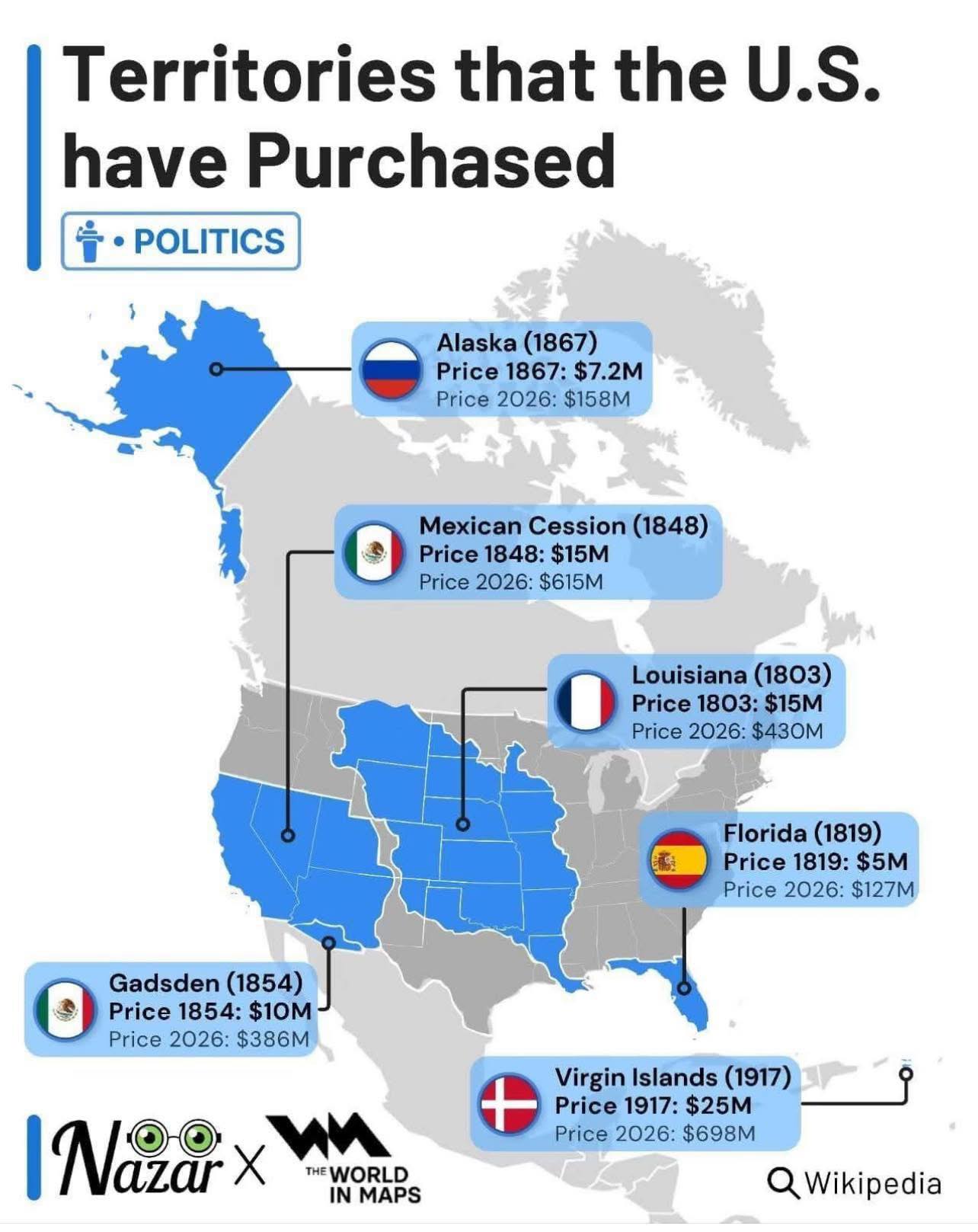
1867: Just after the purchase of Alaska from Russia, U.S. Secretary of State William H. Seward commissions a report on the potential purchase of Greenland and Iceland, which was also a Danish territory at the time. However, perhaps because the recent Alaska deal was ridiculed by many as foolish at the time, no formal offer was made.
Seward actually got much closer to purchasing the Danish West Indies at this time. The Danish government approved a treaty to sell the islands, but the United States senate refused, as the islands had recently been hit by a wave of natural disasters which made them seem like a poor investment.
1891-92: American Arctic explorer Robert Peary plants a U.S. flag at the northern tip of Greenland and claims he has discovered “Peary Land,” a portion of land separated from the Danish colony by a channel of water.
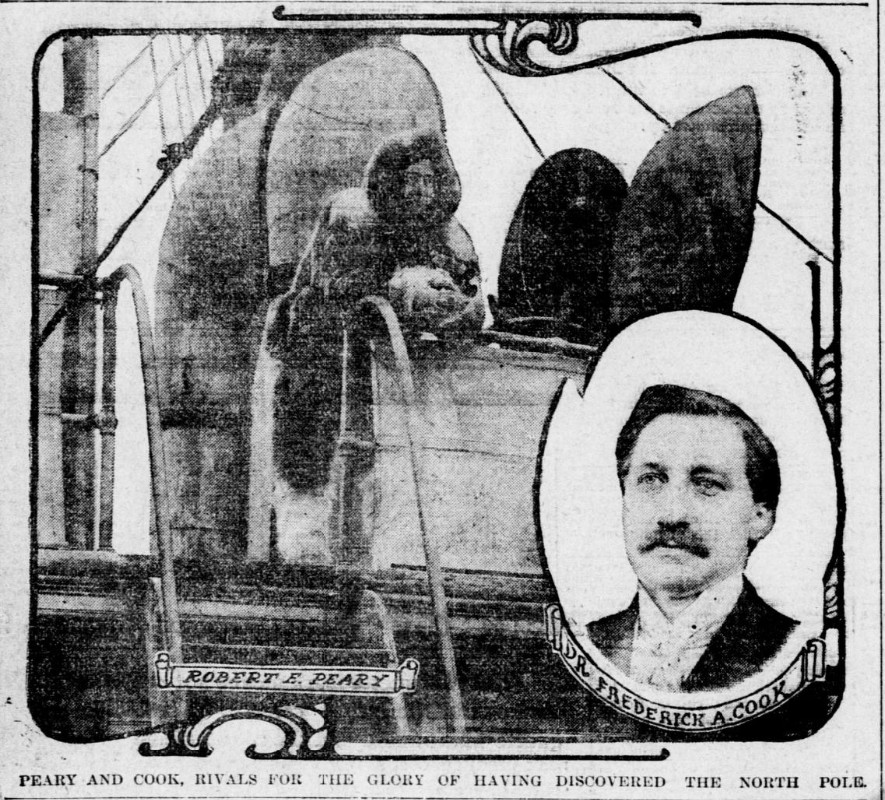
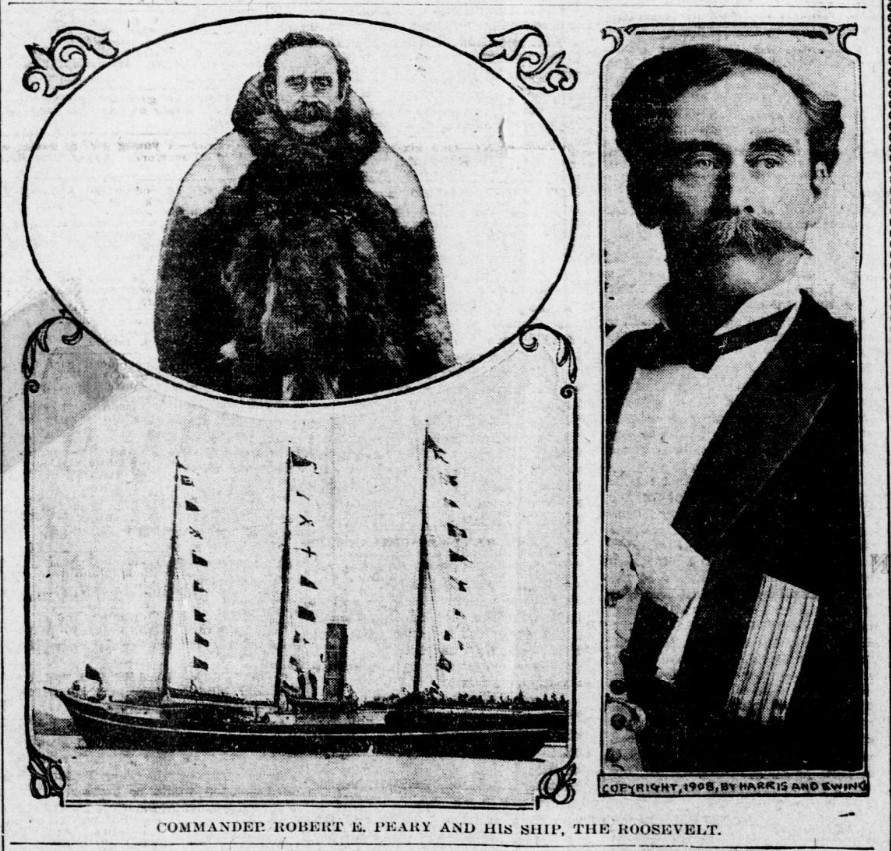
Some leaders in the United States hoped that explorers would find some geographical reason to lay claim to a portion of Greenland. While the United States government never made a claim based on Peary’s maps, the “discovery” offered some uncertainty to Denmark’s sovereignty over all of Greenland until 1916.
VASTNESS OF GREENLAND.
The Ice Crowned Island Is as Big as Mexico or Alaska.
Greenland is the largest Island in the world. Its total length from Cape Farewell, Its southern extremity in 60 degrees north latitude, to Cape Morris K. Jesup, its northern extremity in 83 ½ degrees north latitude, is in round numbers 1,500 miles, almost exactly the same as the length of the United States on the ninety-seventh meridian, from the mouth of the Rio Grande to where our northern boundary crosses the Red River of the North. The greatest width of Greenland is about the same as the distance from New York to St. Louis.
In regard to its area the figures of various authorities vary widely. It may be sufficient to say that it can be grouped in size with the United States east of the Mississippi, Alaska, Mexico, Colombia, Persia, Portuguese West Africa and Turkey in Asia.
Its interior is covered with a great sheet of Ice rising to elevations of probably 10,000 feet In places and several thousand feet in thickness. The available ice free land is a strip of varying width along the coast, intersected by numerous deep fiords.
When one turns the pages of American arctic exploration Greenland Is found more or less intimately associated during over sixty years with all American expeditions, except the Jeannette expedition.
Americans have lifted nearly all of Its northwestern and northern coasts out of the arctic night and fog and have twice crossed Its northern part. American names stud Its coasts, and the name of an American marks its northern extremity, the most northern known land in the world—Rear Admiral Peary in New York Times.
1916/1917: After decades of off-and-on negotiations, the Danish government agrees to sell the Danish West Indies, now known as the U.S. Virgin Islands, to the Americans, who had long desired the islands for their strategic military position in the Caribbean.
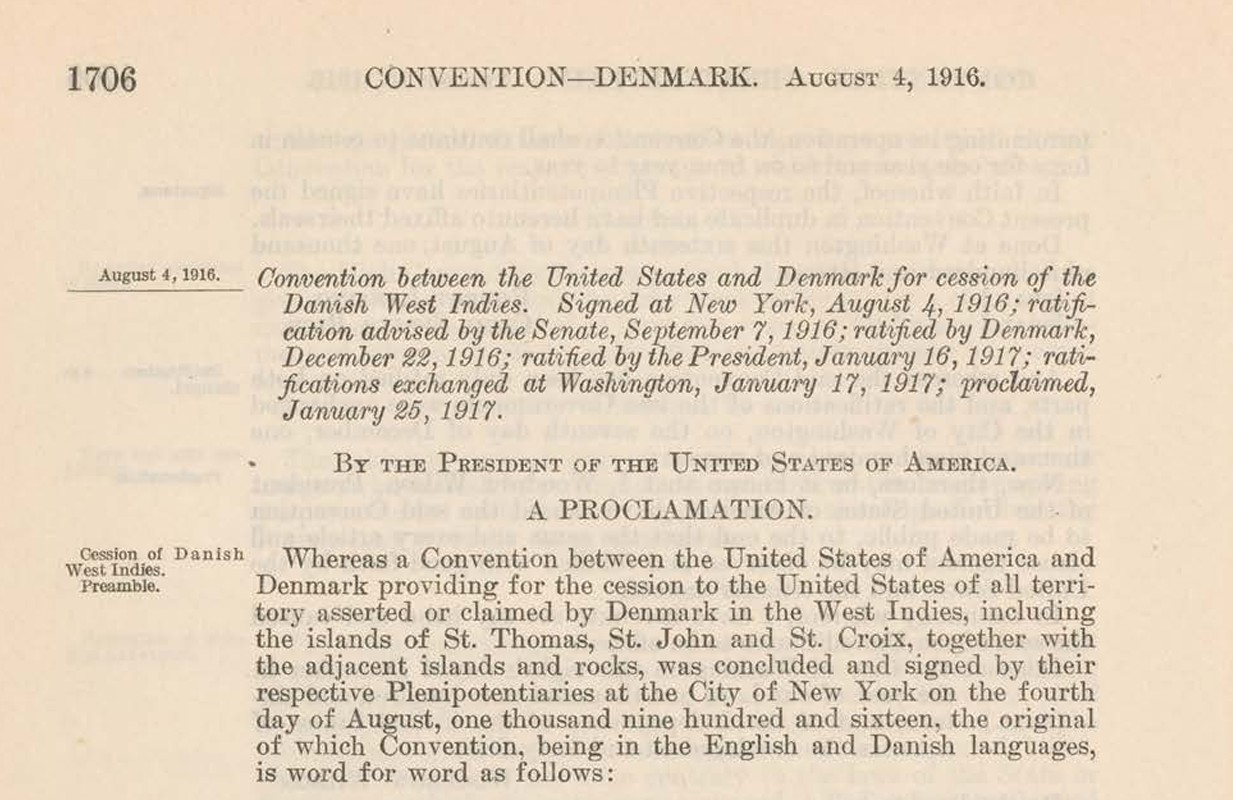
The Lansing Declaration:
During negotiations, Denmark got the U.S. Secretary of State Robert Lansing to include a declaration in the treaty which states “the Government of the United States of America will not object to the Danish Government extending their political and economic interests to the whole of Greenland.”
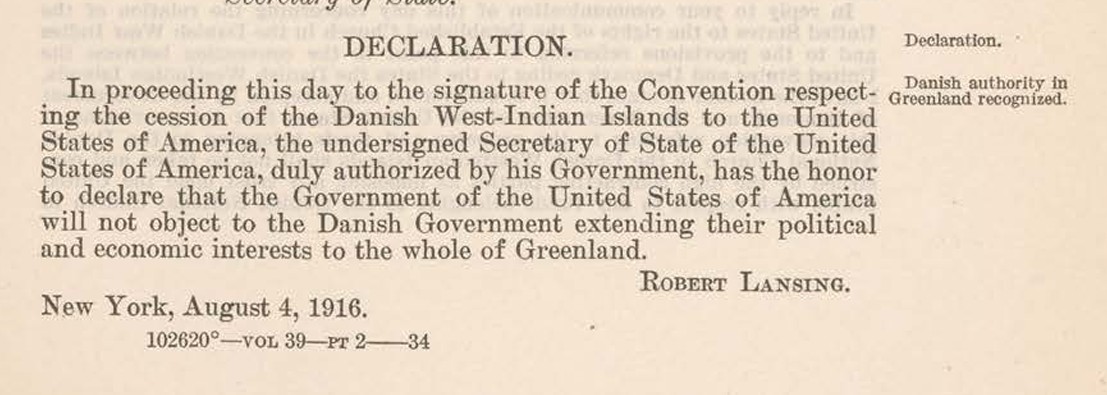
Richmond Times-Dispatch (Richmond, Va.), November 12, 1916
PLAN FOR COLONIZATION Danish Society Wants to Send People to Uninhabited East Greenland
The Associate Press
November 11, 1916
The Danish Greenland Society, which includes the prominent Danish Arctic explorers, intends to launch a plan for the colonization of uninhabited East Greenland. West Greenland will soon be overpopulated, Danish North Greenland already is well-peopled, while in East Greenland the conditions are considered good for supporting a larger population of Eskimos.
Denmark previously has only had nominal possession of the country, and other nations will hardly recognize her supremacy until a Danish station has been established, the Danish flag raised and Danish inhabitants settled.
The announcement of Danish plans to extend colonization in Greenland Is of some particular interest to the United Stales, because, this country may still claim ownership of vast tracts of that Arctic land through discoveries which American explorers have made. In negotiations still pending between this country and Denmark over the sale of the Danish West Indies to the United States for $25,000,000, one condition to the sale is the relinquishing by this country of all Its rights in Greenland. The land discovered by Americans Is mainly along the northernmost coast, however, in a region so deeply covered with snow and Ice that It Is doubtful that it ever can be considered of economic value.
Not everyone in the US Agreed with the decision. Prior to the treaty being signed, there was a very strong campaign mounted to try and halt the progress.
Chief among the protagonists was Rear Admiral Peary and his supporters.
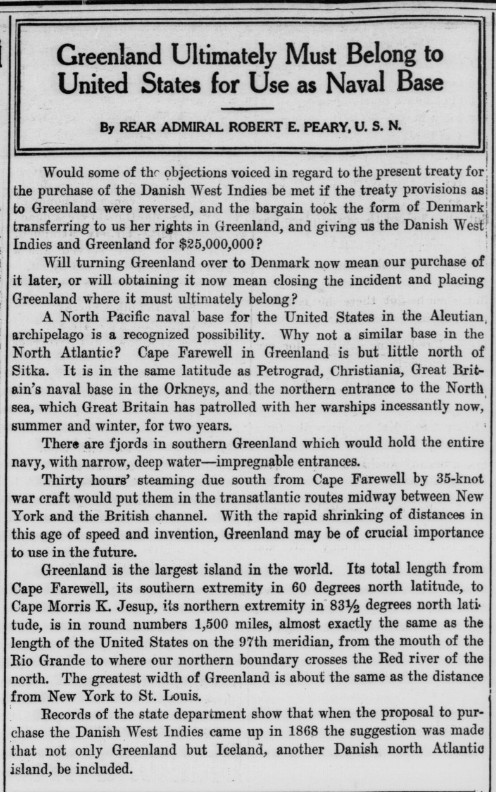
But even the ones who questioned the treaty were not completely convinced of the need to maintain a foothold (however tenuous) in Greenland
Ventnor News (Ventnor City, N.J.), November 11, 1916
OWN PART OF GREENLAND
Comparatively Few Know That the United States Territory Extends That Far to the North.
Very few had any idea that the United States owns a chunk of Greenland as big as one of our average-sized states until they read the provision in the proposed treaty between our country and Denmark whereby, we are to pay $20,000,000 for the Danish West Indies and, in addition, relinquish to Denmark all our claims to territory in Greenland. If you will look at a recent map of Greenland you will see the name “Pearyland” across the upper part of It. This is the land discovered and explored by Admiral Peary. He and other American explorers were the first to visit and map the coast line of the greater part of northern Greenland and Peary discovered that it was an island.
It has always been the recognized right of a nation to claim sovereignty over land discovered by its subjects. Spain got title to a big slice of America through Columbus. Under this title-by-discovery claim the United States could claim all of northern Greenland except the Danish settlement of 34,000 square miles and 12,000 population on the southern coast opposite Iceland. But this is only one-twenty-fifth of the area of Greenland. Now Denmark wants it all.
The average American will be likely to say, “For goodness’ sake, let Denmark have It and good riddance; what do we want of that iceberg?”
The chances are that we don’t want it, and that it would never be any good to us. Still, there is another possibility. When the United States bought Alaska, it was thought by the majority of people to be barren and worthless, but last year it shipped us in goods eight times the value of the purchase price, and now coal is coming to the Alaskan coast by rail to help lower the price in California. Spitzbergen, far up beyond the Arctic circle, has recently become of immense value because of the discovery there of minerals. Dispatches have told of the return of members of the Stefansson Canadian Arctic expedition with news of the discovery of great fields of native copper in Prince Albert land, as far north as Greenland. Canada is exploring the lands of the Arctic with the intention of extending her authority all the way to the pole, on the chance of finding coal, iron, copper and possibly gold.
But the development of those regions, if they are ever to be developed, seems to be the province of the nations of the snows, like Norway, Sweden, Denmark and Canada.
The Second World War fundamentally changed Greenland’s geopolitical situation.
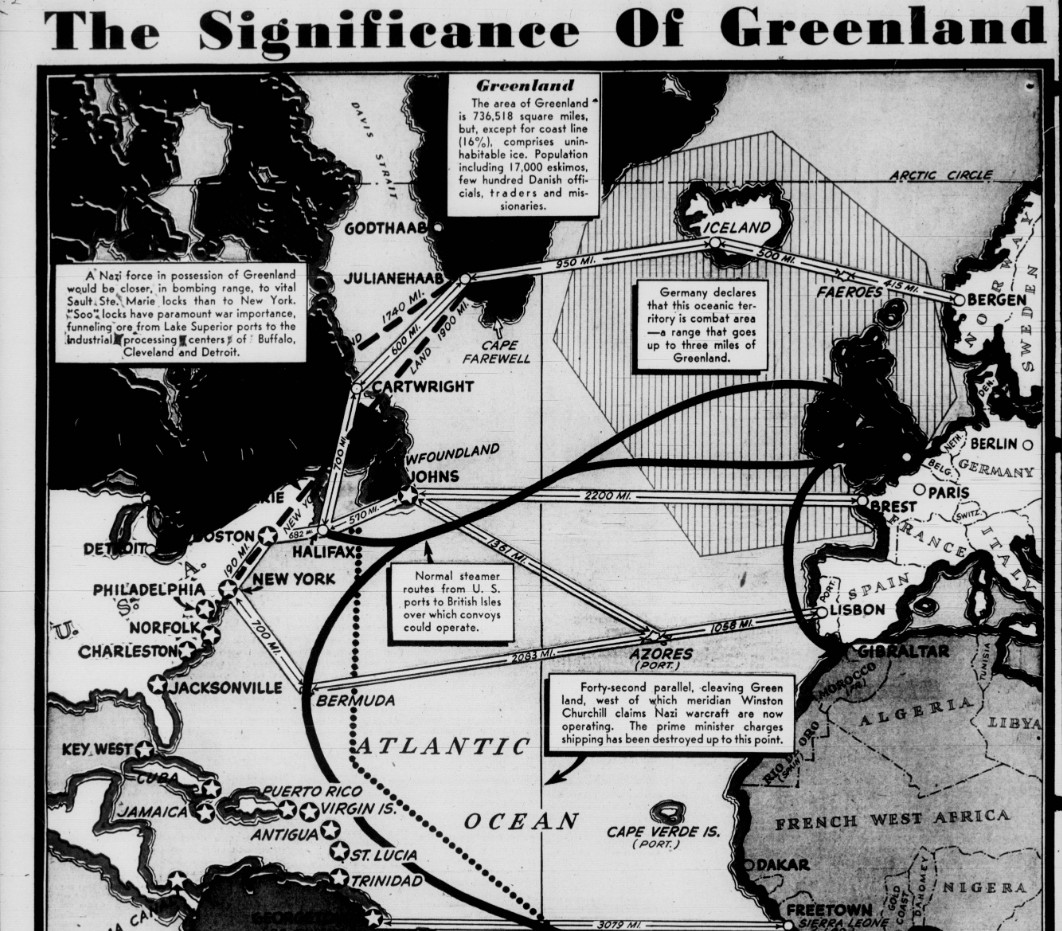
Cut off from an occupied Danish government, the Greenlanders experienced a small degree of self-governance, as well as their first encounter with the United States. German forces had tried to establish a foothold for the purposes of monitoring weather but the arrival of American forces saw a swift repudiation of their efforts.
The island of just under 20,000 inhabitants quickly filled with thousands of American troops. With them came increased infrastructure, new cultural influences, and the opportunity for new trade relationships.
1940: Nazi Germany invades and occupies Denmark. Greenland, now cut off from Copenhagen, declares itself a self-governing territory.
St. Croix avis (Christiansted, St. Croix [V.I.]), May 15, 1940
COMMISSION FORMED TO HELP GREENLAND
April 26, 1940
The Danish Ambassador at Washington, D.C., issued the following statement relative to the steps taken to provide for the welfare of the people of Greenland:
“As a result of the German occupation of Denmark the population of Greenland will be deprived of supplies from the outside world, these supplies under normal circumstances being sent every summer from Denmark Special provision must therefore be made for the welfare of the people of Greenland and I have established an ‘‘American-Danish Greenland Commission” with head-quarters at 107 Wall Street, New York City, to assist me in this task.
“Mr. Hans Christian Sonne of New York has generously agreed to serve as Chairman of the Commission and to carry out its administrative functions, assisted by Dr. Paul Bentzen, Roosevelt Hospital, New York, who was born in Greenland and has spent a number of years there.
1941: Henrik Kauffmann, the Danish Ambassador in Washington D.C., acts independently of the occupied Danish government and signs a treaty which allows the U.S. to build military bases in Greenland.
McAllen daily press (McAllen, Tex.), April 14, 1941
America Pushes Main Defense Line Eastward by Protecting Greenland
By RAYMOND CLAPPER
WASHINGTON, April 14 – Taking Greenland under the protection of the Monroe Doctrine means we are pushing our main line of defense further out into the Atlantic.
Modern warfare makes that necessary. It is the only sure way to keep the bombs from dropping on our own cities and on our own people. If you locate your front line at your own borders, as some of our isolationists have been advocating, then war is waged on your own soil as we see in England.
Once we had our first line of defense on the Rhine, but that went out last summer when France fell. Now our only line of defense Europe is England itself. Without indicating any lack of confidence in England’s ability to hold her line, we do well to be preparing against the worst. Last summer President Roosevelt negotiated for the British bases. That pushed our wall of defense further out from our shores, and particularly further out from the Panama Canal, our most vital spot
Now we push out to Greenland, by making an agreement with the Danish minister in Washington to bring it under the protection of the Monroe Doctrine. In other words, as the White House explained, we are prepared to fight if Greenland is invaded or if Germany attempts to use it for military purposes.
Counted Upon Greenland
Our Atlantic offshore defense has been historically weak because we have always—without admitting it to ourselves—counted upon the security afforded by the British fleet, a powerful, friendly force which protected the Atlantic from menacing enemies. In the Pacific we were on our own. We have built out offshore defenses at Hawaii, and we are now building Alaska into a powerful defense flanking the main route toward our shores from Asia. Greenland occupies in the Atlantic somewhat the same strategic place that Alaska occupies in the Pacific—affording an advance position on the flank of the routes to the United States.
Since the occupation of Denmark, the mother country of Greenland, Germany has been sending frequent missions to Greenland. Recently German planes have been sighted on observation tours over the island. Apparently, the Germans hoped to use Greenland as a base for meteorological observations which would be useful in military operations.
Peary Foresaw Need
The importance of Greenland was prophetically seen 25 years ago. by Rear Admiral Robert E. Peary, the Arctic explorer. At that time the United States was considering the purchase of the Virgin Islands from Denmark for $25,000,000 and as part of the deal proposed to surrender all American rights in Greenland arising from frequent explorations, and that was later done. Admiral Peary protested that, emphasizing the military importance of Greenland of the United States. His article, appearing in 1916, was resurrected by his daughter, Mrs. Marie Peary Stafford, and republished in the Washington Star a year ago when Germany invaded Denmark.
Said Admiral Peary 25 years ago: “Geographically Greenland belongs to North America and the Western Hemisphere, over which we have formally declared a sphere of influence by our Monroe Doctrine. Its possession by us will be in line with the Monroe Doctrine and will eliminate one more possible source of future complications for us from European possession of territory in the Western Hemisphere. Will turning Greenland over to Denmark now mean our repurchase of it later, or will obtaining it now mean closing the incident and placing Greenland where it must ultimately belong?
“Stranger things have happened than that Greenland might furnish an important North Atlantic naval and aeronautical base. A North Pacific naval base for the United States in the Aleutian archipelago is a recognized possibility. Why not a similar base in the North Atlantic? There are fjords in southern Greenland which could hold the entire navy, with deep, narrow, impregnable entrances.
Greenland in our hands may be a valuable piece of our defensive armor. In the hands of a hostile interest, it could be a serious menace.”
1941-1945: The U.S. builds military bases throughout Greenland to defend the island from Nazi invasion and to serve as a refueling station for aircraft headed to Europe.
1944: Nearby Iceland, also cut off from occupied Copenhagen, votes to fully sever all ties with Denmark and become an independent republic.
Trying to purchase Greenland Was not something that started with Trump
1946: President Harry Truman offers Denmark $100 million in gold to buy Greenland. Denmark declines the offer, hoping the U.S. will terminate the 1941 defense treaty and leave the island.
The administration of President Harry Truman pitched a sale to Copenhagen in 1946, in a story told in documents contained in the National Archives and revealed in 1991 by The Associated Press.
WASHINGTON (AP) _ The United States in 1946 proposed to pay Denmark $100 million to buy Greenland after flirting with the idea of swapping oil-rich land in Alaska for strategic parts of the bleak Arctic island, documents in the National Archives show.
The $100 million was to be in gold. And even though the sale did not go through, the United States ended up with the military bases it wanted anyway.
Discovery of the documents, which have been declassified since the early 1970s, was first reported Sunday by the Copenhagen newspaper Jyllands-Posten.
One alternative that was discussed was for the United States to trade land in the Point Barrow district of Alaska for those portions of Greenland that the United States considered of military value.
Under this plan, the Danes would have received the rights to any oil discovered in the district and would have had to sell the oil to the United States.
The U.S. points to the budding Cold War as its rationale for keeping and expanding military forces. The Danish Foreign Minister at the time, Gustav Rasmussen, said “while we owe the US a great deal, I do not think we owe them the whole island of Greenland.”
1951: The Greenland Defense Agreement is signed, allowing the U.S. to build military bases as it deems necessary. Construction begins on the large base now known as Pituffik Space Base.
1953: Denmark changes its constitution, officially ending Greenland’s status as a colony and incorporating it as a “county” of Denmark with two seats in the Danish parliament.
1979: Greenland is granted Home Rule status, taking on additional control.
1985: Using its new Home Rule status, Greenland withdraws from the EU to protect fishing and seal trade.
2004: The 1951 Greenland Defense Agreement is updated to reflect that Greenland is an “equal part of the Kingdom of Denmark” and should be consulted prior to any significant changes made by the U.S.
2009: The Self-Government Act grants Greenlanders additional autonomy, including a legal path towards declaring full independence.
There is more to the history but that is enough for now.
When Wilson and his administration signed the treaty in 1917, the use of the islands to the south was viewed as the most strategic thing that could be done at its time. The war in Europe was raging and by 1917, the menace of U boats was threatening to starve Britain and cut off access for American commerce was certainly a key driver. Having the ability to use the newly acquired islands as part of a strategic advantage was critical.
Wilson nor his team could have imagined the world we live in today.
They did not have the ability to see that Greenland would ever rise to the level of importance it has risen to today. We are in a new Cold War and time is not on our side. Hopefully cooler heads prevail and a sensible solution can be arrived at that will allow the United States to lead the free world once more in the containment of communism and evil forces.
But we should not ignore the prophetic words of Admiral Peary when he stated:
“Greenland in our hands may be a valuable piece of our defensive armor. In the hands of a hostile interest, it could be a serious menace.”
Mister Mac

 theleansubmariner