Chapter Four: Join the Navy and See the World
From the Secretary of the Navy’s 1912 report to the President:
OUTPUT OF NAVAL ACADEMY.
“This year 265 midshipmen entered the Naval Academy; next year there may be as many, or even more, on account of the reapportionment of congressional districts. After June 30 next, however, the law provides that Senators, Representatives, and Delegates shall have only one appointment instead of two. This law, passed in 1903, contemplated that the increase of officers then provided for would be sufficient to meet the Navy’s requirements by 1913. This expectation has not been realized, and the shortage of officers, though less than before, still makes a serious limitation on efficiency and curtails work of wide usefulness.
The present capacity of the Naval Academy is sufficient to furnish officers for the line and staff of Navy and Marine Corps in adequate numbers for many years to come; but if the number of midshipmen be cut in half, the relative cost of educating them will increase, while the existing shortage in the Navy will grow rapidly worse. There is little likelihood of more graduates from the Naval Academy than the Government will require even if the school be kept up to its full capacity of 945 in all four classes; but if there should be a surplus, they would still be available as a reserve in civil life. Such a reserve was of great value in the War with Spain. On the other hand, if too few are graduated, no relief of the resulting shortage in the service can be realized for four years. It was a situation of this kind that seriously embarrassed naval administration during the years directly following the Spanish War. A continuation of the present number of appointments is therefore necessary, and a provision to this effect is incorporated in the draft of the naval personnel bill hereinbefore mentioned.”
Surviving and overcoming
Surviving the scandals and challenges of the first year at the academy was no easy task for the midshipmen of the class of ’16. The new Swedish exercise programs, increased focus on higher level academics and the accursed language programs surely tested Young and his fellow plebes at every turn. The crackdown on hazing only drove the practice underground for a while but it was a rite of passage for all young men who chose to wear the uniform of an academy man. In spite of it all, the one thing that tradition cannot stop is the hands of time. By June of 1913, the all-important June week arrived and the senior class graduated. This was the first class to graduate as Ensigns under the new rules which were meant to give more legitimacy to the process of preparing naval officers for the fleet. Prior to this time, graduates would go to the fleet as midshipmen for two years prior to being eligible to be advanced to Ensign. This additional time was meant to be a seasoning period for the young officer candidates. But with the sweeping reforms of 1912, that was changed forever.
The practice came just in time. The winds of war were already starting to be felt across the ocean in Europe and traveled all the way to the far reaches of the Pacific. The monarchs of Europe and the revolutionaries were becoming restless and the balance of powers were being challenged at every turn. The oceans of the world provided both an opportunity and a challenge for all of the countries that saw themselves in new leadership roles. England remained unchallenged as the monarch of the seas but America had already begin to flex her muscles. The summer of 1913 saw an increasing pressure on the navy to find and create more officers to match the growing fleet that had started under Teddy Roosevelt.
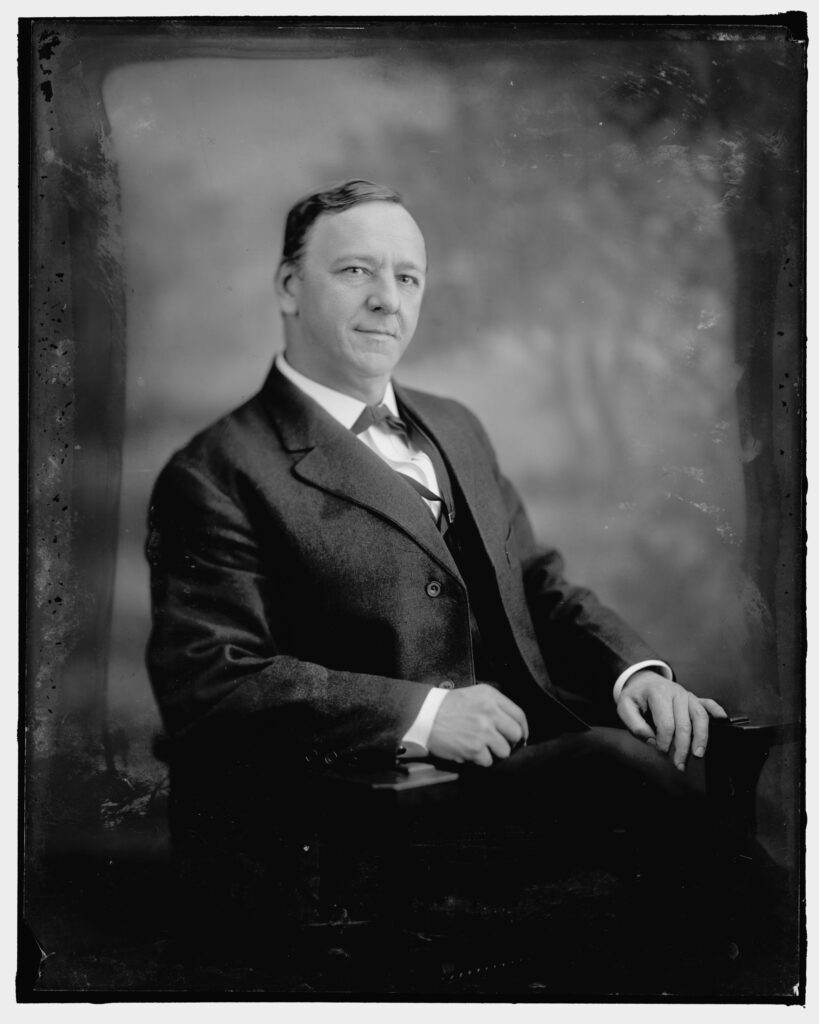
In July, Secretary Josephus Daniels announced to the press that a thousand more officers would be needed to man the new ships in construction that year. Officers from shore stations were being ordered to return to sea and the academy would be expanded to include a membership of over 300, the largest class since 1903 which numbered 313. This would bring the total membership of the academy to 750 men.
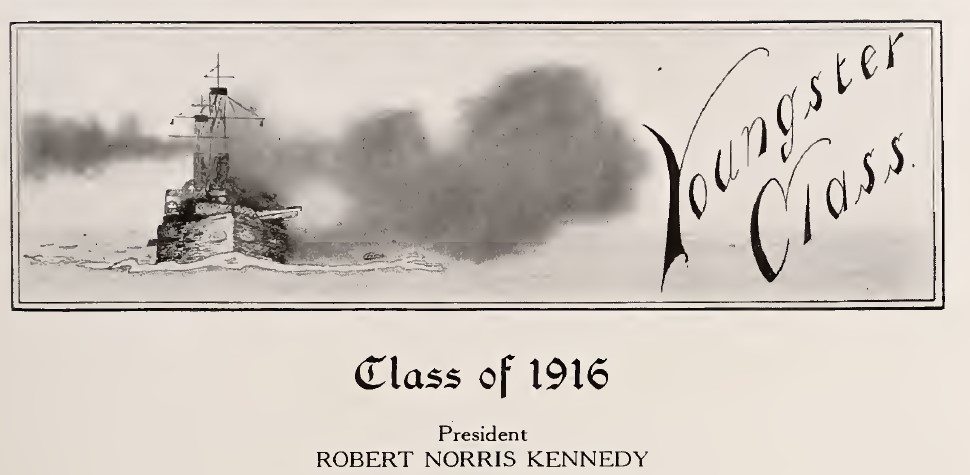
Despite the need for new men in the officer ranks, Captain Gibbons remained relentless as a voice for modernization and change. One of those changes was the employment of the midshipmen during their summer cruise seasons. A tradition that had evolved was that the underclassmen would spend a great portion of their summer cruises on older training ships with little practical experience beyond learning deck seamanship and at sea discipline. With ships that had newer and more sophisticated technology, the need to bring the midshipmen into the fleet more quickly gave advent to a new practice. Instead of limited sailing time on older ships, the Class of 1916 would have the opportunity to completely break the bonds with old Crab town and sail across the ocean to foreign ports.
From the 1912 Secretary of the Navy report: NAVAL ACADEMY CURRICULUM.
“The abolition by act of Congress of the two years ‘ cruise for graduate midshipmen before being commissioned as ensigns, and the development of postgraduate courses for officers in several special branches, have led to a revision of the Naval Academy curriculum, with the general aim to make the institution more thorough in the elements in dispensable to the general training of all naval officers, thus at the same time laying the foundation for further study in the more abstruse and special subjects by postgraduate courses for those who demonstrate aptitude for them .
The changes will go into effect in the main with the opening of the academic term in October. One marked feature is the establishing of Spanish as the foreign language of paramount importance in the course in modern languages, with French next. The new form of practice cruise necessitated is already in effect, first and second class midshipmen being distributed among the battleships of the Atlantic Fleet for the summer months, to their great advantage in acquiring familiarity with the duties of general naval service.”
The stories about the old days must have filled their minds with dread.
Cramped quarters. Sour food. Endless drills. Seasickness with no remorse from their keepers. But the Class of ’16 found itself on board the USS Illinois with only sixteen First Classmen that would be busy learning the art of seamanship and a very charitable Captain to make sure they had a cruise they would never forget. The Lucky Bag for the Class spends most of its storytelling energy on that amazing cruise that saw Young and his fellow midshipmen on their journey across pre-war Europe. For a “Youngster” cruise, the adventures of London and Paris were beyond the ability of the midshipmen to have imagined. The summer of 1913 was the last full summer where the sound of gunfire and hell did not fill the fields and cities of Europe. The Kaiser had not yet initiated his fateful plan of domination and our young American boys got a chance to travel freely and taste the last of a dying world’s pleasures.
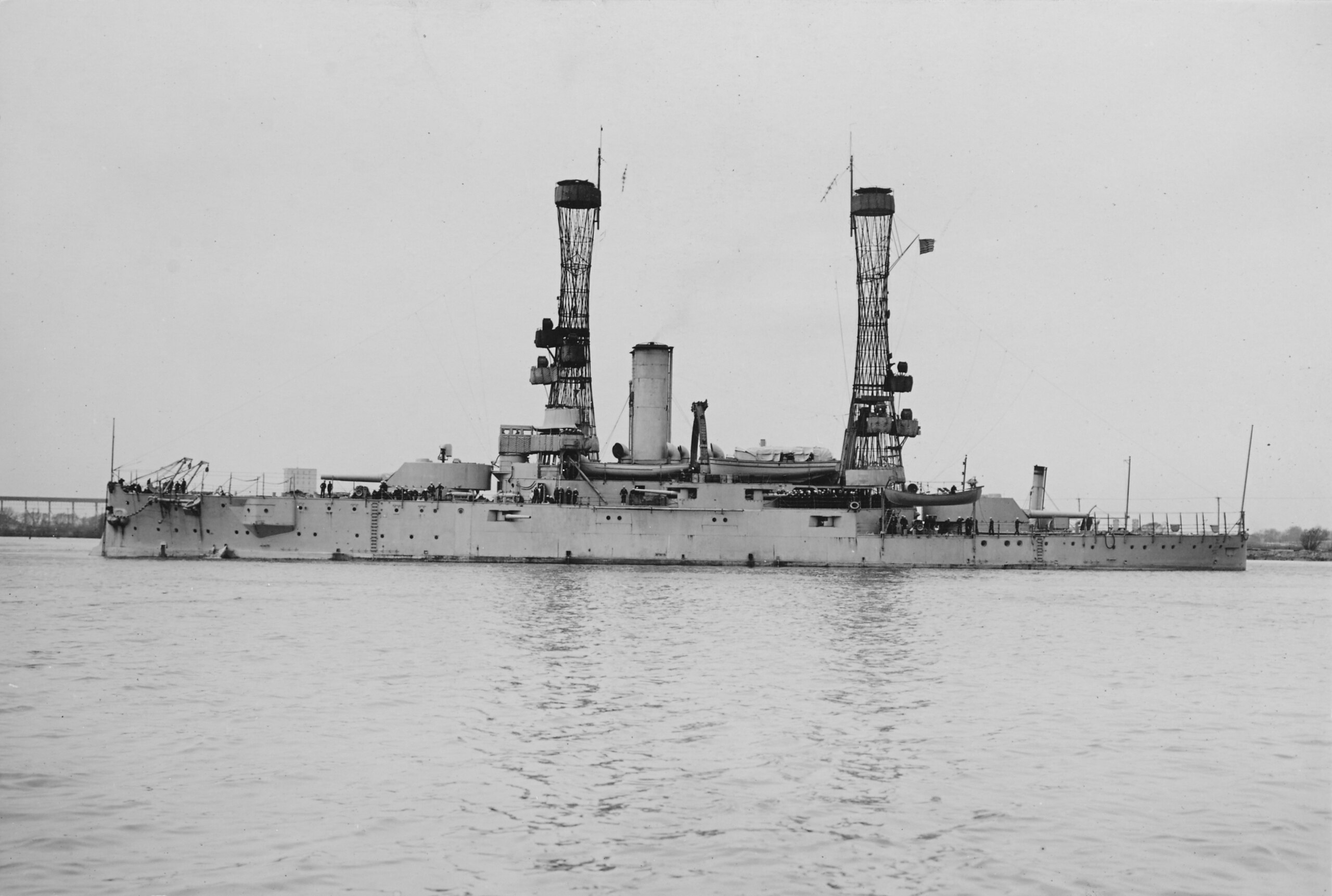
Their summer cruise of 1914 was held on the cusp of war and all reports indicated that the laxness they found in the first ship they sailed on was a fleeting memory.
The Captain of the USS Missouri (or Misery as it was renamed in the memory books) seemed intent on making sure these young men knew that they were going to be part of a man’s navy and laxness was not going to be allowed to exist above or below decks. Maybe it was the seriousness of the situation in Europe and maybe he was just a hard liner, but in either case, there is much less written about this cruise than the first.
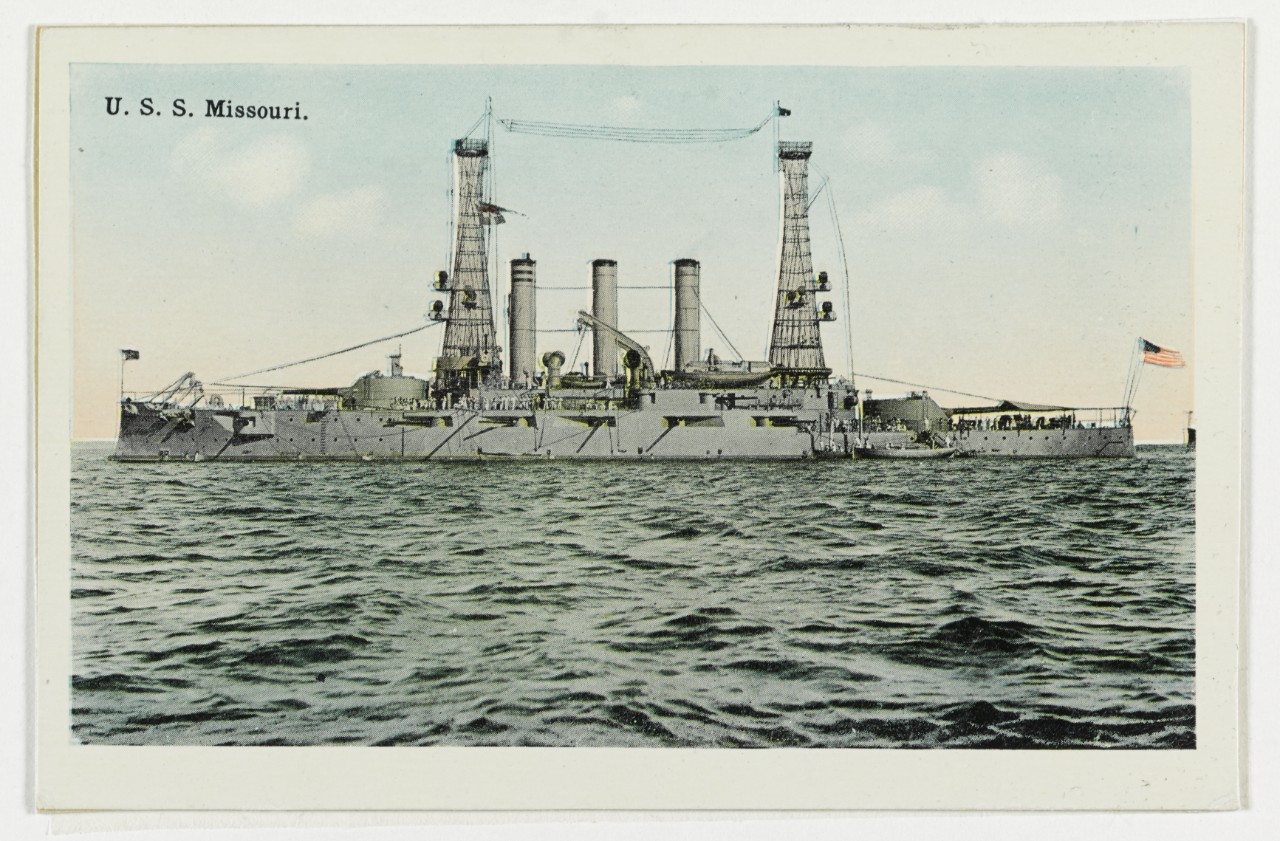
War would break out in August as they were departing for home and the escorts they received as they left England were reflective of the changes. Even in the opening phases of the conflict, it was obvious that something was different. No one in the summer of 1914 could imagine how much things would really change.
One of the rare glimpses of Midshipman Young comes from his portrayal in the Lucky Bag of 1916.
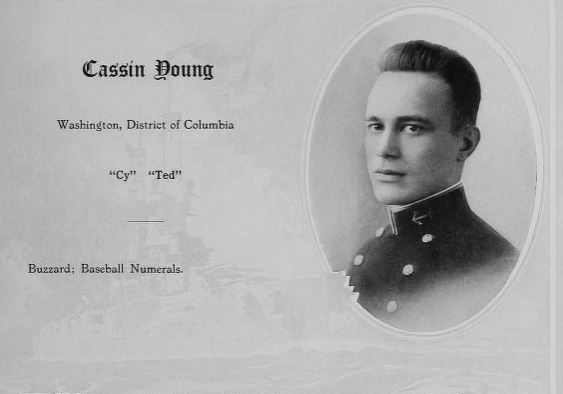
The picture in the book shows a handsome young man who is described as an olive complexioned man with dark eyes. The cruises were a major part of his existence and the trips abroad were more than memorable. In fact, it is stated that “his experiences would make a very clever tale in the hands of the rankest amateur, but when Ted acts as his own historian – light your pipe and gang closer.” The adventures of travel would only be matched by the adventures of the types of duties he would experience as he progressed through his navy journey. Just as he was in the exact right place for the new directions the navy was taking, he would find himself at the cutting edge of many of the changes for the next few decades. It would come to seem that the entire journey was scripted. The last paragraph of his page in the Lucky Bag was more prophetic than the authors could have imagined: “Teddy was made to enjoy life – that is while he is young – but some day he’ll grow up and his abilities, which in here were at times obscured by his indifference to mere matters such as regulations, etc., will come to the surface, and Ted will then get the confidence that his abilities deserve.”

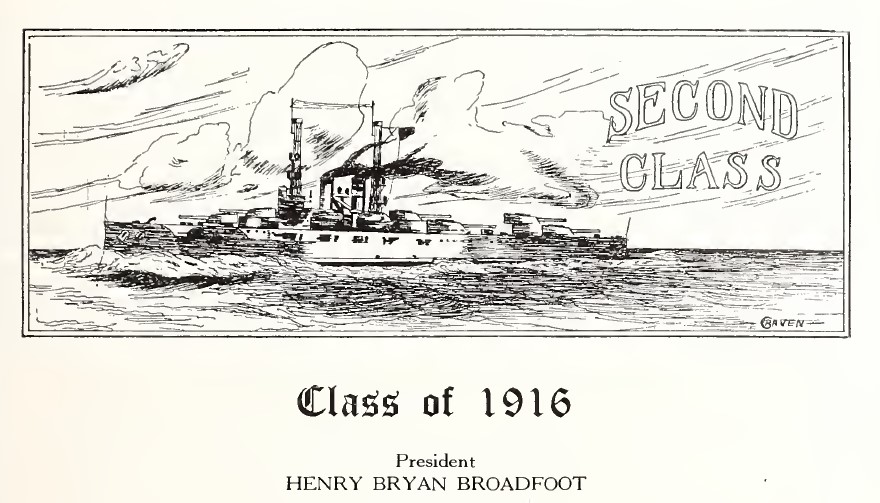
Young and his fellow midshipmen returned to their studies at Annapolis in the fall of 1914 and the old routines set the pace once more. Classes, drills, discipline, study, athletics and all of the things that made up life at the academy. Midshipman Young was now a Second Classman and with that came the responsibilities of a more seasoned man. The battle with 2.5 was the principle battle many of the middies found themselves fighting on a day to day basis. The improved curriculum was harder each year as the advances in technology caught up with the navy. Calculus and geometry were mixed in with the language classes that continued to dog the men.
Outside of the walls, the clash of great armies in Europe was beginning to explode in a cataclysmic way. Country after country fell in line with old alliances and took to arms against one another. Weapons of a new and terrible nature were in their infancy but would change the course of war forever. Guns that could lob shells beyond the sight of their crews brought death and destruction to millions of men in poorly constructed hovels. Machine guns and flying machines advanced in lethality as quickly as the need for more destruction became obvious. Even the vast oceans were affected as the magnificent fleet of the British Empire squared off against the up and coming fleet of the German Navy. But as great as the Grand Fleet was, it was ill prepared for the newer types of weapons that would emerge. One of those weapons was a newly developed technology that would become both despised and feared. The submarine menace.
One officer of the US Navy would not be present to see the return of the midshipmen from their summer cruise.
In July of 1914, Captain Gibbons, the former commandant who had been transferred to command the USS Iowa, was “plucked” along with fourteen other navy officers and forced to retire. Plucking was an odd custom in the navy which allowed a board of fellow officers to reduce the number of officers involuntarily in order to provide room for advancement and keep the number of certain ranks at or below congressional limits.
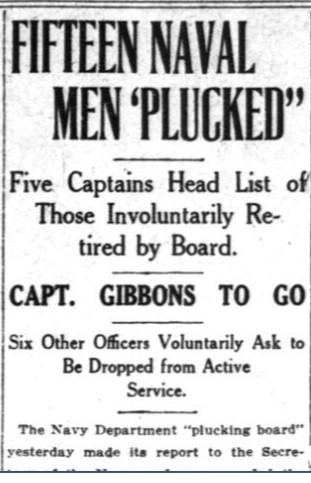
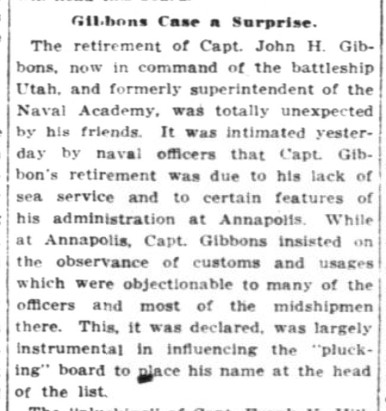
Articles from that time indicate that many were shocked to learn of Gibbons forced departure since he had been so instrumental in making the difficult changes to the academy. But some of the information that leaked out indicated that his place on the Plucking List was directly related to the way he had reformed the academy. As it was stated in the local papers (as quoted from unnamed naval sources) “Captain Gibbons insisted on the observance of customs and usages which were objectionable to many of the officers and most of the midshipmen there. This, it was declared, was largely instrumental in placing his name at the head of the list.” It was not stated in the articles, but the inclusion of a number of midshipmen in broad punishments whose fathers were in congress and in the navy family may have had some weight in deciding his fate as well.
Gibbon’s replacement would face his own challenges with the external forces that drove the direction of the Academy.
His struggles would dwarf those of his predecessor and have a profound effect on his and the academies future.

 theleansubmariner