I belong to a writer’s circle at the community where I live
I have to be honest and say that I have not been to as many sessions as I should have. The caliber of the writers is excellent, and I am trying to humbly learn how to put my words and thoughts together more clearly. It’s a journey.
I was dashing from one meeting to another today and struggling with some team issues. To be honest, calling them team issues is a misnomer. I am having some group issues. Coming from a life of submarines and corporate structures, I have seen the best and worst of both teams and groups. Learning the difference between the two has been something that has helped me as a leader and as a member. That learning is ongoing, and I often find myself in need of a refresher. SO, my input to the writer’s circle was a reflection on that age old dilemma:
What is the difference between a group and a team?
During my work life, I did a lot of team building training. My time in the navy was focused on building strong teams. It must be recognized that no individual has all of the skills, knowledge or abilities (KSA) to accomplish every task that a group may face. Whether it is accomplishing a goal or overcoming a problem, the group often requires people of various combinations of each of the three areas to achieve success.

Submarines provide the most valuable lessons about the need to build a cohesive team. After all, it is life and death and there are few second chances once the boat leaves the pier. Even the worst submarine experience I can remember was overcome by the actions of a team with a shared vision and the ability to problem solve with little to no extraordinary effort. Sadly, I am too old to ride the boats anymore, so I find myself mired in the land of team mediocrity.

But the question remains, what separates a group from a team?
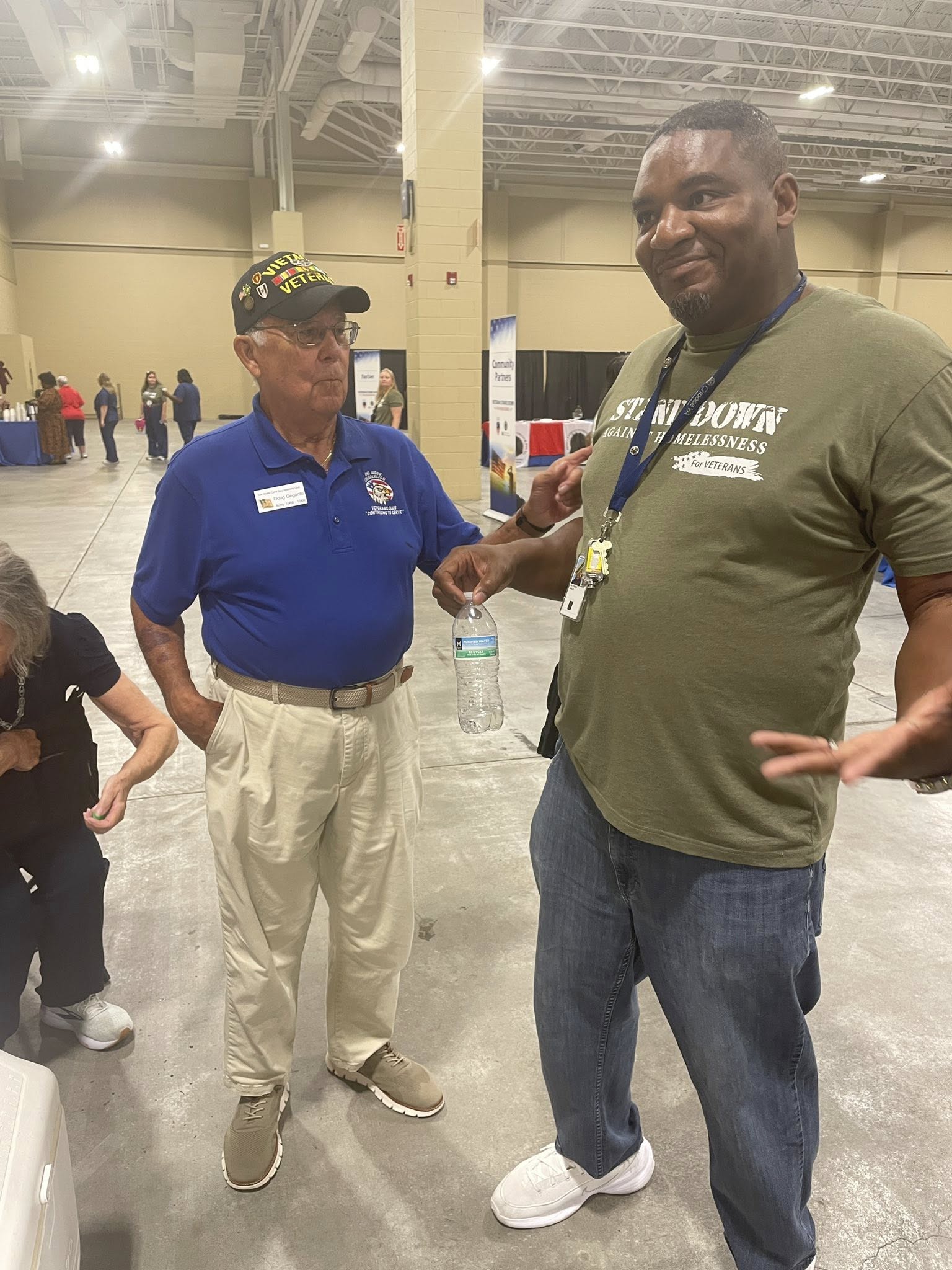
This week, I was seeking some help from a group that I am marginally in charge of. I say marginally since I was elected when no one else wanted the position. There are 148 people on my email list, but most meetings only see about thirty or so people. We were given the opportunity to serve at a Homeless Veteran’s Stand Down in North Charleston. This area has a large homeless population due to our milder weather. Our purpose was to be one of the providers of beverages and snacks while the homeless veterans navigated through the many vendors that were there to help them. It was a phenomenal day, and I had a chance to interact with many of my brothers and sisters who find themselves in a bad way. We can argue all day about why and how, but I saw at least a few dozen female veterans that were in attendance. Many of them served on tenders and other non-combatant ships. But all of them had good attitudes and it was a joy to see the light in their eyes when I asked them about their service and thanked them.

The hard part for me was that of the 148 members of my group, only three showed up to serve. Four counting one of the wives. I guess I discovered that without any doubt, I am the President of a group. There are some great people that are part of that group. All are veterans who have served before, and I honor that service. Many also did amazing things long before I showed up. Age and infirmary conditions have taken their toll. But it did remind me that understanding the difference between a group and a team is an ongoing struggle.

Defining a group is pretty easy.
A group is best defined as a collection of people who have a common interest in a subject or area of interest. There are loosely defined goals or objectives and there is very limited leadership. That leadership may be one or more members who have the strongest interest in the overall purpose but are not reliant on the approval of the rest of the group to move the group in one direction or another. Association is a choice and often people move in and out of the group without any effect on what their activities are.
Some examples are car enthusiasts or sports clubs. There is a common interest in the subject but in many cases, structure is very loosely defined. There is absolutely nothing wrong with the group structure as long as it is understood that very little will be achieved in the way of a goal or mission.
Some simple reminders of how groups function:
- Individuals work independently – sometimes at cross-purposes
- Members are not involved in planning
- Suggestions are not encouraged
- Members do not trust the motives of others
- Game playing occurs; members are cautious about what they say
- Members may be limited in applying their skills
- Individuals cannot resolve conflict situations
- Conformity is more important than results

A team is something very different.
Members are focused on team goals and support
Members have ownership because of planning
Members are actively involved in decisions
Members work in a climate of trust; questions are welcomed
Members practice open and honest communication
Members are encouraged to develop and use skills
Members use collective skills to solve problems
Members participate in decisions – results are everyone’s’ goal
But anyone who has been involved in an effort recognizes that team building and teamwork can be difficult. You almost need to start by asking yourself why teamwork is so difficult to implement?
There are some things about this that may help us to understand the root causes.
We have been programmed from the first grade to apply teamwork to sports and organized recreation. That doesn’t always transfer to other activities. For instance, in the education system that most of us grew up in learning and accomplishing tasks is an individual activity. I was always taught that my own activities would give me an advantage or disadvantage later in life.
In the classroom, we worked individually on our learning objectives
- Don’t talk!
- Don’t copy!
- Don’t give someone else the answers!
- Always try to be the best with the highest grades (teamwork is sometimes called cheating)
The reward systems were based on individual work in school. Who would be in the upper parts of the class and where would those who struggled end up. In my case, I struggled to focus and my grades placed me in a non-achieving group. The teachers tended to focus more on the high achievers and the rest of us could just do the best we were able. Frankly, in my hometown, you didn’t need much education to work in the steel mills or the coal mines. Both were high paying jobs and most of the people who ended up there did quite well. At least until the mills and the mines closed.
Even in our adult lives, we were separated by the way we were measured in our chosen fields. Performance evaluations, merit raises, promotions, and opportunities for life improvement were measures we all had to live up to in order to improve our status in life.
The organizational structure we grew up with was not built to make teams effective. So how do we overcome them?
To be successful in a team environment means that some fundamental changes need to be made to the way we think and how we interact with others. New disciplines need to me inculcated into the thinking process and much resistance needs to be overcome. It requires a focused kind of leadership that understands the basics of team development and structure.
Teamwork requires collaboration (co-labor), working together toward a common goal. Collaboration can allow ordinary/average individuals to review problems and issues and come up with brilliant ideas and solutions.
Effective collaboration requires us to abandon the “me” approach and look at work and problem solving as an “us” approach. Team building is a process of awareness building. It is helping people understand they can accomplish much more collectively than alone. There are barriers at work in this process. Not only the barrier already mentioned about individual achievements but the barriers of communications and reinforced ideologies. We all carry a lifetime of prejudices and opinions. Allowing yourself to set those aside for the achievement of a common goal can be daunting. After all, the experiences that caused you to “own” those beliefs are probably pretty deeply ingrained and reinforced by some pain or pleasure reinforcement.
Getting to collaboration is the key to successful team building.
Effective collaboration requires us to abandon the “me” approach and look at work and problem solving as an “us” approach. Part of team building is conscientiously developing a process of awareness building. It is helping people understand they can accomplish much more collectively than alone. In most cases, it is suspending your old beliefs and embracing the new approach.

Years ago, I learned that there are at least seven things that contribute to a successful team.
- Commitment
- Contribution
- Communication
- Cooperation
- Conflict management
- Change management
- Connections
Commitment is the first element. The team members must have a clear sense of direction, must be behind the objectives and are willing to put the team goals ahead of personal goals.
Contribution means that everyone understands that the success of the team depends on the skills and knowledge of all the members. Everyone is involved…and gives their input. If you find people are not raising their hands to achieve a goal that was agreed upon, a quick analysis of commitment needs to be revisited.
Communication may be third on the list, but it applies to every element of success. There must be an open sharing of ideas, criticism, and attitudes without making it personal. Good communication skills are present (listening, discussion, language, etc.). A lot of energy must be invested into communications for the team to work successfully.
Cooperation has five basic elements:
- Follow-through
- Accuracy
- Creativity
- Timeliness
- Spirit
Conflict management is critical. There will be conflict! The key is managing it. It requires understanding of each other and acceptance of consensus. Of all the classes I have taught in my career as a consultant, this is the most requested subject.
Change management is understanding that in the world we live in, there will be changes. A successful team not only understands that but embraces it, looks for the opportunities that can come with change and then manages the process through the change.
Connections means that the team recognizes that they don’t operate in a vacuum. A successful team develops good rapport with the larger organization, the other teams it interacts with, team leaders and team members.

 theleansubmariner
one of the best ones you’ve ever written Mr Mac
Thanks my friend. Wishing you the best
Mac