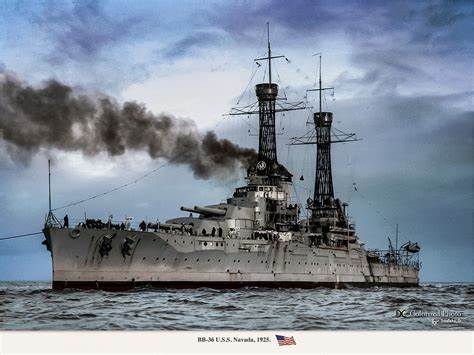
A little under fifteen years from the day the US Navy purchased their first submarine, the future of the small craft was still not settled. In 1915, the United States faced a number of challenges as it observed the growing war in Europe. The conflagration of large-scale war was being brought home to America in the newspaper of the day. This war was being thrust on many nations because of long standing agreements and treaties. Once it began, it grew rapidly like a wildfire.
The United States had long neglected their navy and army despite Teddy Roosevelt’s attempts to make his country a global force. The sailing of the Great White Fleet was a distant memory by 1915, and the fleet was a hollow shell of its former greatness. Woodrow Wilson was president, and his Secretary of the Navy was Josephus Daniels. Daniels was a former newspaper editor who saw the navy as a vast social experiment. He instituted many reforms including abolishing liquor on board navy ships and stations and educational reforms for both the academy and the population of enlisted men.

But as progressive as he was in human resource related issues, he was heavily influenced by the admirals who still clung to the notion that we needed bigger ships with heavier armor and bigger guns. The battleship mentality was one shared by most of the leading navies of the world, and the plan for building these behemoths was the leaderships answer to preparing for any potential role in the growing war.
An opposing voice
The NAVY was a publication published in Washington DC from 1908-1916. My suspicion was that it was a voice for many people who were concerned about the weakness of the US Navy in a world that was growing increasingly hostile. When Daniels was named as Secretary of the Navy, the publication openly opposed many of his activities and decisions.
Daniels supported native Southerner Woodrow Wilson in the 1912 presidential election. After Wilson’s victory, he was appointed as Secretary of the Navy. Secretary Daniels held the post from 1913 to 1921, throughout the Wilson administration, overseeing the Navy during World War I. Franklin D. Roosevelt, a future US president, served as his Assistant Secretary of the Navy.
Daniels was a very complicated man in many ways. He would institute many reforms in technology once the war began and America became part of it. But in the leadup, he was reticent to seek modern day solutions at the expense of the big ships. This was unfortunate since it meant that aircraft and submarine development were hampered.
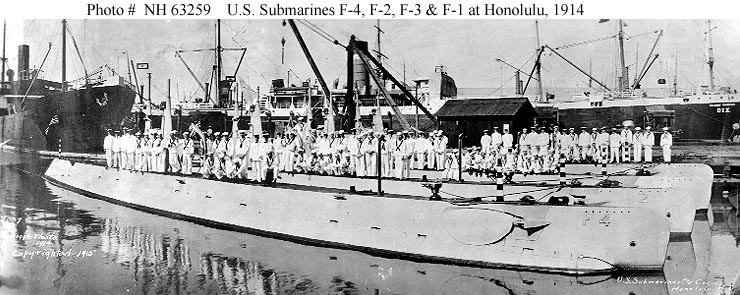
The following article was printed in March of 1915. The submarine had already proven itself to be an enormous influence in the sea war. The vaunted British fleet was hobbled by some crushing blows caused by submarines. No one in their wildest imagination could have projected that the fleet would have to literally hide from the enemy as commerce and military units alike were sent to the bottom of the ocean.

The NAVY
March 1915 EDITORIALS
THE DEVELOPMENT OF THE SUBMARINE
A clause in the Naval Appropriation Bill requests the Secretary of the Navy to submit to Congress next December plans and specifications for building four warships that, in the Secretary’s opinion, formed from the knowledge that he may have gained from the results of naval engagements in the war now being waged in Europe, will be best adapted for naval warfare.
This is a most commendable request and is one that shows, beyond cavil, that Congress is seeking the necessary knowledge for a logical development of the United States navy. But the value of the information which may be given to Congress, if precedents count for anything, will depend entirely on the personal bias of the Secretary.
It would have been much better if Congress had appointed or authorized the appointment of a commission of naval experts whose duty it would be to obtain that important information.
Apropos to this statement is the fact that, although Congress appears to be willing to investigate present conditions of naval efficiency, it appears, if press reports are to be given credence, that Secretary Daniels is so ultra conservative that he is unwilling even to consider the building of a sea-going submarine with a surface speed of twenty – five knots. The newspapers state that the Secretary considers such a vessel as unreasonable and unnecessary.
This is the same habitual conservatism that has so often been exhibited by government officials; it is the conservatism — not to use a less euphemistic term that delayed the introduction of steam power for the propulsion of warships ; that nearly prevented the building of the Monitor by Ericson ; that delayed the development of the submarine for fifteen years ; that has prevented the development of aeronautics in the army and navy; and it was responsible for England , instead of the United States, building the first Dreadnought .
The argument advanced by department officials against the building of submarines of high speed and a large radius of action is that the Diesel engine cannot drive a submarine at that speed, without sacrificing too much weight and space to motive power; neither could Fulton’s engine drive an ocean liner across the Atlantic in six days; but the latent potential power lay in steam and awaited only its developments by the hands of man to produce present – day results.
The engines used at present in submarines cannot develop a high speed, but naval constructors are fully expecting an improvement in the internal combustion type of engine on the principle of the turbine which in all probability will give the power necessary to develop the required speed within practical limits of space and weight.
Because a submarine has never as yet been built with a speed of 25 knots per hour is no reason why one should not be built with even a greater speed than that, and a far greater radius of action than the best submarine possesses today.
It is evident that naval conditions are in a state of transition, and while it is not intended to deprecate in any way the building of Dreadnoughts , our most valuable means of offensive and defensive, it must be apparent to anyone who is at all conversant with the lessons thus far taught by the present European war, that the Dread nought has been shown to be woefully deficient in the power to protect herself against underwater attacks .
German ships of this class have been contained in home ports, but Germany’s naval activities and successes have been remarkable when the fact is taken into consideration that it has been impossible to use the most powerful units of the German fleet. If the same money that has been invested in super-dreadnoughts for the German navy had been spent in the building of a very large fleet of submarines, the iron ring, which the press at present say is thrown around England by these wasps of the German navy, there might have been established a successful blockade of the entire shores of the British Isles. Even with those who have been built merely as naval auxiliaries, England has been compelled during the past week to suspend the sailing of all foreign-going vessels, and within that same period twenty merchant vessels have been sent to the bottom; while in the early days of the war the Formidable and the Bulwark were destroyed; the three cruisers, Aboukir, Cressy, and Hogue were sunk by a single German submarine within an hour of each other on September 22; and on October 16, the British cruiser Hawke was sunk by a submarine, while the British dreadnought Audacious was seriously injured by some under water weapon, the character of which at present is unknown . On January 21 the English squadron, which pursued the German warships that were attempting a raid on the English coast, were compelled to turn back, according to official accounts, because they had approached a fleet of German submarines and a mine area that threatened their existence, contenting themselves with merely sinking a single German warship, the Blücher.
If results thus far attained in the European war are used as a criterion of coming naval development , it cannot be questioned but that in the near future naval development lies along the lines of the submersible type of fighting vessels; and if our navy department has turned its face deliberately away from the consideration of any correction of the present deficiencies of submarines, it is safe to prophesy that the United States will in a short time no longer possess a modern navy.
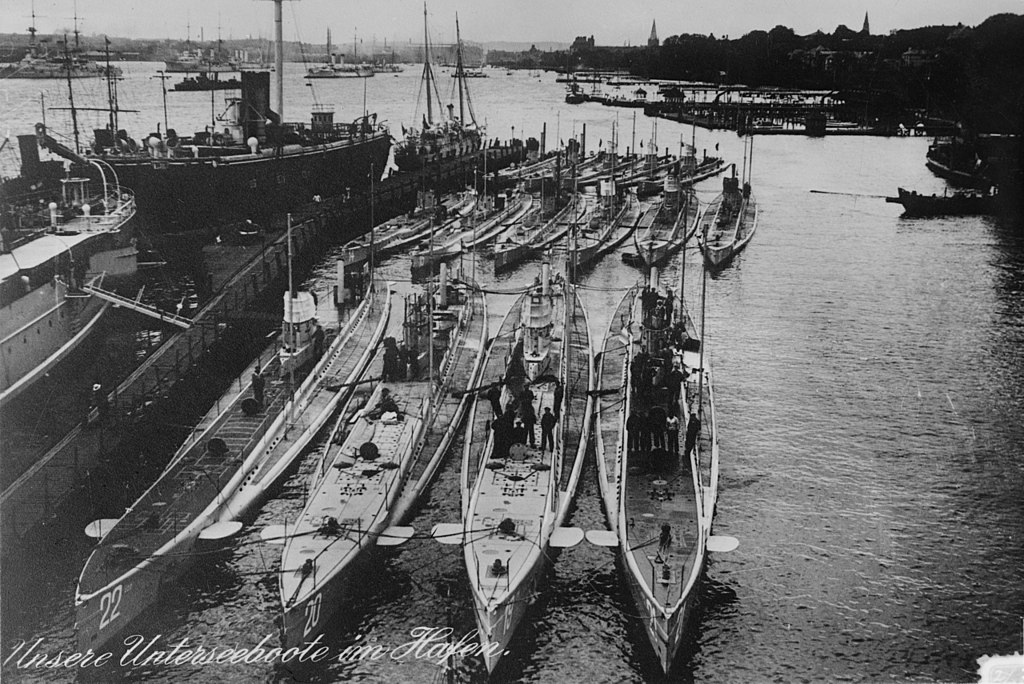
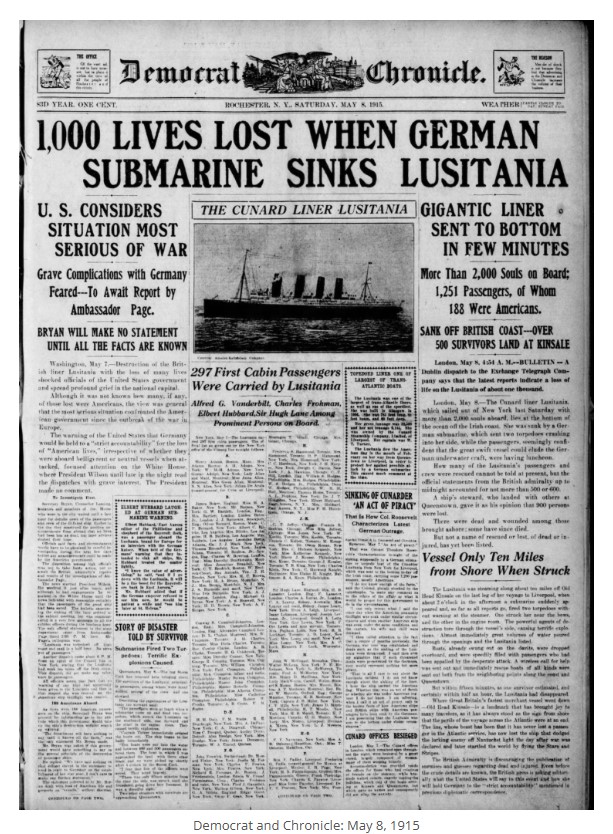
Two months later, a controversial sinking would shake the world.
The RMS Lusitania was a luxury ocean liner that sank off the coast of Ireland after being torpedoed by a German U-boat on the afternoon of May 7, 1915. The ship carrying 1,959 passengers and crew went down in 18 minutes, claiming the lives of nearly 1,200 people, including 123 Americans. The tragedy swayed public opinion and indirectly led to the United States entering WWI.

American Submarine development suddenly gained traction
The voices of the submarine community finally could be heard in many corners. The successes of the U-boats made the world take notice that a relatively smaller investment would change the course of any global contact. Captured U-boats helped advance the technology of the allied navies. The second world war would once again show the power of submarines, and the captured technology of the German war machine would largely lead the free world and the Soviets into another arms race called the Cold War. But one thing that all agreed upon. The day of the large battleship fleets was dead and gone forever. Technology would put the final nail in the coffin of these expensive weapons platforms.
Mister Mac

 theleansubmariner