In the beginning… building a submarine despite the odds (1900)
The 125th Anniversary of the United States Submarine force will occur in April of 2025. This is one of a number of articles related to that celebration.
I spend a lot of time researching history and my favorite source material comes from the National Archives. Specifically, I use a lot of information that comes from newspapers that have been captured in electronic format and can be searched by subject matter and date. In the past, many of my posts were about submarine development and particularly about early submarine advances and challenges. In the year 1900, technology was advancing at a rapid rate. Electricity and power generation were some of the key areas that were significant. The industrial revolution had produced the raw materials that made many of the inventions practical.
An article in January of that year talked about the mountain of patents that were filed and the success and failure of many of them. Inventors were the pioneers of the age and everything form wireless radio to potential for manned flight were already on the books. They actual achievement of many patents was still in the dreaming stage, but the government filed them, nonetheless.
Submarines had long been dreamed of for use in protecting America’s interests.
But coming up with the right model had challenged Holland and others. In March, l895, the Government contracted with the John P. Holland Torpedo Boat Company to build a submarine torpedo boat at a cost of $150,000, the work to be completed March 1″, 1896. The Holland company sublet the contract to the Columbian Iron Works and Dry Dock Company of Baltimore. Md., but the construction of the vessel was never completed. It has been found to be a failure in following the original plans, and its machinery had to be changed. The oil fuel system was changed to gas and other radical changes were made. It was found that by using the original system of generating power, men could not live when the boat was beneath the surface of the water.
But by 1900, Holland was ready for a test run. The newspapers in January of that year were used as a method of paving the way both for the navy as well as the public. One of these was part of a scientific series of articles by Professor William J. Hopkins of the Drexel Institute for The Call’s Home Study Circle, The Drexel Institute was becoming known for their advancement of scientific thought.

SUBMARINE BOATS.
The study of submarine navigation Is far from new. Within the last few years, however, it has been revived and pursued with renewed energy, especially in the United States and in France, and the performances of the boats have been followed by the public with great Interest.
A submarine boat must first of all be habitable both on the surface and beneath it. Otherwise, it is no more than a torpedo. It must be sufficiently under the control of the pilot and go down or up to either side as he directs. Great speed is not necessary, but to be useful it must have reasonably great range of action. In other words, it must be able to operate at a reasonable distance from Its port without becoming helpless and unable to return because of loss of motive power.
Habitability.
The principal thing necessary to make a submarine boat habitable is an adequate supply of air.
For this the crew must depend upon the supply carried in the boat, or there must be communication with the surface through supply and exhaust tubes through which the air is forced by pumps. Both methods have been used, either separately or in combination. The more modern boats are provided with an abundant supply of compressed air in tanks, sufficient in some cases to enable the crew to live comfortably at the bottom for a day or longer, besides serving other purposes in the operation of the boat. Liquid air may possibly be serviceable for such purposes.
Methods of Propulsion
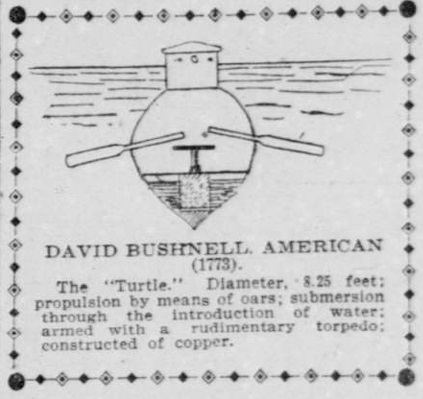
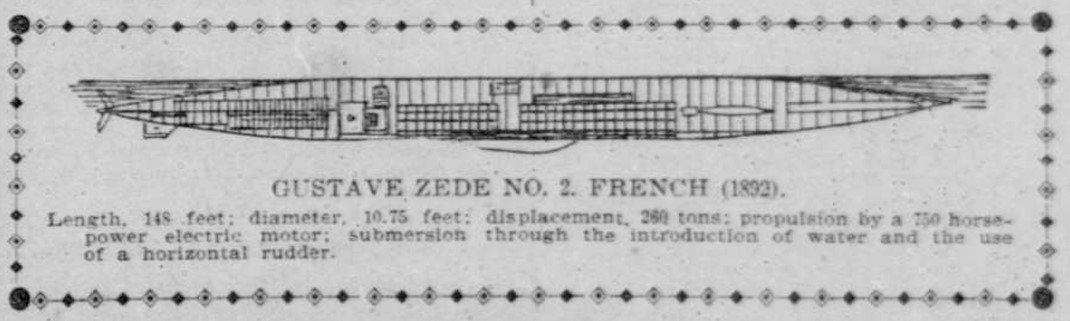
The submarine boats of a century ago were propelled while under water by oars or a wheel. The oars projected through the sides with water-tight joints of oiled leather and could be feathered or turned edgewise on the return stroke. What kind of a wheel was used is not clear, but it probably was not a screw. Since the invention of the screw, however, all boats have used it. In some of the earlier screw boats no motor was provided, and the screw had to be turned by hand. The boat used with ultimate success by the Confederate forces in the Civil War was propelled in this way. Now, two forms of motor are usually provided. A steam, gas or oil engine can be used at the surface, but not beneath it, where there are no way of escape for the smoke or gases. The motor for propulsion under water is in general electric, although superheated water or compressed air may be used. A liquid air motor would possess some advantages for such service. Two of the most successful French boats designed by Zede used electric motors only, supplied by accumulators. Their capacity is sufficient to give a range of action of thirty-five or forty miles.
Methods of Submergence.
Submergence is accomplished principally by the admission of water into tans arranged for the purpose. This is in some cases supplemented by vertical screws by horizontal rudders or vanes. A boat in motion may be made to go under the water by changing the angle of the horizontal vanes, but if the forward motion should cease, the boat without water ballast would rise to the surface again. Any boat which depends on the use of vanes for submergence is more properly a diving or plunging boat. Several of the modern boats can be steered in this way, among them those of Nordenfelt, Zede, Peral and Holland. In the Goubt, Baker and Tuck boats the angle of the propellers can be changed, thus changing the course. An-other ingenious method of submergence is by a change in volume, which may be accomplished by the use of watertight pistons. This, however. Is only a particular way of admitting water ballast. Although much popular enthusiasm has recently been aroused in France by the performances of two or three boats, we may leave them without further description and pass at once to the consideration of the boats which have the most interest for us – those of Holland and of Lake.
The Holland
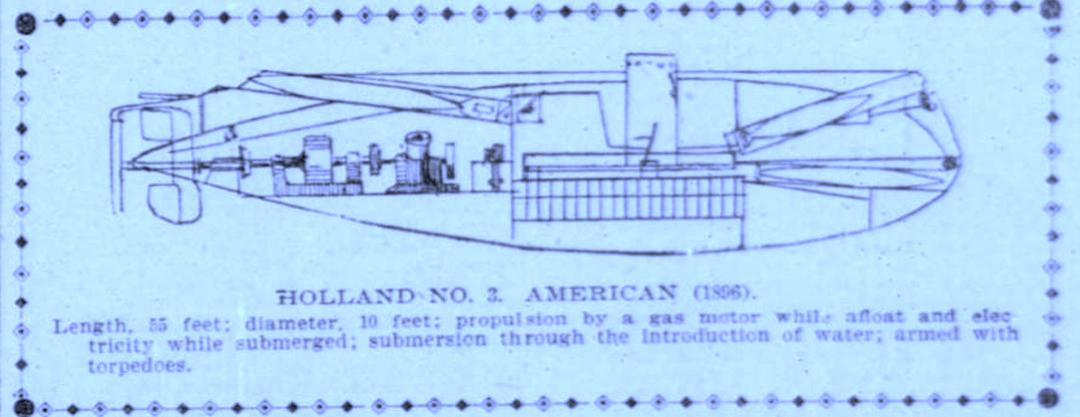
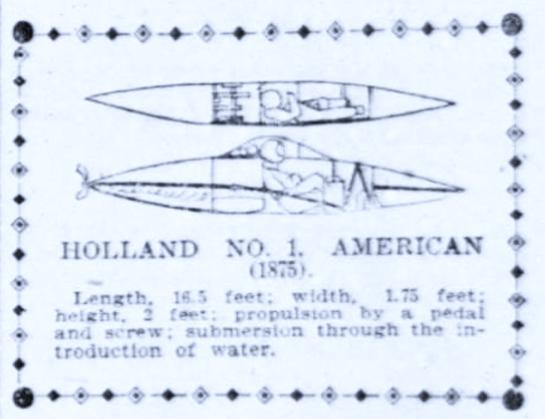
There have been three Holland boats. The first was a very small one, holding but one man. who propelled the boat by working the screw with his feet while half reclining in a very uncomfortable position. The boat was only two feet high and less than two feet wide. The second, known as the Plunger, the largest of the three, is complicated by a great deal of machinery. The third is the one of which we have heard so much in the last three years.
The appearance of this boat at once suggests the whale. It is fifty-five feet long, ten feet in diameter and circular in section. At about the center of the back is the conning tower, in which the pilot stands, and a narrow platform extends lengthwise of the boat for use at the surface. Under it is a small storage space. The boat is propelled by a gas motor while afloat and by an electric motor white submerged. Submersion is by water ballast or by horizontal vanes, or both. The boat carries an abundant supply of compressed air and is armed with torpedoes, two aerial and one submarine. The trials of this boat have been very successful and her performances appear to be reliable. In her official trial before the navy board about a year ago she made several successful dives and ran for a considerable distance ten feet below the surface with scarcely an appreciable variation from her course. The course, when under water, is largely a matter of guesswork, as the compass inside a steel boat is of little or no service.
The proper function of a submarine torpedo boat is said by experts to be, to act one part in the scheme of harbor defense or to clear an entrance of mines. It is much more limited than is generally supposed.
The Lake Boat.
Nearly if not quite all the boats-except those of Lake are Intended for war purposes only. Lake, however, is built on a different plan and his boats are intended chiefly for peaceful pursuits. The fundamental difference is this: Other boats are Intended to navigate between the surface and the bottom. The Argonaut, the name which Lake has given to each of his boats, is intended to navigate on the surface or on the bottom. Surface navigation is provided for in the usual way. For progressing on the bottom there are three wheels, one of which serves for steering. The other two are worked by the motors and may be assisted by the screw. The latest Argonaut, launched last summer, has a regular yacht body built above the submarine boat, so that when sailing on the surface the crew can live comfortably as on any surface boat. When itis desired to go to the bottom the crew retires into the metal shell, which Is closed, and anchor weights are lowered until they rest on the bottom. Water ballast is then taken in and the anchor chains are wound up, pulling the boat down. By regulating the amount of water admitted the boat may-be made to rest on the wheels with any desired pressure, according to the character of the bottom over which she has to proceed. Plenty of compressed air is carried in tanks, but its use is chiefly mechanical, as air is pumped in from the surface through tubes attached to floats.
The arrangement for giving the divers free access to the vessel when on the bottom is ingenious. The divers’ room is tightly closed and compressed air admitted until the pressure within is the same as that of the water without. Then the door in the bottom is opened. Water cannot enter because of the air pressure, and the divers can easily step in or out. Or a man can stand in the room quite dry and pickup articles from the bottom with a rake or fork.
The Argonaut is provided with pumps for sand and coal, and is designed to be used for recovering cargoes from wrecked vessels, as well as for all kinds of diverse work, such as cleaning ship’s bottoms and laying stones under water.
Note: This paper concludes the course in “Scientific Discoveries,” No examination will be set in this course.
The real examination was still in the making.
By April, a decision would be made that would change the course of naval history forever. America was on the verge of becoming a superpower despite the many misgivings of the admirals in charge of the fleets. Forty-one years later, this small investment would help to turn the tides of a war in ways that were still unimaginable in 1900. The world would never be the same.
Mister Mac
Holland Club
Class of 2024

 theleansubmariner