
One of my favorite books in my small collection about submarines is one that was written by Robert Hatfield Barnes in 1944. I did an extensive search about Mr. Barnes background and came up short. The copy I have has an inscription in the front that merely says “Dedicated to the officers and men of the United States Navy who go down under the sea. Robert Hatfield Barnes.”
In the book, Barnes accurately captures the development of submarines up until 1944. One section of the book was written to discuss the submarine endeavors of the Civil War. In February of 1864, the world got a glimpse of what the future of submarine warfare would look like. On a chilly night in Charleston Harbor, the Officer of the Deck of the USS Housatonic would spot what at first looked like a porpoise headed towards the ship. As it came closer, the terror must have washed over the now alert crew as they realized something new was afoot. The ensuing explosion erased any doubt.

From Barnes book:
SUBMARINES IN THE CIVIL WAR – Robert Hatfield Barnes
The first man-of-war in all history to be sunk by a submarine occurred during the Civil War. This was the Union steam sloop-of-war Housatonic which was torpedoed by the Confederate submarine Hunley while anchored in Charleston Harbor in 1864. Although this feat did not break the blockade of the Union forces at that port, it caused considerable consternation and anxiety among the Federal commanders. They did not know what to expect.
To break the strangulating effect of the North’s blockade, the Confederates resorted to devious schemes and subterfuges. On the sea, one method was the conversion of the former Union frigate Merrimac into an ironclad ram. After the Merrimac had won notable victories over the wooden sailing vessels, the frigate Congress and the sloop-of-war Cumberland, things looked bad indeed for the United States Navy. Great was the alarm and concern throughout the North, and had it not been for the introduction of a counter weapon, the outcome of the Civil War might have been entirely different. But when the Monitor appeared on the scene and routed the Merrimac, the doubtful control of sea power reverted to the Federals.
The Confederates became interested in the possibilities of submarine warfare, in 1862, when private citizens of the South built a subsea craft which was named the Pioneer. It was tried out in Lake Pontchartrain and intended for use against the Union forces at New Orleans. Moderately successful in its trials, this submarine was abandoned when New Orleans fell.
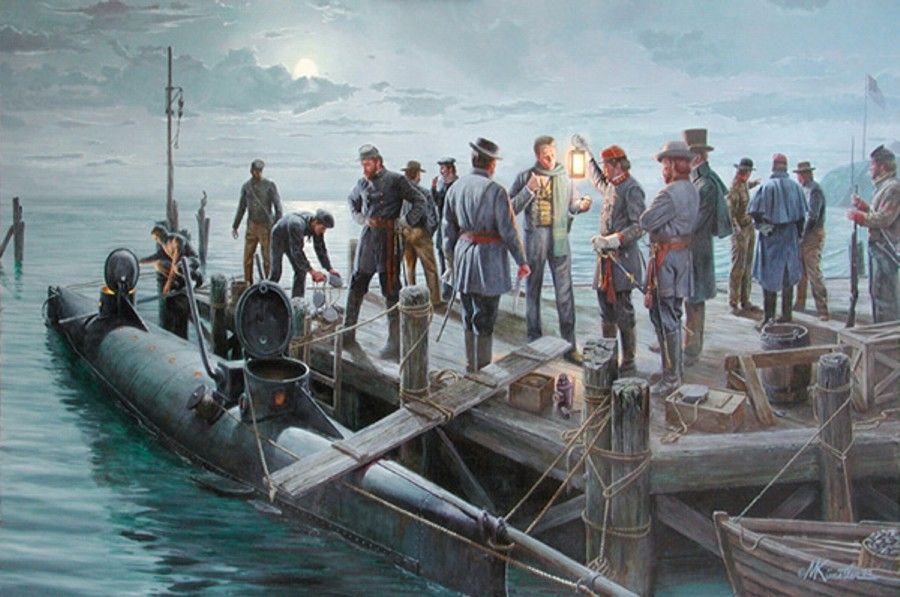
Horace L. Hunley was the principal figure in this group of private war workers. After building another submarine and losing it in a heavy sea in Mobile Bay, still another Hunley – type craft was constructed. It was this submarine which was later transported upon two flat cars to Charleston, South Carolina, there to attack the Federal ships.
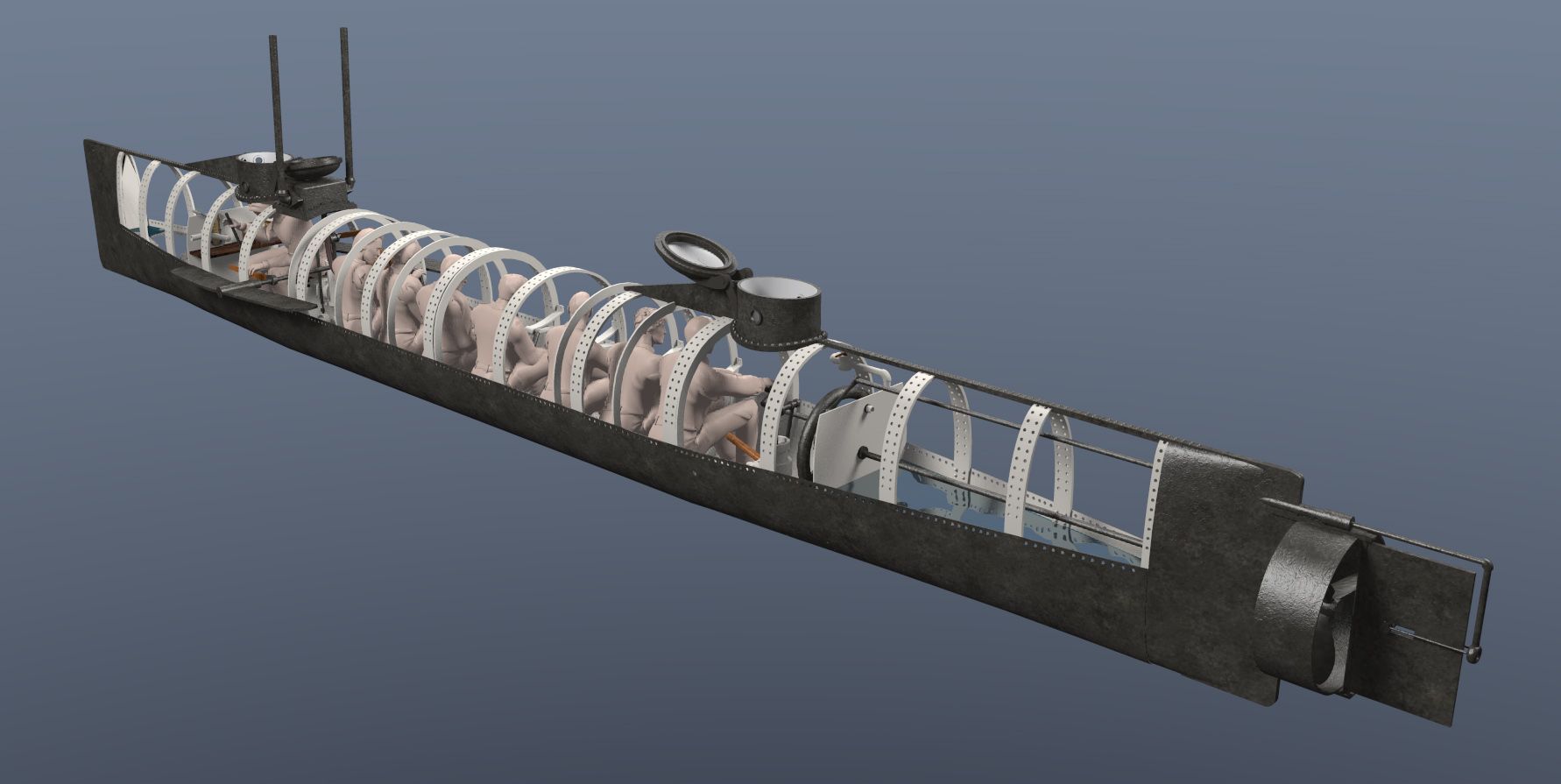
The Hunley was in the shape of a cylinder, twenty – five feet long, and forty-eight inches in diameter. It was manned by nine men, eight of them principally for the purpose of manning the eight hand cranks on the shaft connected to the propeller. Two ballast tanks were installed, one at each end of the vessel. In addition to the vertical rudder for steering, two side planes were provided — near the bow — for controlling the depth. There were two deck hatches, one forward and one aft. Cast iron weights were secured to the keel for releasing in any emergency.
The torpedo was towed and exploded on contact. The principle of operation was to head for an anchored vessel, dive underneath, come up on the other side, pulling the torpedo into the intended victim, thus blowing the vessel up.
During the period of her many dives, the Hunley sank to the bottom out of control five times, drowning a total of thirty-five volunteers. Her outstanding achievement in which she sank the Housatonic was never celebrated by her brave warriors. She and her crew also went down with the sloop-of-war, never to return to the surface again.
(See note at the end of this article)
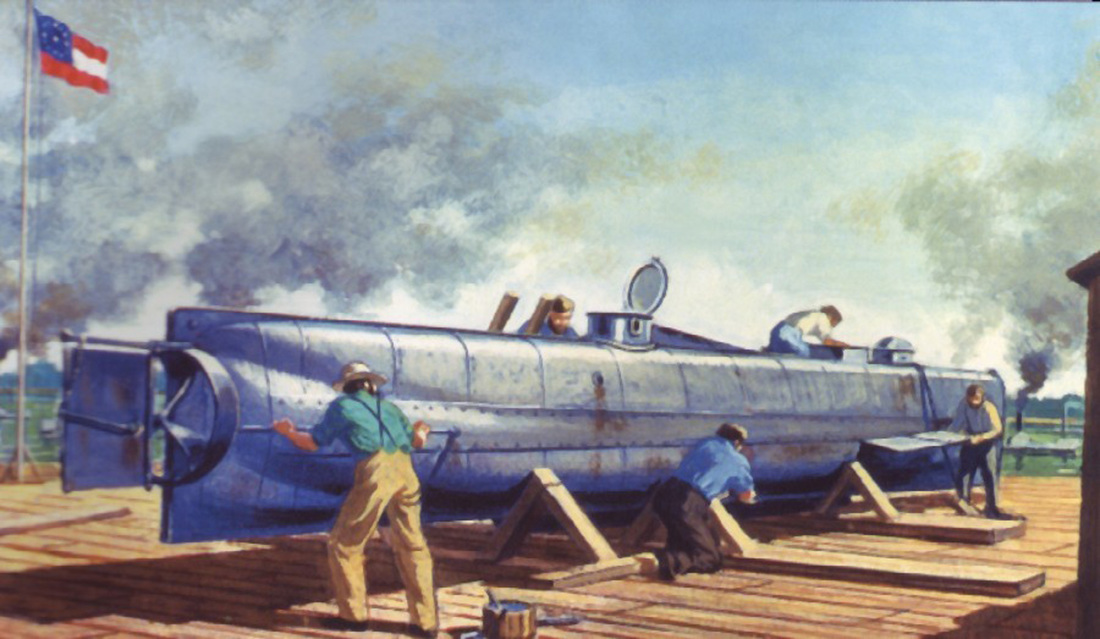
David Versus Goliath
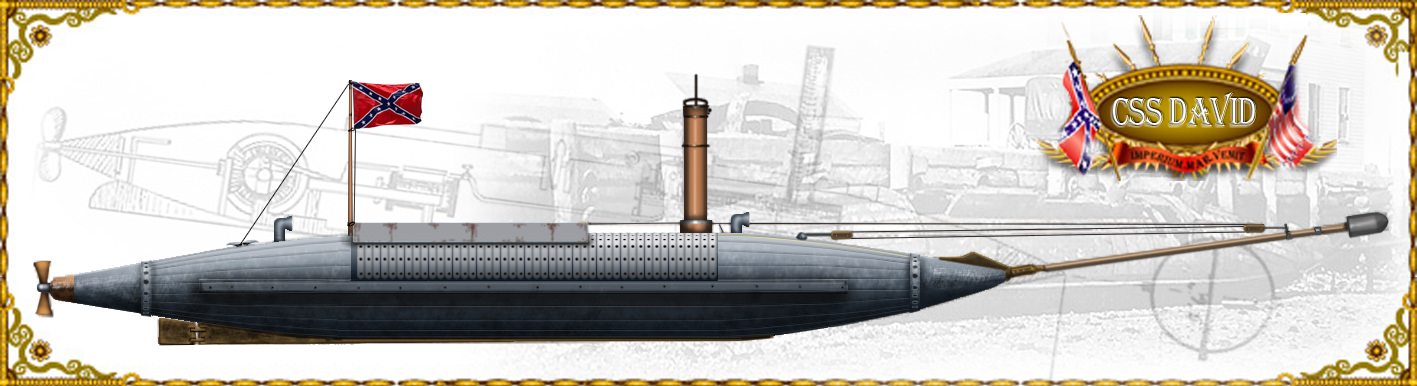
Several semi-type submarines, which were called “Davids,” in honor of David Bushnell, were also built and used by the Confederates. They were fifty – four feet long, with a pointed bow and stern; a beam of five point six feet, and the same dimension in depth in the center. They were propelled by steam, and submerged to the awash condition, that is, with the hull almost wholly submerged but with part of the top above the surface.
One night, in 1863, off Charleston, South Carolina, one of these ” Davids ” attacked the Union Ship New Ironsides. Now along with other vessels of her force, New Ironsides had been shifting anchorage each night to prevent surprise submarine attacks. She also surrounded herself with defensive booms and nets. On this particular occasion, the officer – of – the – deck sighted what appeared to be a water – soaked log approaching. Being suspicious, he ordered the quartermaster to hail it. Hardly had this been done when a hail of musketry came from the low, dark object, killing one of the ship’s officers. This was immediately followed by an explosion from a torpedo fired by the submarine, with the result that New Ironsides ‘ engine room was flooded and considerable damage done to the rigging above the waterline. Due to striking near the surface, the torpedo did not cause the destruction it might have inflicted had it been more submerged. Also, by being near the surface, the surface disturbance caused the swamping of the submarine. The commanding officers and two members of the crew were saved by a passing schooner.
From the official navy records, information about the danger was known before the night of February 17th.
JANUARY 7, 1864.
The “American Diver,” [H. L. Hunley] was built at Mobile and was brought on two platform cars from Mobile to Charleston; saw her in all stages of construction at Mobile. Sometimes worked near her in the same shop. Thinks she is about 35 feet long; height about same as “David” (5½ feet); has propellers at the end; she is not driven by steam, but her propeller is turned by hand. Has two manholes on the upper side, about 12 to 14 feet apart. The entrance into her is through these manholes, the covers being turned back. They are all used to look out of. (Will give a sketch and description of her.) She has had bad accidents hitherto, but was owing to those in her not understanding her. Thinks that she can be worked perfectly safe by persons who understand her. Can be driven 5 knots an hour without exertion to the men working her. Manholes are about 16 inches high and are just above water when trimmed. Believes was brought here about 1st September; has seen her working in the water afloat; passed her in the gigshe being [sic] the last time before his arrival. Has drowned three crews, one at Mobile and two here, 17 men in all. When she went down the last time, was on the bottom two weeks before she was raised. Saw her when she was raised the last time. They then hoisted her out of the water, refitted her, and got another crew. Saw her after that submerged. Saw her go under the Indian Chief, and then saw her go back under again. She made about one-half mile in the dives. Saw her dive under the Charleston; went under about 250 feet from her, and came up about 300 feet beyond her. Was about twenty minutes under the water when she went under the Indian Chief. Her keel is of cast iron, in sections, which can be cast loose when she wishes to rise to the surface of the water. Believes she is at Mount Pleasant. One of her crew, who belongs to this vessel, came back for his clothes, and said she was going down there as a station, where they would watch her time for operations.
U.S. Navy Interrogation of George L. Shipp, Confederate deserter, regarding the Hunley.
JANUARY 8, 1864
Believes that the “American Diver” [H. L. Hunley] is at Mount Pleasant; saw her when they were getting the drowned men out of her. She was pulled upon the wharf at the time. He was about 30 yards from her. There were seven men drowned in her. Was looking at her when she went down 60 yards from the receiving ship. She went down several times but came up again. She would stay under water ten minutes each time, and would come up 75 to 80 yards from where she went down. At last she went down and would not come up again. She remained down nine days before she was raised. This was about two months ago. She was then taken to the wharf and hauled up. They launched her again in about a week, but nothing was done with her until lately, when they fitted her up again and sent her down to Mount Pleasant, where she now is. Does not know that she has dived since. It was promised to the men that went in her that she would not dive again. When she does not dive, she only shows two heads above the water about the size of a man’s head. He thinks she is about 20 feet long and the manholes are about 8 feet apart. She is made of iron.
Report of Rear-Admiral Dahlgren, U.S. Navy, regarding the Confederate “Davids” and the “Diver” (H.L. Hunley).
At the end of the final report given by Dahlgren was a very compelling statement:
The Department will perceive from the printed injunctions issued that I have been solicitous for some time in regard to these mischievous devices, though it may not be aware of the personal attention which I have also given to the security of the ironclads; I naturally feel disappointed that the rebels should have been able to achieve a single success, mingled with no little concern, lest, in spite of every precaution, they may occasionally give us trouble. But it will create no dismay nor relax any effort; on the contrary, the usual enquiry will be ordered, though the whole story is no doubt fully known.
I desire to suggest to the Department the policy of offering a large reward of prize money for the capture or destruction of a “David;” I should say not less than $20,000 or $30,000 for each. They are worth more than that to us.
I have the honor to be, very respectfully, your obedient servant,
JNO. A. DAHLGREN
Rear-Admiral, Comdg. South Atlantic Blockdg. Squadron.

The rest of the story
The fate of Hunley remained a mystery for more than a century until the wreck was found in May 1995. In the summer of 2000, the submarine was raised and transported to the Warren Lasch Conservation Center. During the week, the center is an active laboratory for preserving Hunley, but on weekends, visitors can tour the facility and learn about the fascinating discoveries the wreckage has yielded.
My last ship was the USS Hunley AS 31. She was built to serve the Polaris submarine fleet although by 1991 when I retired our main customer base were fast attack submarines. Hunley did not survive the imaginary “Peace Dividends” anticipated with the end of the Cold War. In 1994, she was decommissioned and later broken up for scrap. 130 years after the first Hunley sank, the name Hunley was retired. As I sit here looking at all the paraphernalia I collected in my career, it’s hard to believe that was thirty years ago.
I never really gave much thought to the fact that Hunley was a confederate. He died on one of the test dives of his infamous weapon. A few years ago, I had a conversation with a guy whose dad and grandfather were both navy officers. His dad was a submariner who had gone through the ranks and was given command of one of the early boomers. The story was that he hated the name of the boat he was assigned to. He felt that it was a disgrace that the navy gave a modern submarine the name of a long dead Confederate General. Yet that boat and all of her fellow submarines kept the world from evolving into a nuclear holocaust. Hunley was there to serve them too. For me, the irony is that the names were redeemed. You can bet a gold coin that you couldn’t pull that naming off in this day and age. Pity.
Mister Mac


 theleansubmariner
Living in the Wilmington, NC area, I have meant to visit Charleston if for no other reason than to visit and pay homage to the brave men who led the way.
Trying to get enough people for one of the weekend tours in April. A perfect end to a submarine themed week
Mac
Great reminder of the history of submarines in the US, further back is the Turtle in the Revolutionary War. But HL Hunley contributed to the evolution in submarines and the success as a weapon. Yes, he was a Confederate, but before that he was an American and part of our history. For “those that do not know history are doomed to repeat it”. We must not erase it, but study it to increase our knowledge.
I have studied American Submarine development for a number of years. Until today< I never knew that the original name was "American Diver". I would love to learn more about the name and Hunley but history mostly focuses on the ones who are victorious. (To your point)
Mac
“The names were redeemed.” I like that phrase. You always have a way with words, Mister Mac!
Thanks. I was inspired.
Mac