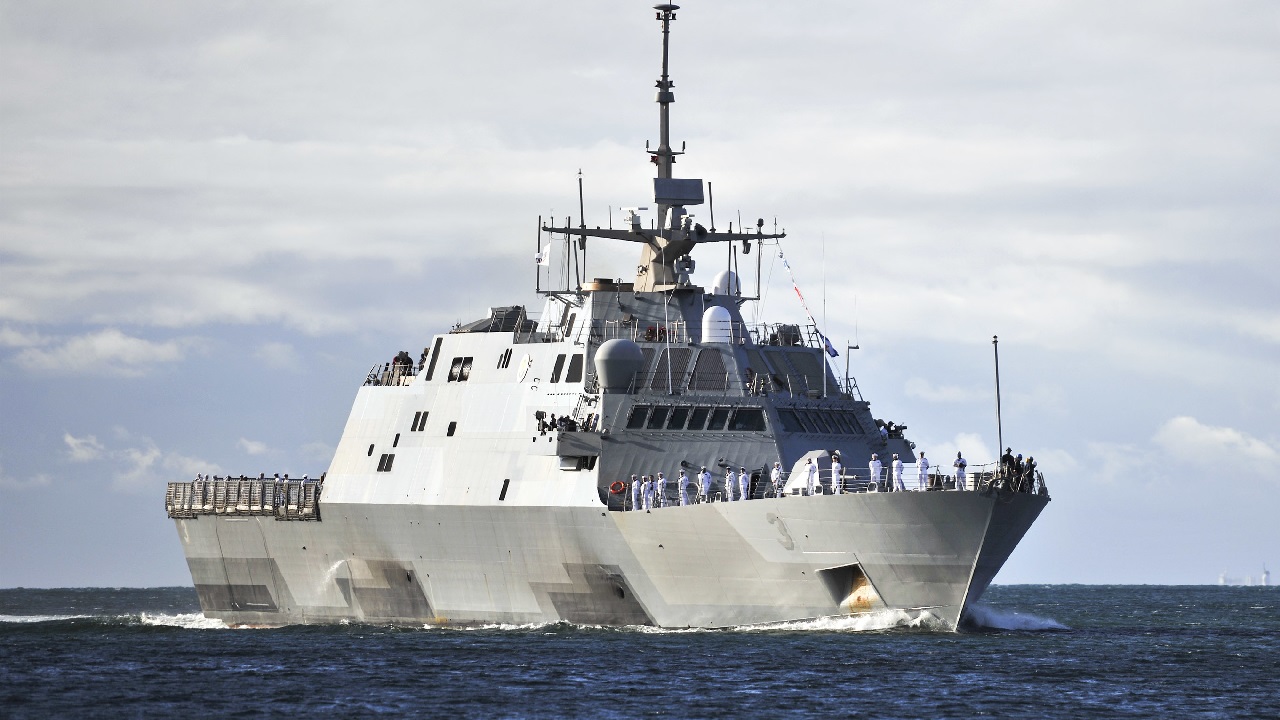
Watching the types of ships being built for the past few years reminds me of the ideology of the 1920’s.
There was a desire for peaceful relations between the global community mixed with theunderstanding that peace was an illusion as long as resources were desired by the same forces around the world. Battleships were limited and aircraft carriers were just beginning to emerge as a futuristic weapon. Even the danger of submarines had not quite reached its nadure since most nations were only beginning to understand the full measur of their future use.
In this country, enormous amounts of money have been spent on littoral combat vessels only to find most of them being decommissioned well before their sell by date. The difference between then and now was that we still built ships that were stout and capable. The Marblehead was one of those ships.
The Marblehead
The USS Marblehead (CL-12) was an Omaha-class light cruiser, originally classified as a scout cruiser, of the United States Navy. She was the third Navy ship named for the town of Marblehead, Massachusetts. She was launched on October 9, 1923 shortly after the US Navy was committed to the disastrous Naval Arms Limitation Treaty that would have a major impact on the ability of our Navy to meet the challenges of World War 2 in the pacific.

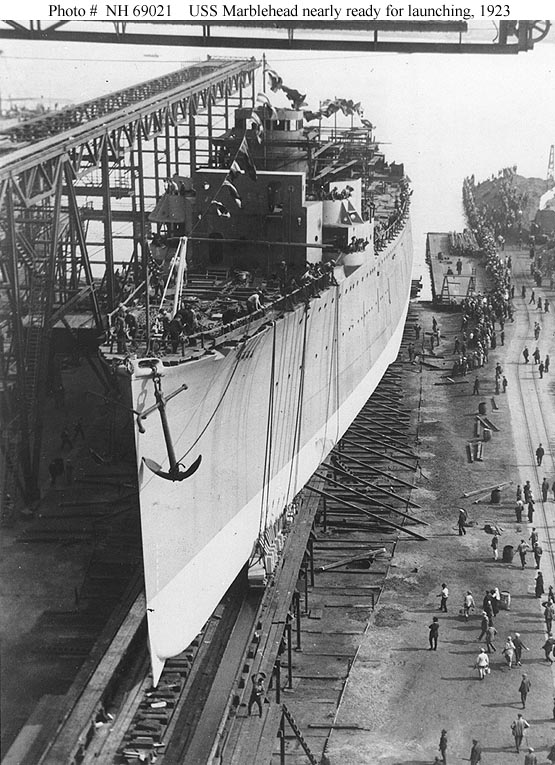
From the Washington Times, October 9, 1923:
FLEETEST CRUISER TAKES WATER TODAY
Marblehead to Make 35 Knots an Hour—Fitted for Airplanes.
By the Associated Press.
PHILADELPHIA, October 9.—One of Uncle Sam’s fleetest fighting craft, the cruiser Marblehead, will slip from the ways at Cramp’s shipyard at high tide today. She will be sponsored by Mrs. Hannah Martin Evans, first gold star mother of Marblehead, Mass. More than forty ranking naval officers will attend the ceremonies.
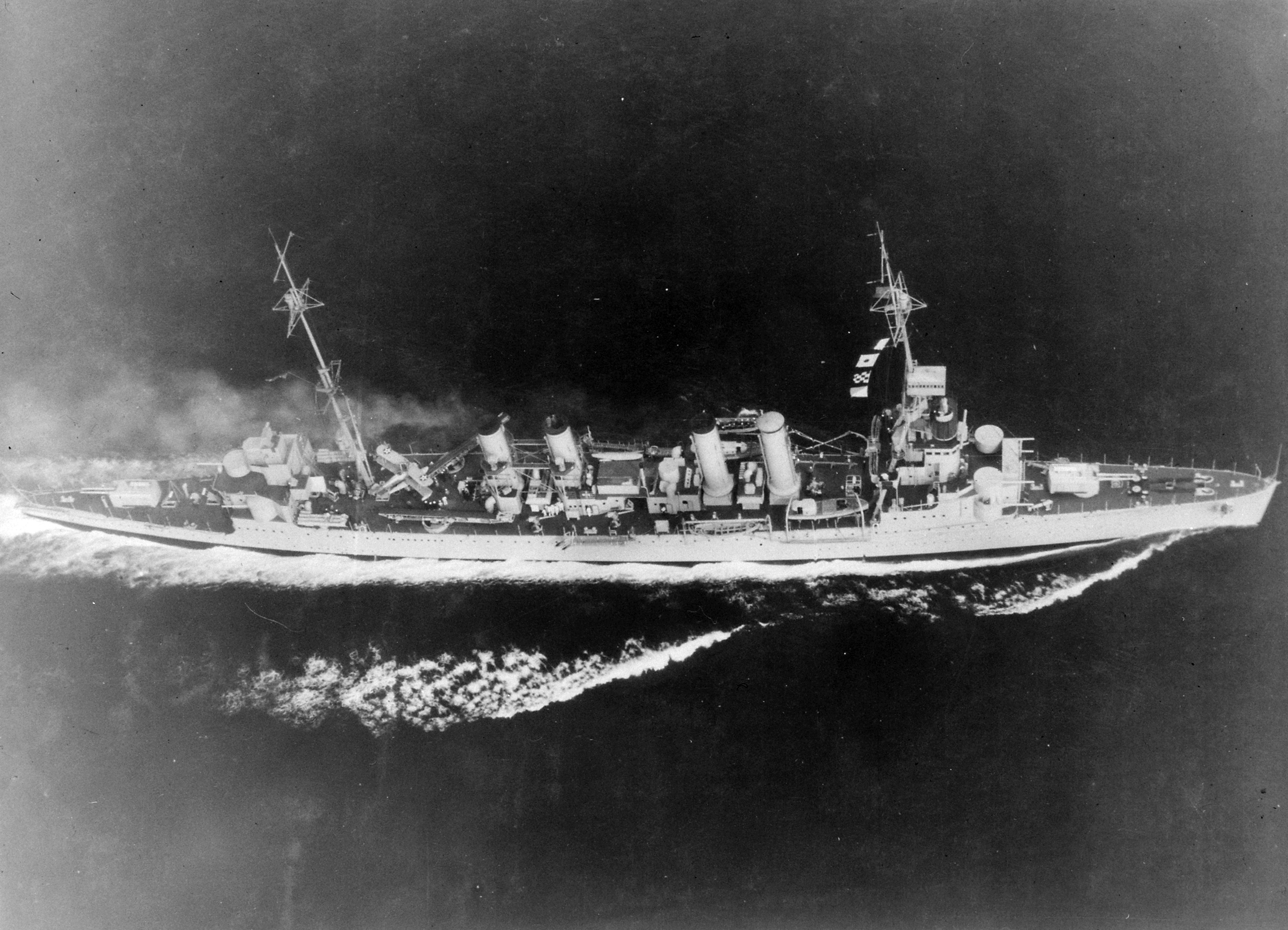
The Marblehead measures 555 feet in length over all and is fifty-five feet wide at load water line. It is modeled like a United States destroyer, except that It Is seven times as large as the largest, destroyer and equally as fast, its speed being more than thirty-five knots an hour. Trial displacement is about 7,100-tons.
There are four propellers, driven by cross-compound turbines, which are capable of developing 100,000 shaft horsepower. The turbines are among the most powerful ever built.
The main battery consists of twelve six-inch fifty-three caliber rapid-fire guns. The secondary battery consists of two 3-inch fifty caliber anti-aircraft guns and two three-pounders. Two triple and two twin above water torpedo mounts also are provided.
In addition to scout cruiser duty, the Marblehead Is fitted for carrying and launching airplanes and will be fully equipped with mine-laying apparatus.
The United States Navy Will have ten vessels of this type when all now under construction are completed.
Armament
During her career Marblehead went through several armament changes, some of these changes were to save weight, but others were to increase her AA armament. The lower torpedo tube mounts proved to be very wet and were removed, and the openings plated over, before the start of World War II. Another change made before the war was to increase the 3-inch guns to eight; all were mounted in the ship’s waist. After 1940, the lower aft 6 in (150 mm) guns were removed and the casemates plated over for the same reason as the lower torpedo mounts. During the Battle of Makassar Strait, Marblehead had seven 3-inch/50-caliber guns and eight .50 caliber machine guns, four mounted atop the foremast and another four aft. The ship’s anti-aircraft armament were augmented by three twin 40 mm (1.6 in) Bofors guns along with twelve 20 mm (0.79 in) Oerlikon cannons by the end of the war.
War Comes to the Marblehead
The Marblehead was a prominent fixture is the Pacific for most of the next few decades. Her ability to operate independently made her an integral part of the American presence all across the wide expanses of that great ocean. But the war caught her far from home.
“About 24 November 1941,” her war diary reported, “the Commander‑in‑Chief, U.S. Asiatic Fleet sensed that the relations between the United States and Japan had reached such a critical state that movement of men‑of‑war…was indicated.” The next day, Marblehead, with TF 5, departed Manila Bay for seemingly “routine weekly operations.” She anchored at Tarakan, Borneo, 29 November and waited for further instructions. On 8 December (7 December in the United States) she received the message -Japan started hostilities; govern yourselves accordingly.”
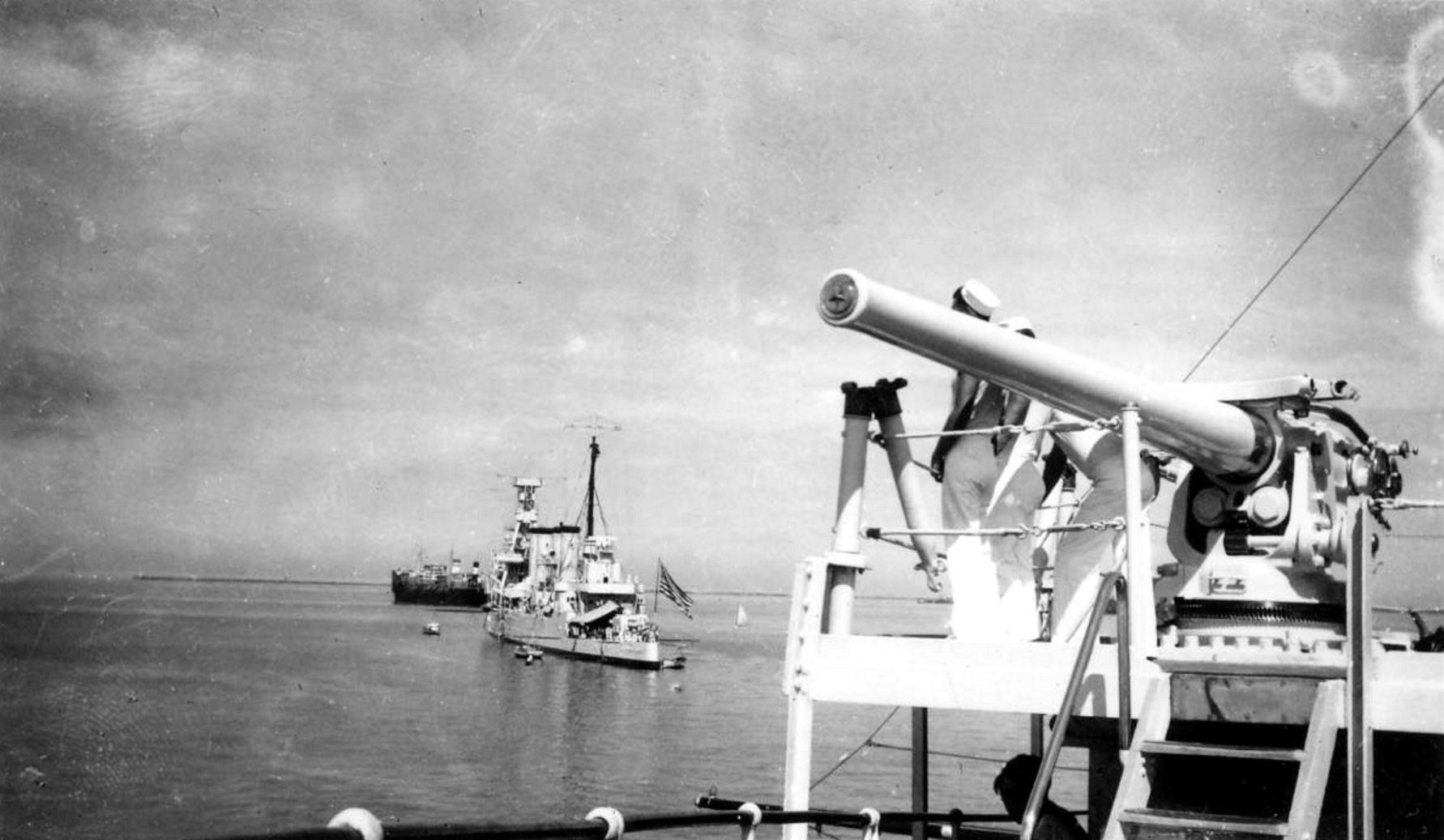
Marblehead and other American warships then joined with those of the Royal Netherlands Navy and the Royal Australian Navy to patrol the waters surrounding the Netherlands East Indies and to screen Allied shipping moving south from the Philippines. On the night of 24 January 1942, Marblehead covered the withdrawal of a force of Dutch and American warships after they had attacked, with devastating effect, an enemy convoy off Balikpapan. Six days later, in an attempt to repeat this success, the force departed Surabaja, Java, to intercept an enemy convoy concentration at Kendari. The Japanese convoy, however, sailed soon after, and the Allied force changed course, anchoring in Bunda Roads 2 February. On the 4th, the ships steamed out of Bunda Roads and headed for another Japanese convoy sighted at the southern entrance to the Makassar Straits. At 0949, 36 enemy bombers were sighted closing in on the formation from the east.
Marblehead successfully maneuvered through three attacks. After the third an enemy plane spiraled toward the cruiser, but her gunners splashed it. The next minute a fourth wave of seven bombers released bombs at Marblehead. Two were direct hits and a third a near miss close aboard the port bow causing severe underwater damage. Fires swept the ship as she listed to starboard and began to settle by the bow. Her rudder jammed, Marblehead, continuing to steam at full speed, circled to port her gunners kept firing, while damage control crews fought the fires and helped the wounded. By 1100 the fires were under control. Before noon the enemy planes departed, leaving the damaged cruiser with 15 dead or mortally wounded and 84 seriously injured.
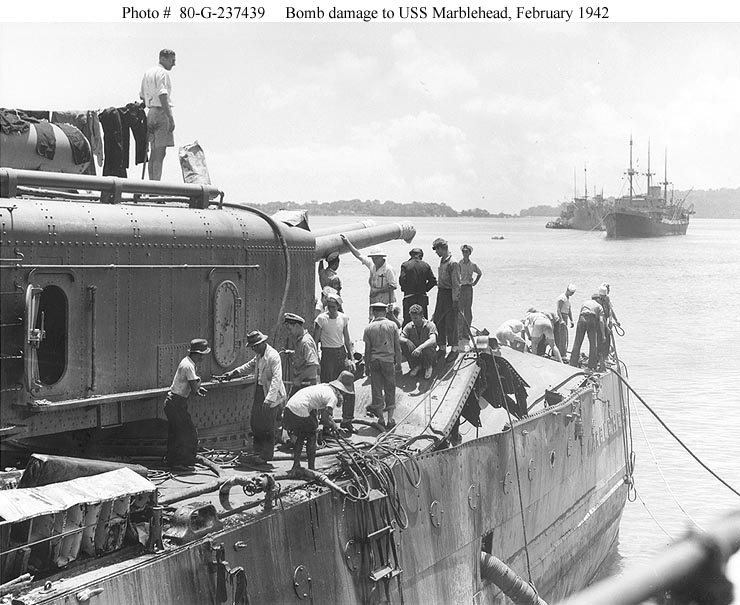
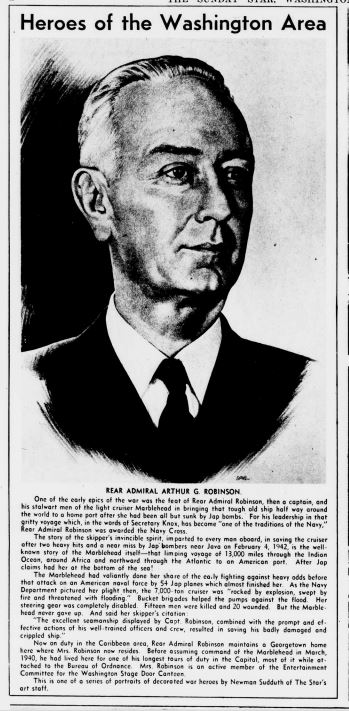
Marblehead’s engineers soon released the rudder angle to 9- left, and at 1255 she retired to Tjilatjap, steering by working the engines at varying speeds. She made Tjilatjap with a forward draft of 30 feet, aft 22 feet. Unable to be docked there, her worst leaks were repaired and she put to sea again on the 13th, beginning a voyage of more than 9,000 miles in search of complete repairs.
Still steering with her engines, she made Trincomalee, Ceylon on the 21st. Repairs could not be made there or anywhere in India for several weeks. So Marblehead departed for South Africa 2 March. After touching at Durban and Port Elizabeth, Marblehead arrived at Simonstown 24 March. There she underwent extensive repairs and on 15 April sailed for New York. Steaming via Recife, Brazil, she arrived New York 4 May and immediately entered drydock at the navy yard.
On 15 October 1942; the rebuilt Marblehead again put to sea.
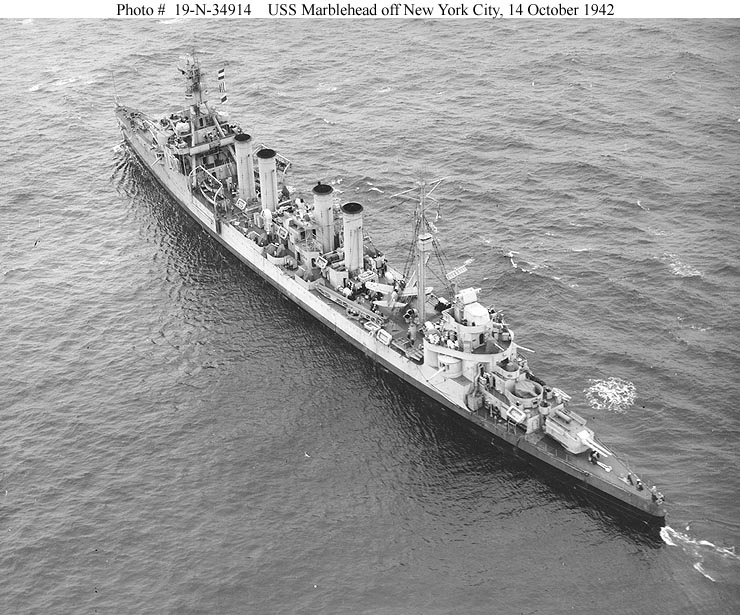
Attached to the South Atlantic Force, she operated against the enemy in the South Atlantic from Recife and Bahia, Brazil, until February 1944. Returning to New York 20 February, she operated along the convoy lanes of the North Atlantic for the next 5 months. She then sailed for the Mediterranean. Arriving at Palermo 29 July, she joined the task force then staging for operation “Anvil”, the invasion of southern France. On 15, 16, and 17 August, the crusier bombarded enemy installations in the vicinity of Saint Raphael, where Allied assault troops were landing. On the 18th, she withdrew to Corsica, her mission complete.
Marblehead returned to the United States, conducted a summer training cruise for Naval Academy midshipmen and then entered the Philadelphia Naval Shipyard, where she decommissioned 1 November 1945. Her name was struck from the Navy Register 28 November 1945 and her hulk was scrapped 27 February 1946.
Marblehead received two battle stars for World War II service.
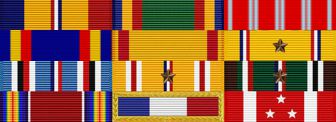
Precedence of awards is from top to bottom, left to right
Top Row – Navy Combat Action Ribbon – Navy Unit Commendation – Second Nicaraguan Campaign Medal
Second Row – Yangtze Service Medal – Navy China Service Medal – American Defense Service Medal w/FLEET Clasp
Third Row – American Campaign Medal – Asiatic Pacific Campaign Medal (1) – European-African-Middle Eastern Campaign Medal (1)
Fourth Row – World War II Victory Medal – Philippine Presidential Unit Citation – Philippine Defense Medal
Cruisers played a critical role in the early part of the war in the Pacific. The decisions which influenced the number and types of war ships forced them into roles which they were not orignally intended. But it is the indomitable spirit of the American Naval fighting men and the outstanding building capacity of a free nation that helped liberate the enslaved nations across the globe. Marblehead and her crew were outstanding examples of both.
In researching today’s blog, I came across this link which tells the story of this brave warrior in greater detail.
https://www.ussmarblehead.com/index.shtml
Mister Mac


 theleansubmariner