I was digging around some old files today and ran across an article in an old ALL HANDS magazine from 1954.
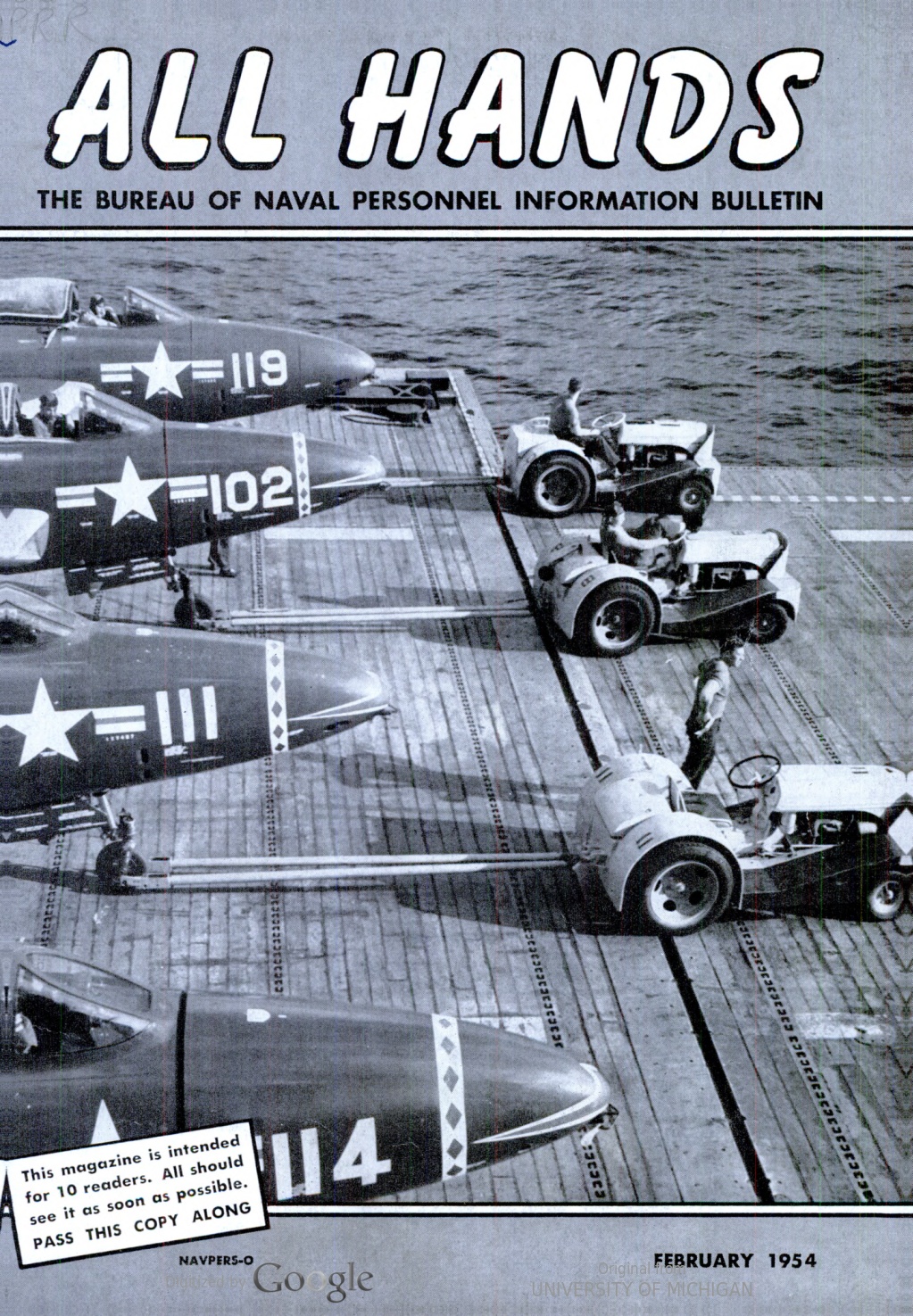
Seventy years ago, the Navy was still recovering from its role in Korea. After the second World War, peace was supposed to be a thing but somehow the Communist Incursion in Korea pushed that down the road. Vietnam was still a French problem. The Battle of Điện Biên Phủ was still a month away and the disastrous results would not be fully felt for a long time in our country.
But Pearl Harbor remained at the center of the Navy’s world in the Pacific. And in the middle of the harbor was an Island named after a Boston physician who practiced medicine at the Hawaiian Insane Asylum and the U.S. Marine Hospital from 1861-1866: Dr. Seth Ford.
Ancient Hawaiians called Ford Island Moku-umeume — the isle of attraction.
When Ford died, the island was sold to the Honolulu Plantation. Crops of watermelons and sugar cane covered the island before the U.S. Army purchased it during World War I for $236,000 from the Li Estate. It was transferred to the Navy in 1923.
At the height of World War II more than 40,000 people lived and worked on the 450-acre island.
Fifty pre-World War II plantation-style homes still dot the island. Presidents Franklin D. Roosevelt, John F. Kennedy and George Bush were guests there.
For decades since World War II, the only lifeline to the 450-acre island in the middle of Pearl Harbor had been the ferry. This story talks about the first generation of ferries that made the hourly trips back and forth.
Nihoa: The Ferryboat that Went to War
THE ferryboat USS Nihoa (YFB 17), which did its heroic bit at Pearl Harbor on 7 Dec 1941, is still going strong.
When the Japanese attack came, Nihoa was without power steering. Although bouncing awkwardly in the harbor, she managed to maneuver well enough to rescue many sailors floating in the waters.
Nihoa also acted as a ” hospital ship ” during the attack, rushing ambulances from Pearl Harbor and Ford Island to areas where they were needed to evacuate the wounded.
As if steering difficulties weren’t enough, Nihoa’s work was further complicated by the burning USS California (BB 44) which partially blocked the ferry’s entrance into the Ford Island slips. USS Arizona (BB 39) was afire and sinking nearby, but did not present a hazard to the ferryboat.
Today, Nihoa – in company with USS Sheffield (YFB 45) – daily plies the waters of Pearl Harbor, ferrying personnel, automobiles and equipment between Oahu and Ford Island.
These boats, which chug back and forth across the harbor on hourly schedules, form the means of transportation for Navy personnel and civilian workers from Oahu to the Pearl Harbor Naval Air Station.
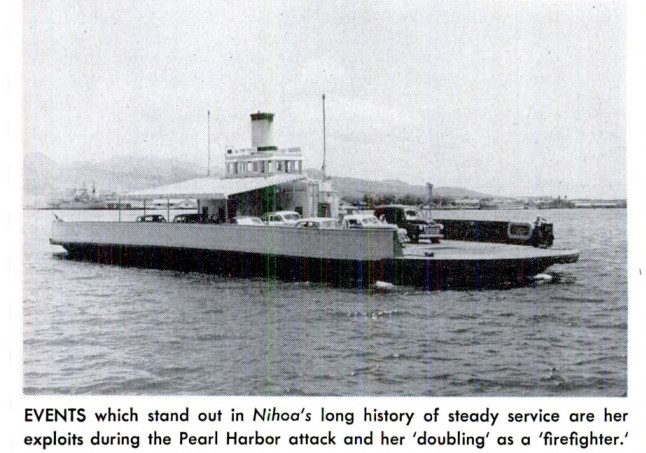
Both ferries are ” native Hawaiians, ” having been built in the Pearl Harbor Naval Shipyard. They are among the largest craft ever to be constructed in the Islands.
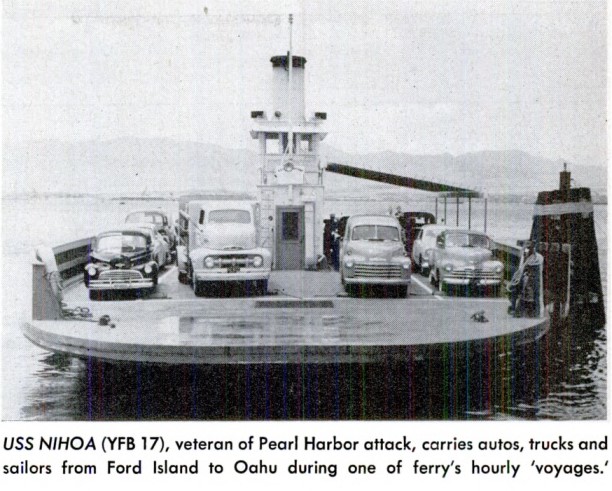
Caption: USS NIHOA (YFB 17) , veteran of Pearl Harbor attack, carries autos, trucks and sailors from Ford Island to Oahu during one of ferry’s hourly ‘ voyages. ‘
Nihoa was built in October 1941. Shefield, launched in 1944 at the peak of the war, helped ease the peak of the war, helped ease the load on Nihoa. At that time, as many as 2000 sailors and civilian workers were carried by the ferries on one trip.
The boats have even been used as harbor- going ” fire trucks. ” On one occasion, when a fire broke out under the King Docks at the Naval Supply Center, it was impossible to fight the flames from shore. Nihoa took aboard fire trucks from Ford Island, steamed across the harbor in short order, and took up a position along- side the pier. The firemen then proceeded to put out the flames that were threatening the supporting timbers.
EVENTS which stand out in Nihoa’s long history of steady service are her exploits during the Pearl Harbor attack and her ‘ doubling ‘ as a ‘ firefighter. ‘
The forerunner of these flat bottomed, barge-shaped ferries was the old ferry Manuwai, which means “Water Bird ” in Hawaiian. Purchased by the Navy in 1940, Manuwai (YFB 16) has since been taken out of service and is in mothballs.
The crew of each of these Navy ferryboats consists of a pilot, an engineer, a marine oiler and two deck- hands.
The ferries have carried everything from the Navy’s largest bulldozer to the smallest aviation machine part. In one well-remembered instance, the crew had trouble getting a large, black limousine on board. It was so ” low – slung ” that alterations of the ramp were necessary to get it on the ferry without scraping the bottom of the car.
Navymen in the Pearl Harbor area often refer to Nihoa and Sheffield as ” Cinderella Coaches. ”
It seems that if you miss the last ferry from Ford Island – it leaves at 2345 – you are in for a night away from home- or for a long swim.
J. A. Williams, JOSN, USN, Fleet Air Hawaii.
FEBRUARY 1954 All Hands Magazine
When I arrived in Pearl Harbor in 1973, I got an early introduction to small boats and ferries.
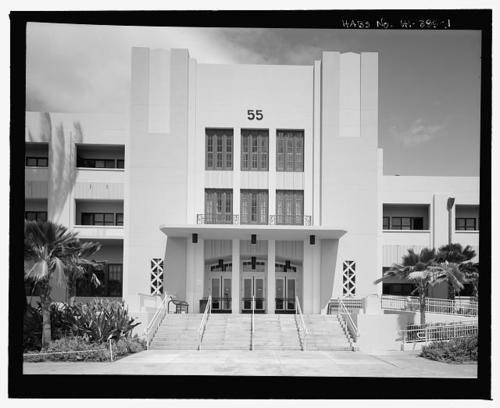
As a young, enlisted man, I was assigned to a barracks on Ford Island.
It was home to the submarine ballistic missile crews when they weren’t on board their boats. The barracks rooms looked and felt like they had not been updated much since the day the Japanese attacked Pearl Harbor. They were clean and airy but no air conditioning and very spartan. I think I may have had a transistor radio.
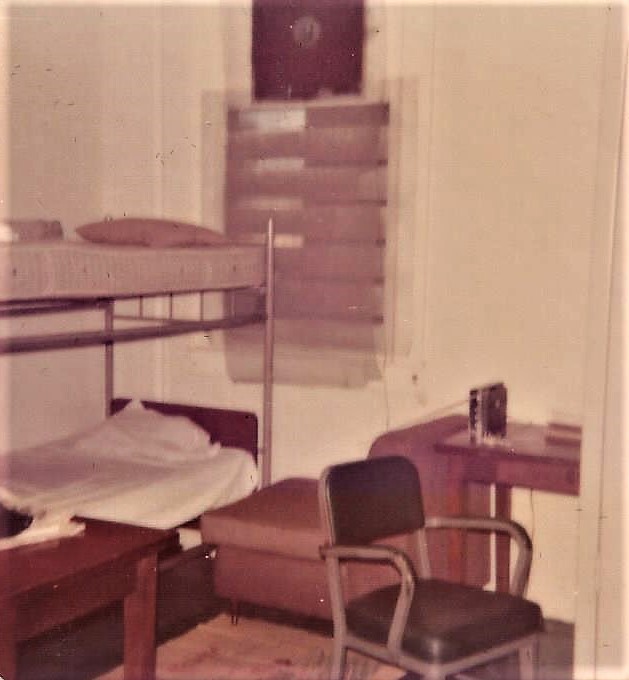
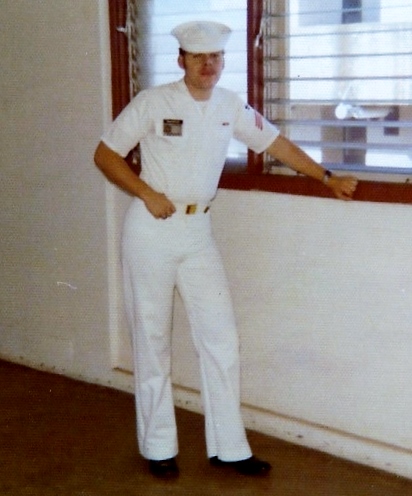
My crew was still at sea, so I made daily trips to my assigned workstation at subbase.
There was a theater near the barracks, and I would go there when I was bored. I also used to jog around the airfield.
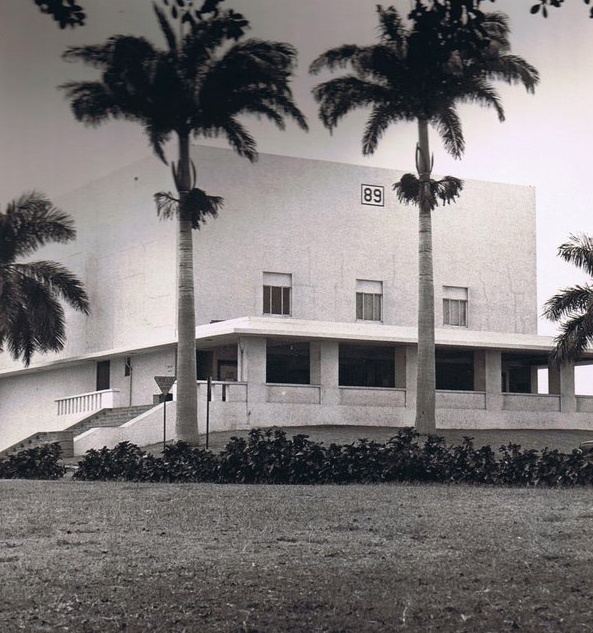
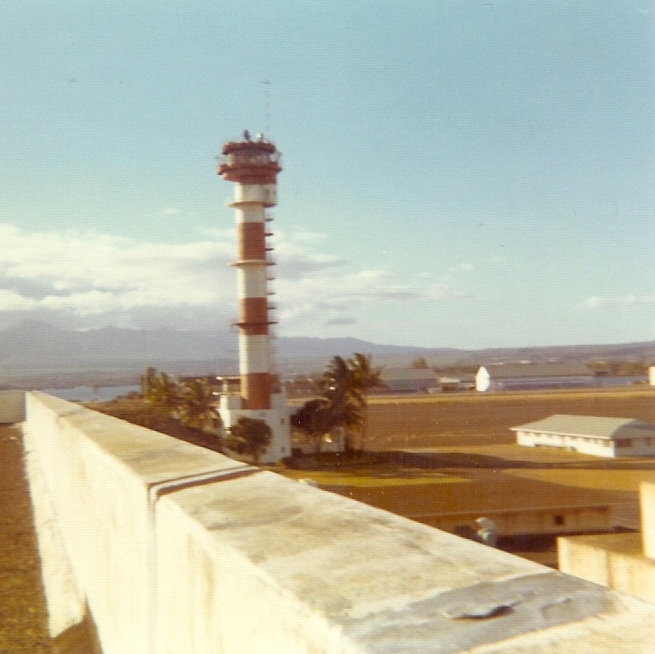
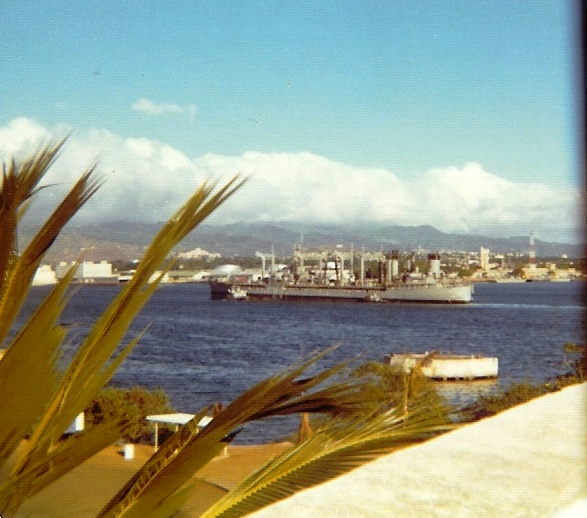
It wasn’t very busy at that time. You could make a circuit that took you past the iconic tower and past the hangers that had been used in making the movie Tora Tora Tora. I was pretty glad when the crew finally came back from sea and I started fitting into their group. I have to admit that I was kind of depressed before then and really wondered how big of a mistake I had made.
Over time I made the adjustments we all do as we mature. I moved off of Ford Island after my second patrol and lived out in one of the lush valleys with a few other guys.
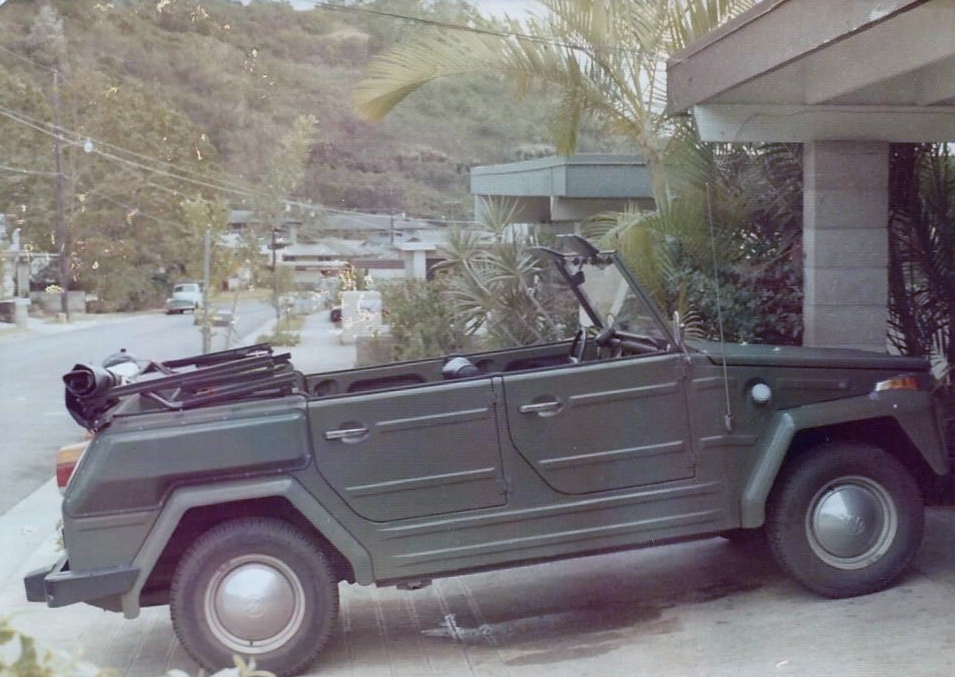
That is when I truly learned about the ferries. Each day, we would have to line up and hope to get a spot on one of the boats. I had purchased a Volkswagen “Thing” and it was a true “Island” car. The windows came off, the windshield went down and the top was rarely on. Plus, it was easy to get on and off the ferry. Great gas mileage too which helped since we weren’t paid very much back in the day. I hated having to sell it but the Navy would not ship it for me when I transferred to California.
Two diesel-powered ferries, Waa Hele Honoa (YFB-83) and Moko Holo Hele (YFB-87), served the island. The Waa Hele Honoa (meaning ‘canoe go to land’) was purchased in 1959 for $274,000 and pressed into service by the Navy on March 3, 1961. It is the older and larger of the two ferries, at 181 feet (55 m), with a capacity of 750 people and 33 vehicles.
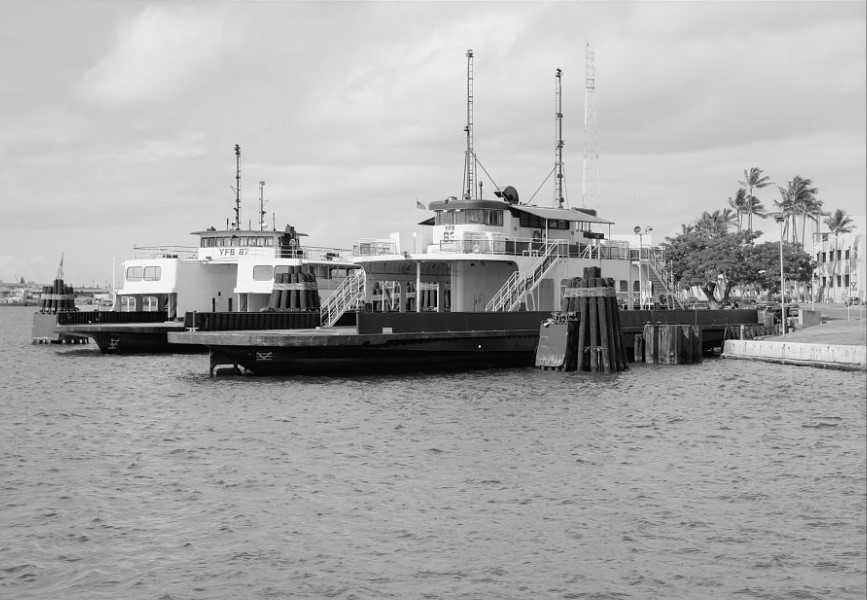
The other, Moko Holo Hele (meaning ‘boat go back and forth’) was purchased for $1.1 million on May 25, 1970. At 162 feet (49 m), its capacity was 750 people and 42 vehicles. Both ferries were operated by US Navy personnel, and access to the island was restricted to US military personnel, their dependents and invited guests. In addition to the two car ferries, there were several smaller “foot ferries” allowing pedestrians to travel between Ford Island and alternate landings around Pearl Harbor
Debbie and I went back to Pearl with my Mom in 2003.
The ferries were gone by then, replaced by a beautiful new bridge. It seemed strange to me and sad.
The Admiral Clarey Bridge is named after the man who was commander in chief of the Pacific Fleet when he retired from the Navy in 1972. It connects Ford Island to the Kamehameha Highway at the eastbound Salt Lake Boulevard intersection. Clarey was a Commander of the US Second Fleet and eventually Commander of the US Pacific Fleet. He was at Pearl Harbor serving aboard the submarine USS Dolphin (SS-169) when the Japanese launched their attack.
I’m glad they came up with a solution to getting things on and off the island. But it’s another old tradition that I have to admit I miss. The ride across the harbor each day was one of life’s routines that forced you to not be consumed by rushing. You took the ride as a chance for a few moments of reflection or maybe shut your eyes for a few moments before the events of the day. And you never forget the smells and sounds of the harbor. Seems like yesterday. Is that a sign that I’m getting old?


I was there 67-69 on MG Vallejo SSBN-658 Gold. We were kicked out of the barracks cause there was no room for our crew as the last of the 41 for Freedom to arrive. So we were “forced” to live off base with BAQ and Cost of Living for the high cost of Hawaiian living.
Of course the only way you could get to the ships office to check in once a week first month back from patrol, in was either on the car ferries or the launches that ran from near the EM Club over to Ford Island. Since 17 from our crew found a nice apartment building right behind the International Marketplace we had to fight that awful traffic, H-1 had opened part way on our route. . Two hours on the road was not uncommon. Our apartment was still there when I returned for a week in 2016.
We were off crew when the Forrestal arrived in Pearl after her devastating fire off Vietnam. Seeing all that destruction really got you thinking about all those lives lost. The Enterprise stopped there too and got stuck in the channel near where the bridge would later be built. Took a lot of work but the tugs to get her moving. And the New Jersey stopped in the West Loch to get new 16” barrels from the Ammo Deport before taking her turn in Nam.
A side story was when we brought Vallejo over from Bangor after the missile loadout for the Blue Crew to take her on the first patrol we tied up at berth F-12 on the back side of Ford Island next the the hulk of the USS Utah, the other ship not raised after the attack which remains a memorial for the 54 lost on her crew which is inaccessible to the public. . The reason I point this out is that my mom’s brother was on the USS Raleigh CL-7 at F-12 and they were sunk there. He survived and worked until December 25 cutting holes in the Utah’s capsized hull trying to rescue those trapped but it turned into recovery for a few, many however remain there too.
One of the guys in our Nav gang got tremendous footage when Tora Tora Tora was filmed. He was near where bridge was built on the Sub Base side.
There were still lots of buildings that showed damage from December 7, including the barracks and the medical building if you knew where to look. Lots of great memories of my time in Hawaii and your ferry story brought them back.
E Bills ET1(SS)
Great feedback shipmate. After my third patrol, a few of us moved off base and lived downtown off of Princess Kaiulani Street. The party never seemed to stop for the entire two months we lived there. I think a few of the boys needed to go back to sea just to dry out for a while. I can still smell the food vendors and hear the laughter.
I remember the back side of Ford Island very well.
Mister Mac
Seventeen Vallejo Gold lived in a great building on Nahua St right behind the International Marketplace. Walked thru there every night going to our bar on Kalakaua Ave. usually Don Ho was performing for the tourists when we went thru there. There was also a Black Angus Steak House behind the Marketplace that was a great place to eat and watch the shark swimming in the 300,000 gallon aquarium.
I also requalified on the Steinke Hood at SubBase in 67. I qualified at Groton when we got the Hood on the Sealion II (APSS-315) after yard overhaul in Charleston in 64. So, I had a total of 6 trips in the tank. My original 2 for Sub School being the first.
Oh for the Good Old Days!
A lot of fond memories about Ford Island and Pearl Harbor.
I also was home ported in Pearl 1970-75 in Sargo. We went to Ford Island to load/off-load our war shot torpedoes going & coming off Spec Ops there.
I also recall in one of the graphics below, the Tower. Even though we did Blow and Go training at the Tower (Tank) in Groton years earlier, we had to re-qualify using the Stanke Hood. Hoo, Hoo, Hoo. I actually loved it all.
The Boomer off-crew Chief’s had a WW-II BOQ not too far outside Makalapa (Sp?) Gate. Their was a small Chief’s club (of sorts) with swimming pool, etc. that was the hang-out for Submarine Chief’s. Skimmer Chiefs were not too welcome there. Navy Diver’s had their own hang out but were welcome. That’s where Carla and I first met. (Different story there I might share sometime.) Someone named it Oceans Eleven.
Anyway, I wanted to mention a tub of wine and other spirits we concocted poolside with Dry Ice to give off some steam effect… someone dubbed it Purple Jesus. Play Hard – Drink Hard.
Re Adm. Clarey. My wife (a WAVE) was stationed at CincPacFlt in 1970, before I got there and before we met (later married). She did a cake-cutting ceremony with Adm. Clarey for the opening of the new the then new computer center. Years later, Retired Adm. Clarey and his wife attended a Navy League dinner in Colorado. Carla brought some B&W photos of her and Clary cutting the cake with his (someone’s) sword. Before looking at the photo’s he quipped “they’re not compromising, are they.” (alluding to Tail Hook.) Everyone got a good chuckle.
Carla also recalls, when the movie Tora, Tora, was being filmed at Pearl, she was standing out on the landing of CincPacFlt building watching the (she obviously knew) American fighter planes with a red meatball on the fuselage flying in. Even knowing they were American she still sensed a slight raising of hair on the back of her neck. Then… a year or so later, when the movie was showing in Honolulu, recalling the Japanese-American descendants (Nisei and other) although loyal American citizens, as the crowd exited the theater, no one made eye contact. We all just looked down and left. Maybe some ‘not-to-fond’ memories.
Oh… we also had the honor later, in Colorado, of meeting and knowing Jim Doyle, a WW-II Navy Enlisted pilot who was also a professional photographer. He was stationed at F.I. when the Japanese attacked and had published many of the B&W photos the press and later entities used to show the carnage of the attack. I’ll send his bio separately. As a history buff you may be interested.
I’m cc-ing our oldest son Robert who was born at Tripler Army Hospital there and revisited on-and-off later.
Keep up the good work Shipmate.
Bob
Bob Gerle, Sr. 303.263.1109 BobGerle@Outlook.comBobGerle@Outlook.com
Thanks Bob. Great feedback and very nice story about your wife and the Admiral. Until I did the story, I did not know about his connection to December 7th. Every time I watch Tora Tora Tora, I can easily transport my imagination back to those adys when I was walking in that same hallowed ground.
Be Well
Mister Mac
Once again, another nice article to bring old memories to the surface for me. After 4 years on a fast attack and almost 3 years on a diesel boat out of San Diego, go figure that I had to wait until I was on a Trident out of Bangor to visit Pearl. I remember that they had us parked at Ford Island and that, for whatever reason, we had no shore power. That, of course, meant that the poor nukes were in port and starboard so we could keep steaming. Anyway, I remember that first day of liberty they had a duty van drop us off at some other pier way on the other side of the island so that a small boat could take about a dozen at a time across. After a full day of a different type of steaming, it was very late as three of us caught the last small boat back to the island. There was no duty driver waiting, and no way for us to contact the boat. After waiting an eternity (like 5 minutes in inebriated time), we decided to walk. Frank (let’s call him that to protect the guilty) decided to cut across the tarmac. There was no moon and it was VERY dark, and more than a little creepy. I have no idea if we were walking in a straight line or not, but we eventually came across an airplane hangar. In what little light there was, I noticed bullet holes in the glass, and I still had enough functioning brain cells to realize that they came from December 7th. I just stood there in awe, until Frank walked right up to the side of the hanger and announced “I gotta take a whiz”. ”You do, and I’ll beat you to death right here, right now”, I screamed. ”What’s wrong with you?”, he asked. All I could do was grab a fist full of hair, yank his head back, and point to the glass. I took a few moments for him to connect the dots about what he was looking at, and then just breathed “damn”. I’ll remember that walk as long as I live.
ICFTBMT1(SS) Maxey, USN (retired)
I did a couple of tours in Pearl Harbor on both FBM and fast boats. Like you, I got to visit once more on the Ohio but the put us over on the destroyer side. I have a similar memory of coming back to the boat very late after some adult beverages. Let’s just say that I am glad there were no cell phone cameras in that day and age or I probably would not have made Chief. Thanks for your feedback and your service
Mister Mac