Navy Training, Sir
One of my favorite movies of all time is Stripes and one of the best lines in the movie is when the platoon completes their razzle dazzle maneuver, and the general asks where they have been. Eventually Bill Murray shouts: Army Training sir.”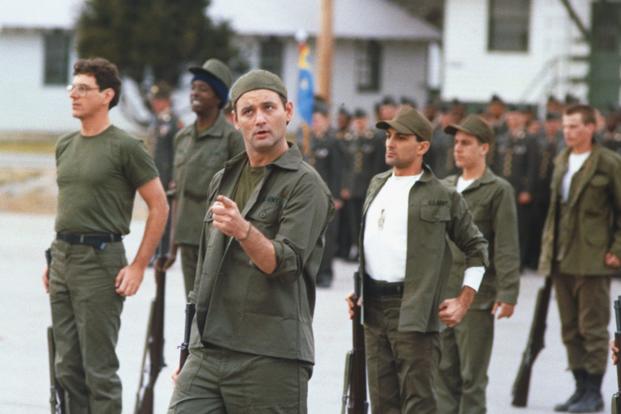
I’m assured by my friend Phillip Dockter that the army goes to great lengths to conduct actual training in the preparation of their soldiers. He has told me on numerous occasions that that training was enhanced by value priced beer and loads of beanie wienies.
My experience with Navy training was a bit more aggressive.

No pressure. Only our countries glorious future was in the balance!
I originally signed up as a nuclear field candidate where I was assured by my recruiter, I would someday make copious amounts of money as a civilian nuclear technician. All it would cost me was six years and some training. I had scored very high in my ASVABs (Armed Services Vocational Aptitude Battery). So, the sky was the limit for SN Recruit MacPherson in June of 1972.
The areas tested included:
- General science
- Arithmetic reasoning
- Word knowledge
- Paragraph comprehension
- Mathematics knowledge
- Electronics information
- Auto and shop information
- Mechanical comprehension
- Assembling objects
- Verbal expression
My lowest score was in mechanical comprehension. Frankly, I thought my electronics score was a lock on getting an assignment as an Electrician or Electronics Technician. But in the summer of 1972, the gentleman in boot camp that was assigning us to our next training saw it differently. That began my journey as a Machinist Mate. To be honest, everyone in my boot camp company that was in the nuclear field that summer were also perfect fits for the Machinist Mate path. As we received my orders, I got my first lesson in needs of the navy.
So, after a brief time off at home, I came back and moved into Snipes Castle on base to begin my training at the Great Lakes Naval Training Command.
I had been a below average student in high school. There were so many distractions and frankly I did not have the motivation to excel. College was a far-off dream, and I was sure I did not want to work I the steel mill, so the navy was the best choice.
Unfortunately, I had absolutely no clue what a “machinist mate” was supposed to do.
Machinist Mate Class A school cured me of that gap in my understanding.

From the Machinist Mate Manual
“The primary purpose of training is to produce a combat Navy which can guarantee victory at sea. This victory is dependent upon the readiness of the personnel aboard. Each individual is assigned tasks to perform dependent upon the needs of the ship. The information in this manual relates to tasks required to meet shipboard needs — tasks that are assigned to personnel aboard ship, serving as a Machinist’s Mate Third Class and Machinist’s Mate Second Class.
This rate training manual provides information related to the duties required to operate and maintain ship propulsion machinery and associated equipment. It is only when we have personnel aboard who can and do perform these tasks efficiently that we will have each ship operating at a high state of readiness and add her contribution essential to victory at sea.
When you are assigned duties aboard ship as an MM3 or MM2, you will be expected to have a thorough knowledge of the information contained in this manual. The degree of success of the Navy will depend in part on the ability you possess and the manner in which you perform your assigned duties.
Machinist’s Mate 3 & 2, NAVTRA 10524-D was prepared by the Navy Training Publications Detachment, Washington, D.C., for the Chief of Naval Training. Information provided by numerous manufacturers and technical societies is gratefully acknowledged. Technical assistance was provided by the Naval Ship Systems Command, the Naval Development and Training Center, San Diego, and the Service School Command and Naval Examining Center, Great Lakes, Illinois.
Published by NAVAL TRAINING COMMAND
First Edition 1951
Revised 1952 Revised 1958 Revised 1963 Revised 1968 Revised 1972
UNITED STATES GOVERNMENT PRINTING OFFICE WASHINGTON, D. C.: 1972
Well, that made it clearer. All I had to do was memorize everything in that book, do some practical training and head to the fleet so I could help save it. Although I had rarely ever touched a wrench or operated anything more complicated that a Dodge Dart Swinger, all this training stuff would mold me into a mechanic and machine operator.

From the 1972 Machinist Mate 3 &2 NAVEDTRA Manual:
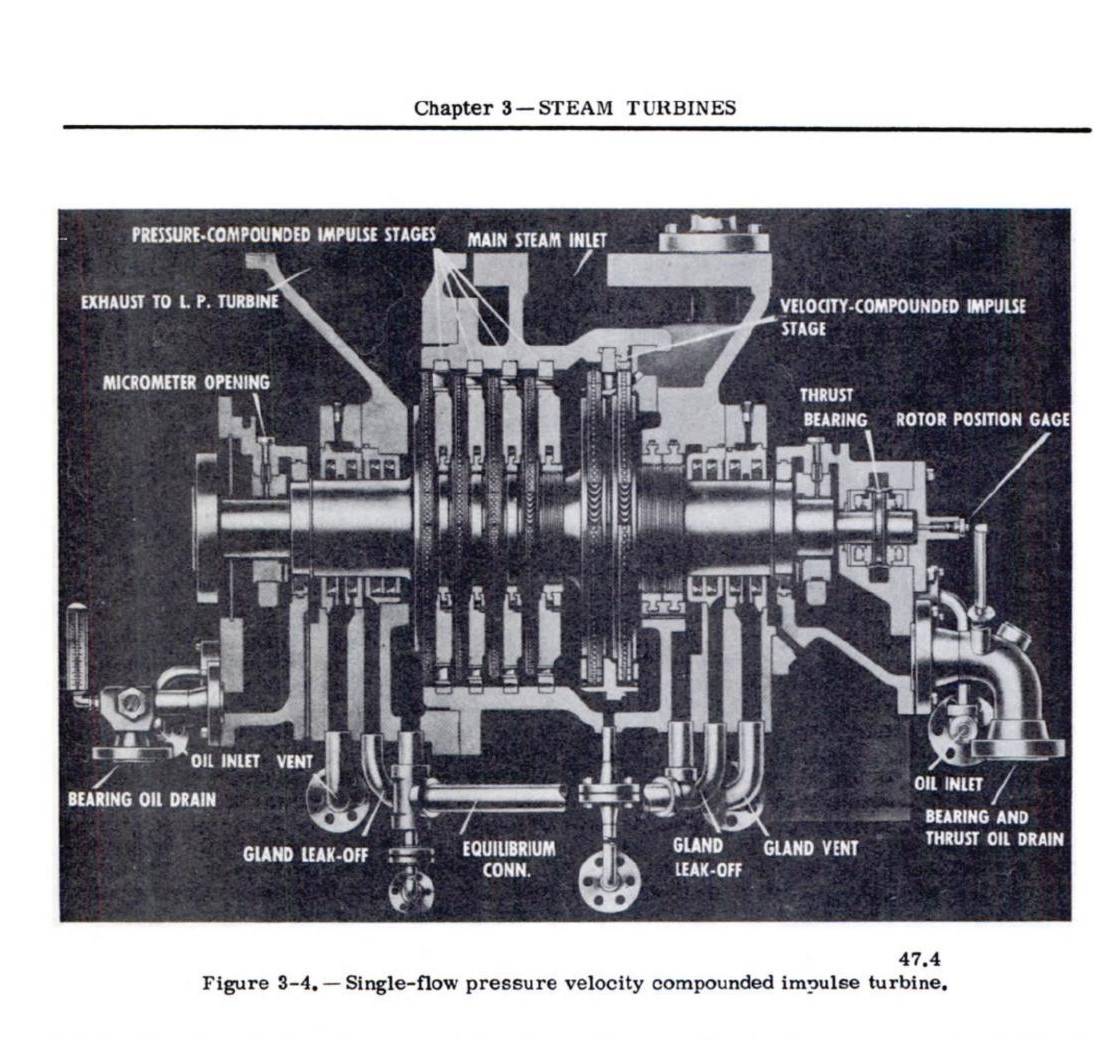
Steam turbines are used for ship propulsion and for driving many of the auxiliary machinery units associated with the propulsion plant, such as lubricating oil pumps, condensate pumps, feed pumps, circulating pumps, fuel oil pumps, forced draft blowers, and ship’s service generators.
As an MM3 or MM2, you will need a great deal of general information about propulsion plants and associated auxiliary machinery, and you will need specific information about the operation of the propulsion machinery installed in your ship.
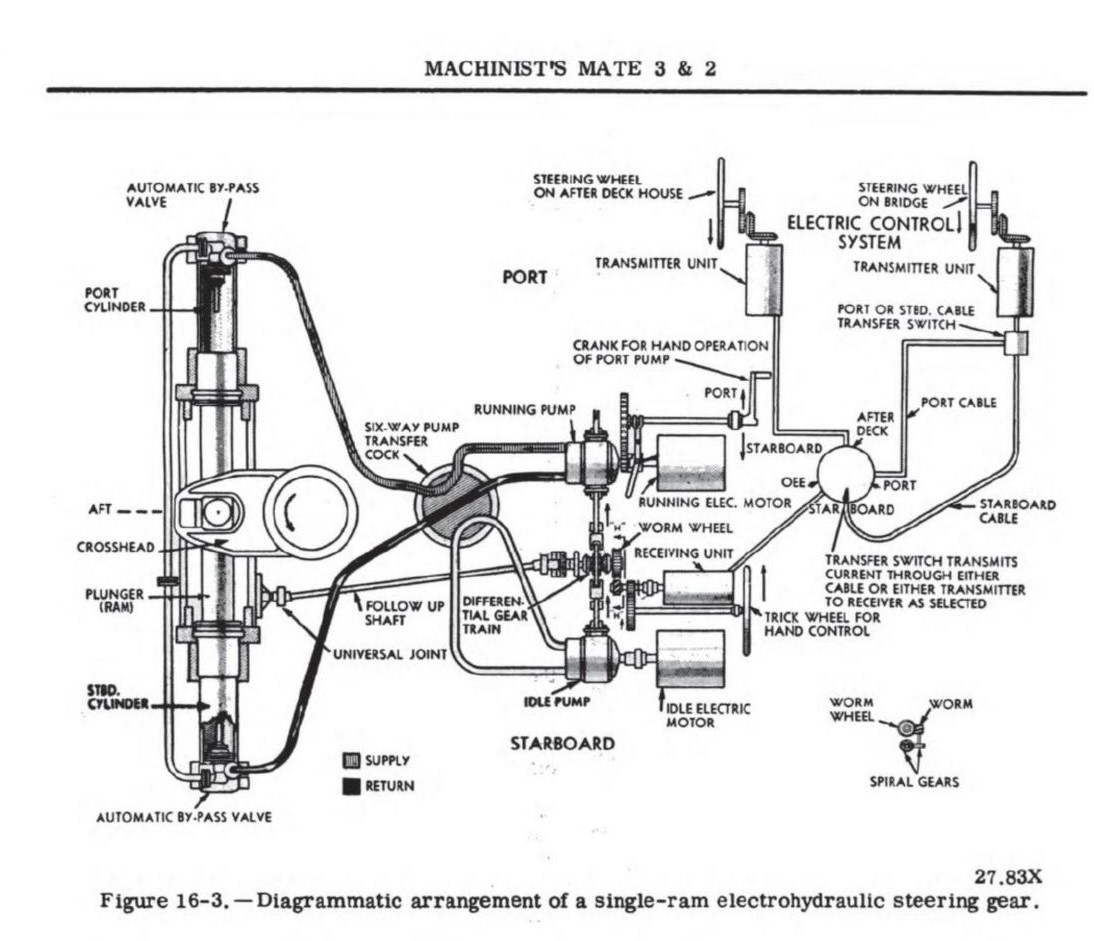
Impulse and reaction turbines, Single-flow pressure velocity compounded impulse turbine, Combination impulse and reaction turbine, Low pressure double-flow reaction turbine, Ship’s service generator turbine, heat exchangers, condensers, lubrication systems, air conditioning and refrigeration, distilling plants, compressed air plants, electromechanical steering gear, and so on.


There was just one flaw:
Since I had no inner discipline to study and had long ago given up on the idea of being very smart, nearly none of what they tried to pour into my brain seemed to be sticking. Plus, early on, one of my classmates had explained to all of us that the entire school was a waste of our time. He had come to the school from the fleet and was already a Petty Officer. He reassured us that the only really knowledge would come from being in the fleet. Telling me that information gave me the freedom to not get too concerned about being overwhelmed. Ther would be plenty of time later. SO, I became preoccupied with anything but the lessons that were given.
By Late November, it was obvious that I was not going to become a nuclear anything. In fact, they were only going to graduate me so that I could go on to my next assignment at submarine school. On arriving thee, I learned that the previous three months of training on surface ship technology was a complete waste of time. Submarines used different equipment altogether and now that I was a conventional Machinist Mate, I could forget everything I had learned.
Fortunately, that didn’t take much effort.
Submarine school was a blast and I got to do some amazing things. The curriculum was based on modern day fast attacks and the latest boomers. Even the dive and drive trainer was set up to resemble a sleek new submarine with all the bells and whistles. I put my mind to it determined to do better than A school and managed to graduate in the upper part of my class. So I was ready for my first boat. Of course, like everyone else, I applied for a diesel boat in Key West or a brand-new boat anywhere else.
The needs of the Navy struck again.
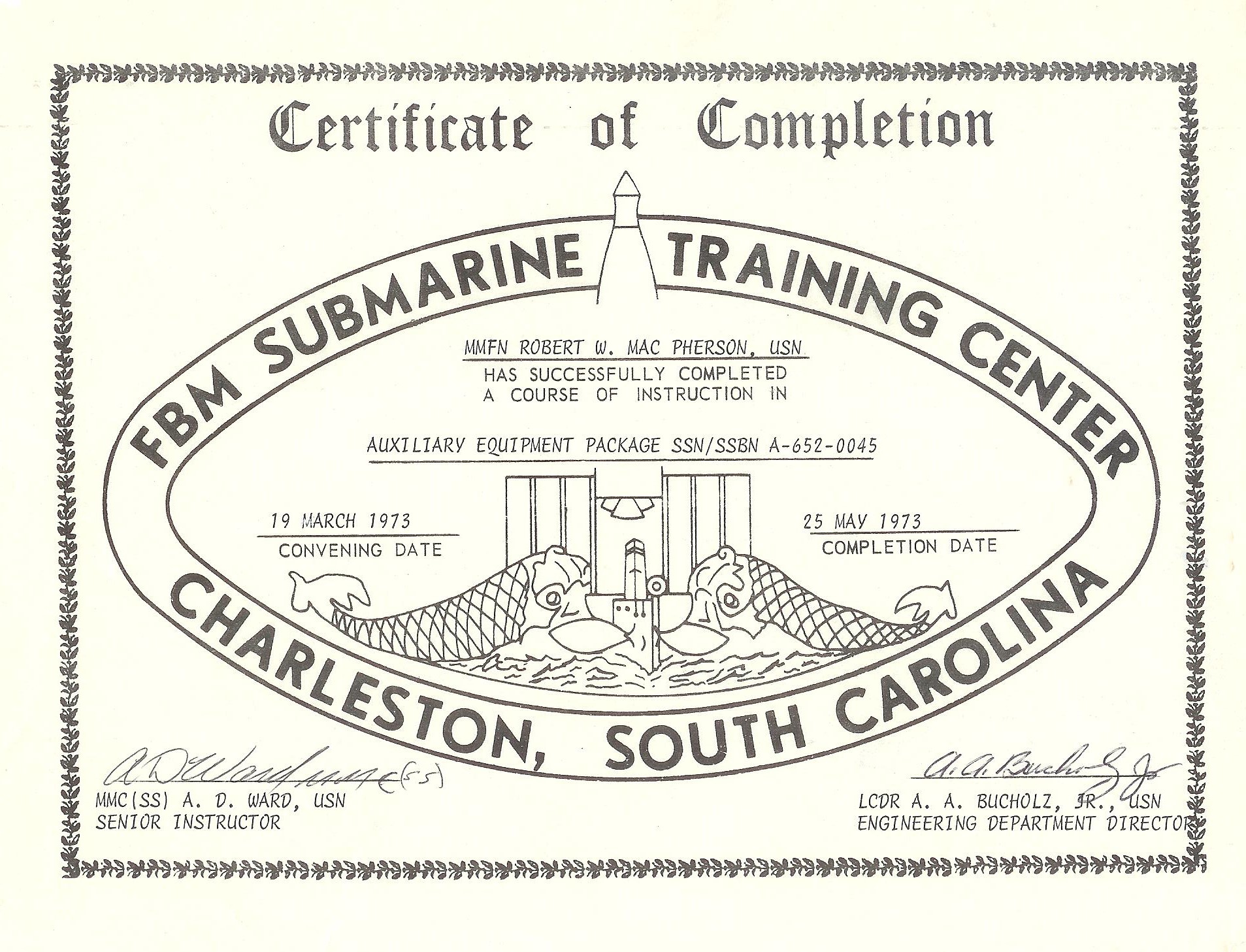
The next stop was more school. Sheesh, did they never run out of schools? I flew to Charleston and entered some pipeline called Auxiliary Package Course. Ten more weeks of school. Ten more weeks of torture. On top of the now seemingly useless training from A school and the intensive submarine training for a type of submarine I would never see no less serve on, here I was getting another school and even more information to try and pack into my already overloaded brain.
It did not go well at first.
All of the equipment I was being trained on was brand new to me. The instructors were probably good but the student struggled with the terminology, the theoretical principals and the mechanics of the more compact equipment. Even the air conditioning and refrigeration were different in the nature of the equipment from what I had already leaned. But gradually, I did the best I could to adapt and finally began to learn how to learn. I graduated and was grateful to finally be heading to a boat for real experience.
If I thought school was over, I was in for a big surprise.
Over the course of the rest of my career, I would return to training classes again and again. When I made the transition to the Trident submarine program, I got to repeat Auxiliary Package course and a lot more. In total, I attended over sixty-two technical and non-technical training courses in my career. I became a Ship’s Career Counselor, Master Training Specialist and have five Naval Enlisted Classifications (NEC’s) before becoming a Chief Warrant Officer. Eventually I would graduate from college with a Bachelor of Science (Magna cum Laude).

What I learned about learning
I have done a lot of training as a participant and as a training and development professional since I retired in 1994. I can’t begin to count the number of classes I have developed and delivered in those years. This week I am working on some classes for a youth group that helps kids achieve and overcome adversity. I hope what I develop helps them. What I have learned is that many times, learning is an attitude. We can choose to overcome even the greatest weaknesses when we have the right attitude and the proper tools.
I’ve also learned to be more compassionate and patient when I get students that are struggling. I was fortunate that there were always more chances for me to overcome my early reluctance to understand what it took to succeed. There were several people along the way that offered me a hand when I was drowning in a sea of information. My goal as I became a leader was to always try and emulate that. I hope that along the way, maybe I made a difference in someone’s life. I hope and pray as I enter into this new arena, I can hold on to that vision.
It’s been fifty-one years since I hit that first wall. But I have to be honest and tell you that I was reading through some of the technical material I am using as a reference for this post, some of that stuff is finally making sense to me. Funny how that works.
Mister Mac

 theleansubmariner
Oy vey! How I do identify with your passage through the Navy’s way of training. It really wasn’t until I arrived on my boat that the real education began.
We had the best trainers in the world.
Mac
I was encouraged by the realization that if I was not adequately trained then I was NOT an asset to the ship. As I gained experience, that was passed along to those junior to me.
Amen to that. My first Chief was a patient but firm teacher. “No” was not an answer he allowed. Ony “not yet”. I learned so much from MMC(SS) John Mills.
Mac
Wow, what a great article. So many memories.
As a fellow submariner, Master Training Specialist, and Curriculum Developer I’m sure we have shared many of the same training experiences. Like sitting on an Navy school’s Academic Review Board (ARB) and talking to the guy that’s about to get bounced out of school for being behind and telling him “Look me in the eye and tell me you want this, then look me in the eye and tell me you will do EXACTLY what I tell you to do”. Or taking the guy that just failed his sub qual board and and telling him “Look me in the eye and tell me you want this, then look me in the eye and tell me you will do EXACTLY what I tell you to do”. Or taking the guy at your civilian job that is about to get fired from lack of technical competence and telling him “Look me in the eye and tell me you want this, then look me in the eye and tell me you will do EXACTLY what I tell you to do”. Then later at the school graduation / sub qual ceremony / work social function having the guy come up and say “I can’t thank you enough. I never would have made it without you”.
I’ll bet your reply was similar to mine. “Don’t thank me. You walked down that road all by yourself. I just shined a flashlight on your feet”.
ICFTBMT1(SS) Maxey, USN (retired)
I have been writing this blog for over 12 years. Ther have been a lot of great comments from readers. But both my wife and I agree that your comment today ranks among the best and most accurate. Thanks for the comment and thanks for reading my bolg.
Mac