I contribute articles to the Pittsburgh Council of the Navy League, and this is one of my recent submissions about a unique naming situation for five current and future LPD amphibious ships.
Pittsburgh and Pennsylvania have contributed their names many times to warships and support ships over the last 240 years. Even my hometown of McKeesport was used for a war time ship. This article focuses on the present and the future.
Pennsylvania Amphibs
Bob MacPherson, Past President
What is an LPD? The technical name is Amphibious Transport Dock
Description: Amphibious transport dock ships are warships that embark, transport and land elements of a landing force for a variety of expeditionary warfare missions.
Features: LPDs are used to transport and land Marines, their equipment, and supplies by embarked Landing Craft Air Cushion (LCAC) or conventional landing craft and amphibious assault vehicles (AAV) augmented by helicopters or vertical take-off and landing aircraft (MV 22). These ships support amphibious assault, special operations, or expeditionary warfare missions and serve as secondary aviation platforms for amphibious operations.
Background The LPD 17 San Antonio class is the functional replacement for over 41 ships including the LPD 4 Austin class, LSD 36 Anchorage class, LKA 113 Charleston class, and LST 1179 Newport class amphibious ships. The newly designated LPD Flight II ships (formerly LX(R)) will be the functional replacement for the LSD 41/49 Whidbey Island Class. The San Antonio class provides the Navy and Marine Corps with modern, sea-based platforms that are networked, survivable, and built to operate in the 21st century, with the MV-22 Osprey, the upgraded Amphibious Assault Vehicle, and future means by which Marines are delivered ashore. Construction on USS San Antonio (LPD 17), the first ship of the class, commenced in June 2000 and was delivered to the Navy in July 2005.
USS New York (LPD 21) was the first of three LPD 17 class ships built in honor of the victims of the Sept. 11, 2001 terrorist attacks. The ship’s bow stem was cast using 7.5 tons of steel salvaged from the World Trade Center. The Navy named the eighth and ninth ships of the class Arlington and Somerset, in honor of the victims of the attacks on the Pentagon and United Flight 93, respectively. Materials from those sites were also incorporated into the construction of each ship. USS Portland (LPD 27), the eleventh ship of the class, delivered in 2017. LPDs 28 and 29 are currently under construction at Huntington Ingalls Industries (HII) on the Gulf Coast. As the 12th and 13th San Antonio class ships, LPDs 28 and 29 will perform the same missions as the previous 11 ships of the class while incorporating technically feasible cost reduction initiatives and class lessons learned. In 2018, the Navy made the decision to transition the LX(R) effort to a second flight of the LPD 17 design. LPD 30 will be the first of 13 planned LPD Flight II ships, for a total complement of 26 ships in the LPD 17 class.
The LPD Flight II ships will be the functional replacement for the Whidbey Island Class (LSD 41/49). The San Antonio-class is designed to support embarking, transporting, and landing Marines and their equipment by conventional or air-cushioned landing craft. The ship’s capabilities are further enhanced by its flight deck and hangar, enabling the ship to operate a variety of Marine Corps helicopters and the Osprey tilt-rotor aircraft (MV-22). Because of the ships inherent capabilities, they are able to support a variety of amphibious assault, special operations, expeditionary warfare, or disaster relief missions, operating independently or as part of Amphibious Readiness Groups (ARGs), Expeditionary Strike Groups, or Joint Task Forces.
The Pennsylvania connection
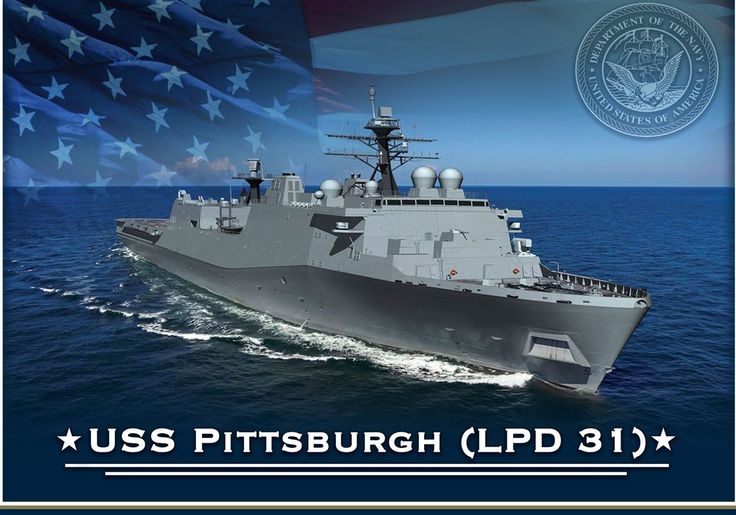
While USS Somerset was added to the first flight of LPDs. Now the first three LPD’s will be named for three principal cities in Pennsylvania. Harrisburg (LPD 30), Pittsburgh (LPD 31) and Philadelphia (LPD 32) have all been named and authorized. All three names have been used in previous US Navy related vessels. When you add the USS Somerset and USS John P. Murtha, Pennsylvania will have quite a presence in the fleet for many years to come once the Flight II ships are in service.
The future San Antonio-class amphibious transport dock USS Pittsburgh (LPD 31) will be the fifth Navy vessel to bear the name. The first was an ironclad gunboat that served during the American Civil War. The second USS Pittsburgh (CA 4) was an armored cruiser that served during WWI, and a third USS Pittsburgh (CA 72) was a Baltimore-class cruiser that served during WWII – supporting the landing at Iwo Jima. The fourth USS Pittsburgh (SSN 720) was a Los Angeles-class submarine that served the Navy from December 1984 to August 2019.

General Characteristics, San Antonio Class LPD Flights I and II
Builder: Huntington Ingalls Industries
Propulsion: Four sequentially turbocharged marine Colt-Pielstick Diesels, two shafts, 41,600 shaft horsepower
Length: 684 feet
Beam: 105 feet
Displacement: Approximately 24,900 long tons (25,300 metric tons) full load
Draft: 23 feet
Speed: In excess of 22 knots (24.2 mph, 38.7 kph)
Crew: Ship’s Company: 383 Sailors and 3 Marines. Embarked Landing Force: Flight I: 699 with surge capacity of 800; LPD 28/29:650; Flight II: 631.
Armament: Two Mk 46 30 mm Close in Guns, fore and aft; two Rolling Airframe Missile launchers, fore and aft: ten .50 caliber machine guns
Aircraft: Launch or land two CH-53E Super Stallion helicopters or two MV-22 Osprey tilt rotor aircraft or up to four AH-1Z or UH-1Y or MH-60 helicopters
Landing/Attack Craft: Two LCACs or one LCU; and 14 Amphibious Assault Vehicles
In a world where too many people still think they can achieve their goals by force, it is good to know we will have the means to continue to project force in a timely fashion with amazing ships and sailors.

 theleansubmariner
The USS Sealion II LPSS-315 was the first submarine to have a helicopter land on its deck. Sealion and its sister USS Perch LPSS-313 were the last submarines to have guns (2-40 mm single mounts and 4-.50 cal machine guns) to support landings of UDT, SEALs, and Force Recon. They could carry over 100 troops on modified WWII diesel boats. Sealion was awarded a Presidential Unit Citation for sinking the Japanese battleship Konga in WWII, the only sub to sink a battleship. And during its service in 50’s and 60’s was often SubLant Flagship when in its homeport of Norfolk. Sealion trained troops at the old WWII SubBase of St Thomas, and participated in operations during Cuban Missile Crisis. Perch performed actual amphibious operations during the Vietnam War, and was often based at Subic Bay where Sealion I was destroyed by the Japanese on December 8, 1941.
Thanks for the nod to the Gator Navy!
We are honored to have a representation in the Gator Navy. I am hoping that we get a lot of support for the ship from Pennsylvania and other folks
Mac