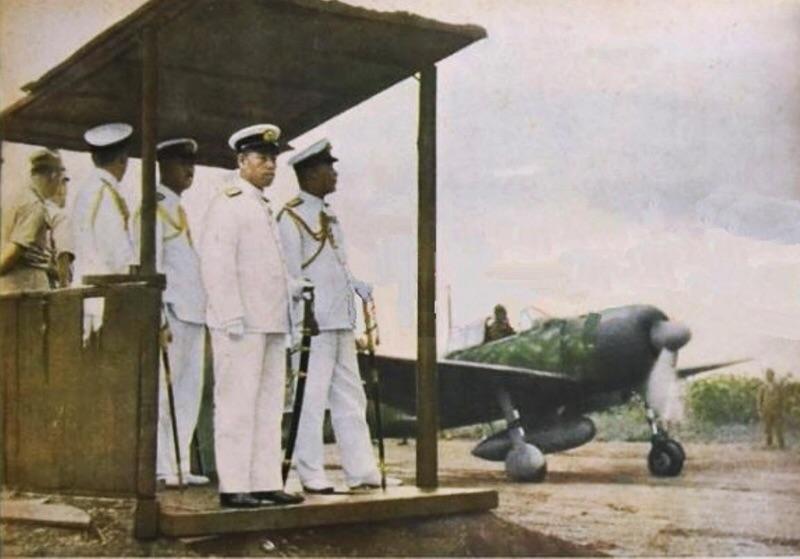
Rabaul was a significant base used by the Japanese during the early years of the secone World War.
The Battle of Rabaul, also known by the Japanese as Operation R, an instigating action of the New Guinea campaign, was fought on the island of New Britain in the Australian Territory of New Guinea, from 23 January into February 1942. It was a strategically significant defeat of Allied forces by Japan in the Pacific campaign of World War II, with the Japanese invasion force quickly overwhelming the small Australian garrison, the majority of which was either killed or captured. Hostilities on the neighboring island of New Ireland are usually considered to be part of the same battle. Rabaul was significant because of its proximity to the Japanese territory of the Caroline Islands, site of a major Imperial Japanese Navy base on Truk.
World War II
On January 4, 1942 Japanese flying boats first bombed Rabaul. On January 20, 1942 a Japanese aircraft carriers including Akagi, Kaga, Shokaku and Zuikaku under the command of Admiral Nagumo launched carrier planes to attack Rabaul. On January 22, 1942 the Japanese launched another carrier plane strike but found no targets and preformed aerobatics before departing while the Japanese invasion force approached from St. Georges Channel.
On January 23, 1942 after midnight, the Japanese Army the 144th Infantry Regiment “South Seas Detachment” landed at several locations: Raluana Point and to the west of Kokopo and Kerawun and north of Vulcan. Also Malaguna, west of Praed Point and Nordup. Opposing them were the outnumbered Australian Army 2/22nd Battalion and New Guinea Volunteer Rifles (NGVR) opposed. By morning, the Japanese occupied Rabaul.
Developed into a massive base and Army and Navy Headquarters in the South Pacific. The Navy controlled the eastern half of the town, with their HQ at the New Guinea Club building. The 8th Army HQ at Four Corners (Four Ways). The Japanese expanded the two existing airfields and built four additional airfield in the Rabaul area. Several locations were used as seaplane anchorages. At the peak of their occupation, 97,000 Japanese were stationed in Rabaul and the vicinity, in addition to Allied POW’s, slave laborers and roughly 3,000 “comfort woman” (military prostitutes) from Japan and Korea.
Reportedly, 367 anti-aircraft weapons defended Rabaul (192 Army, 175 Navy) by late 1942. The harbor area was defended by an estimated 43 coastal guns and 20 searchlights according to the US Strategic Bombing Survey. Rabaul was the most heavily defended target in the South-West Pacific Area (SWPA).
In order to advance in the Southwest Pacific Theater, the Allies had to damage Rabaul’s formidable base.
Japanese leaders scanned charts and grunted with satisfaction. Rabaul lay as the pivot point between New Guinea and the Solomons, so well situated that there was argument as to which should be taken first. The Army declared for New Guinea, springboard to Australia; the Navy looked to the east, intent on snipping supply lines from America to the Antipodes.
So, on October 12th 1943. A substantial air raid was launched on the base.
SOUTHWEST PACIFIC THEATER OF OPERATIONS (Fifth Air Force): Allied aircraft begin a major air offensive against Rabaul, with the aim of isolating and neutralizing it. Almost 350 B-24’s, B-25’s, P-38’s, and RAAF airplanes pound the town, harbor, and airfields in the area, including B-25D Mitchells from 345th BG that conduct the first low level para-frag bomb attack against Vunakanau Airfield.

What is a para-frag?
The idea for the AN-M40 “Para-Frag” was first created by George Kenney in the 1920s. While the AN-M40 was not accepted for use in Europe, largely because the Allies preferred high-altitude bombardment, the large amount of Para-Frags then available were thus moved to the Pacific. The first operational use of the AN-M40 was during an air raid over Buna Airfield in Papua New Guinea in which a large air group of various attacker aircraft such as Douglas A-20s and converted P-40s dropped nearly 300 ‘Para-Frags’ over the target with an alleged seventeen aircraft ground kills despite incredibly poor weather. After this attack, the AN-M40 was put into full operational service with units in the Pacific. Seeing the success they had, their creator, Kenney urged the conversion of as many fragmentation bombs to the Para-Frag standard as possible. In the end, thousands of fragmentation bombs had been created during the war and used in dozens of strafing attacks on Japanese airfields during the war.
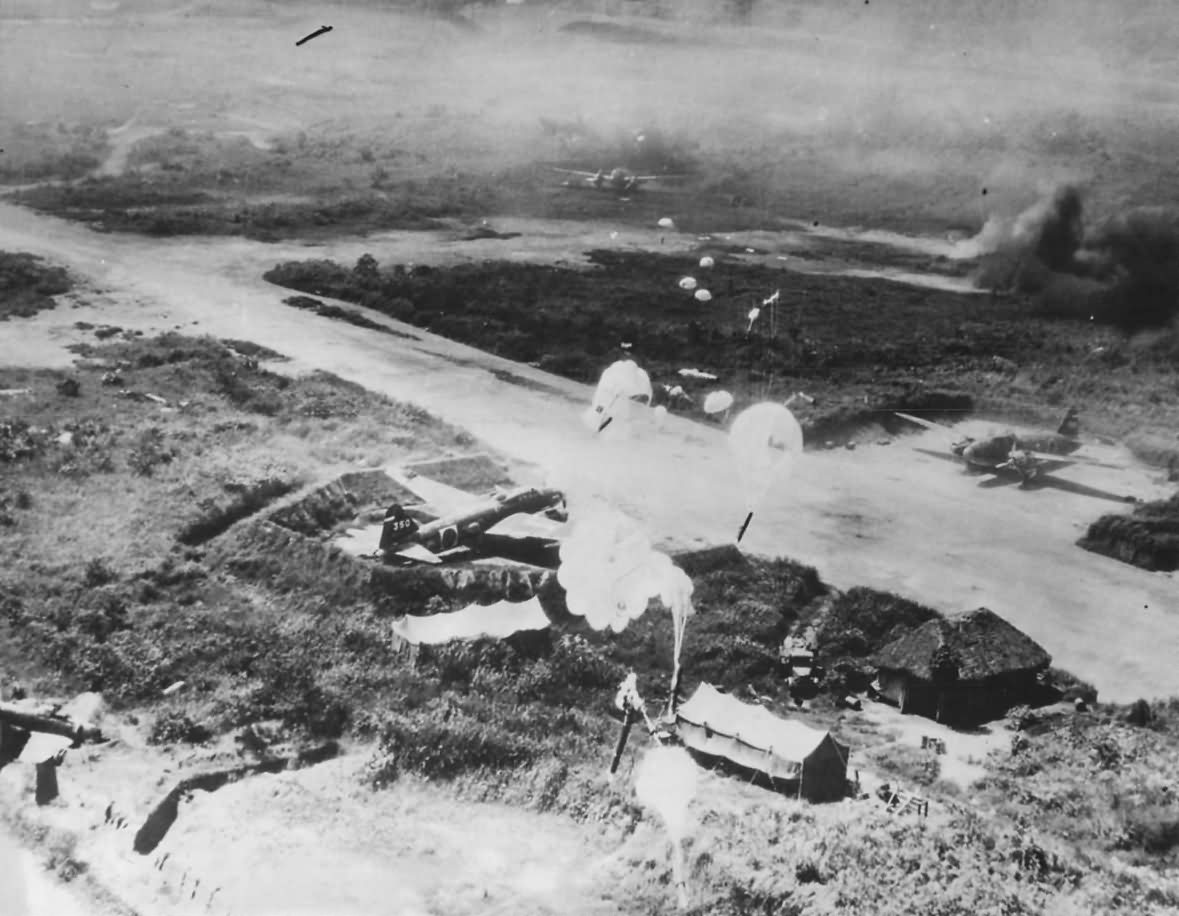
The Allies claim 50+ Japanese aircraft destroyed and three ships are sunk and several damaged plus several small harbor craft are sunk. Lost are B-25D 41-30239 pilot 2nd Lt. Edsal L. Crews (MIA), B-24D 42-40675 pilot Captain Dorwin C. Wilson (rescued) and Beufighter A19-97 pilot F/L Derrick Robert Stone (MIA). Also, B-25’s fly small strikes against targets on Timor and other areas of the Netherlands East Indies.
The results of the October 12th Raid
Afterwards, USN codebreakers intercept a radio message about the air raid “Southeastern Force Action Summary. (October 12th Rabaul Air Action). —-. Attacked from 1004 to 1022 by: 54 (Heavy bombers in 9 waves of three to ten planes covered by about 16 P-38s attacked vessels and Rabaul airdrome vicinity. ——. Losses. (a) Vessels Tsukushi and Naruto hit: slight damage and holes in hull. Mochizuki, damaged by near misses and holes. Gun #3 inoperative. Miyatzuki [sic Minazuki], #2 —- slight damage from near miss. Guns #1 and #2 out of commission. Tachikaze, —– damage. I-180, as a result of a 60 kilo bomb hit unable to dive. I-177 and RO-105, holes from near misses.”

The Japanese submarine I-177 was among vessels present during the attack.
I-177 Japanese Submarine History
Built at Kawasaki’s Kobe yard. Commissioned on December 28, 1942. Assigned to the Sasebo Naval District to Kure SubRon with LtCdr Nakagawa Hajime (former CO of I-4) as the captain.
Wartime History
On May 14, 1943 cruising on the surface east of Brisbane, 24 miles ENE of the Point Lookout lighthouse on Stradbroke Island, Cape Moreton. At 4:10am fires a torpedo at Australian Hospital Ship Centaur. The ship is set on fire and sinks in only three minutes. Afterwards I-177 surfaces nearby, but takes no action for or against the survivors. Only 64 survived from 332 people on board. Her sinking was the worst merchant ship tragedy on the Australian coast during the war.
The loss of Centaur
On March 30, 1I-177 got underway from Truk on 10 April 1943, assigned a patrol area off the east coast of Australia together with I-178 and the submarine I-180. She was near Brisbane, 20 nautical miles (37 km; 23 mi) southeast of Cape Byron on 26 April 1943 when she attacked an Allied convoy and sank the British cargo ship Limerick at 28°54′S 153°54′E. The convoy′s escorts counterattacked, dropping two depth charges, but I-177 escaped damage.
During the predawn hours of 14 May 1943, I-177, operating on the surface 40 nautical miles (74 km; 46 mi) east of Brisbane, sighted the 3,222-ton Australian hospital ship AHS Centaur 24 nautical miles (44 km; 28 mi) east-northeast of North Stradbroke Island.[2][3] Centaur had departed Sydney, Australia, on 12 May 1943 bound for Port Moresby, New Guinea, via Cairns, Australia, to evacuate sick and wounded personnel during fighting in the New Guinea campaign, and was steaming northward in darkness displaying the lights and markings required of a hospital ship in wartime under the Hague Convention,[5] I-177 nonetheless submerged to periscope depth and fired a torpedo at Centaur at 04:10 which struck her at 04:15.The torpedo ignited a fuel tank, setting the ship ablaze. Centaur rolled to port and sank within three minutes in 550 meters (1,804 ft) of water at 27°17′S 154°05′E.

I-177 surfaced nearby, then departed the area. Centaur′s survivors drifted until 15 May 1943, hearing I-177′s diesel engines as she passed through the area of the sinking again on the surface in the early-morning darkness of 15 May, before a Royal Australian Air Force Avro Anson patrol aircraft sighted them clinging to debris. The United States Navy destroyer USS Mugford (DD-389) departed Brisbane to come to their assistance, arriving on the scene at 14:00 on 15 May and pulling them from the water. Of the 332 or 333 (according to different sources) crew, patients, medical staff, and passengers on board Centaur, only 64 survived.] I-177 concluded her patrol with her return to Truk on 23 May 1943
Sinking History
On October 3, 1944 the submarine was north-north-east of Angaur. Spotted by radar aboard USS Hoggatt Bay (CVE-75), the destroyer USS Samuel S. Miles is sent to investigate. At 4:40am the destroyer sites the submarine surfaced, and speeds towards it. Seeing the attacker, I-177 attempts to crash dive but is sighted on sonar and fires 24 Mark 10 “hedgehog” projector charges, followed by a second salvo that sinks the submarine with the entire crew of 101 aboard.
The next day, the Navy fails to get a planned radio message. Officially on November 18, 1944 the submarine was presumed lost in the Palau area.
War Crimes Trial
Nakagawa denied sinking the Centaur, but serves four years in the Sugamo Prison after pleading guilty to the machine-gunning of merchant crew survivors in the Indian Ocean while captain of I-37.
And what happened to Rabaul?
On February 20, 1944 all remaining Japanese planes were flown from Rabaul area airfields northward to Truk. By the end of the month, roughly 30 Zeros, 6 Bettys, 8 Vals, 10 Judys and 5 or 6 Kates were successfully withdrawn. This effectively the end of the air war over Rabaul. About 30 damaged or grounded Japanese planes remained at Rabaul area airfields and later a few were repaired and continued very limited aerial operations.
Bypassed by the Allies, Rabaul remained in Japanese hands for the duration of the war and was subject to almost daily air raids, left to “wither on a vine” until the Japanese surrender. In total, American aircraft dropped 20,000 tons of bombs on the town and vicinity.
Postwar
At the end of the war, it took two years to repatriate all Japanese Prisoners Of War (POWs) back to Japan. At Rabaul was a war criminal trial by the United Military Law Office (Allies) with some Japanese sentenced to death by hanging on August 7, 1947. Others found guilty were sentences to hard labor in the area. By the early 1950s all remaining prisoners were transported to Japan to serve out their sentences.
On October 22, 1956 Japanese salvage companies Okadigumi Salvage Co. and Nayo Boeki Kaisha were given permission to salvage shipwrecks around Rabaul. During 1957-1958 salvaging shipwrecks including Naruto (Japanese Tanker No. 5301) that was loaded with scrap metal and then towed to Singapore and scrapped.
Today
During 1994, Rabaul was devastated and largely destroyed by a volcanic eruption that covered most of the town in ash. Since the eruption, Kokopo developed as the new economic center of town with shops and amenities. Slowly, life and commerce along the harbor and Rabaul area has returned to normal. Today, most of the town is dug but many areas, particularly the southern portion nearest to Tavurvur remain changed by ash and have never been repaired.
The best telling of the story of Rabaul I found is here: https://www.usni.org/magazines/proceedings/1951/june/rise-and-ruin-rabaul

 theleansubmariner