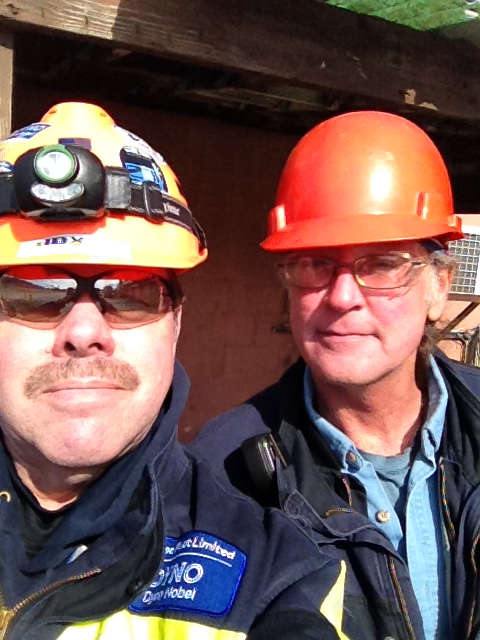
In 2014, I was still deep in my second career as a Continuous Improvement Lean Manufacturing Six Sigma Training and Development Change Management Leader.
That career had started in the late 1990’s and I kept adding tools (and titles) to my toolbox in order to help the various companies I worked for to eliminate waste and improve their workflow. If you ever worked in a corporate setting, you know that each company had their own version of the Toyota Production System or a variant of Six Sigma. Untold billions of dollars were invested in training and rollouts of these systems in an effort to gain a competitive edge in the marketplace.
Between the veiled efforts to make the systems culturally unique and the massive amount of money and energy to completely retool their individual workforces, success may not have been achieved but admission of failure was not an option. Careers were on the line and opportunities were created out of thin air. KPI was king (key performance indicators) even if the KPI’s were also made up out of thin air. The most important part was that armies of consultants would find new pathways to personal excellence and even the simplest task would be excessively analyzed until it turned into a massive gargantuan of overstuffed cabbage roll.
Instead of using the real golden rule (Keep It Simple Stupid), newly trained teams would consume gallons of team-based coffee while downing millions of Deming Donuts in well-lit conference rooms filled with charts, white boards and spread sheets. The only physical prowess required was the ability to alternately sit on one’s backside or stand in front of a metrics board for days on end.
The most annoying thing was the people who used each new fad as a way to advance their career. Most would have gone to extraordinary lengths to push past their contemporaries anyway but finding them sitting in one of my sessions was a particular source of frustration. Something must have snapped inside of me one day because I created a PowerPoint slide show about what I was seeing. (One has to chuckle at the irony of creating a PowerPoint slide show about the irony of what I was doing for a living…) I buried the slides deep in one of my archives and gave myself a stern talking to. Then I promised myself that someday I would bring it to life. Preferably after I retired. So here we are.
I’ll walk you through the slides.
(That’s how these things work. You could have just sat at your desk or by the pool and read them, but the system requires a trained facilitator to guide you through what is patently obvious.)
Introduction:
I would like to welcome you all to our offsite.
I know that many of you have traveled (in coach) for many hours, enduring screaming kids, delayed flights, and temperamental airline attendants just to join us. Sorry about you missing your daughter’s dance recital and junior’s last baseball game, but your supervisors thought it was important enough for you to give up your personal life just to listen to me read the slides.
Fill up on the donuts. I do not want to have to take them back to my room. My pants barely fit as it is. If you have any questions about the content, write them down and submit them to be by day’s end. I’ll lose them on my way to the airport, but trust me, I value your opinion and can’t wait to see them. As a reminder, your supervisors will be getting a written report on how well you participate, and your next promotion may or may not rest on my feedback.
We will be doing some experiential exercises during the day that involve games a third grader could see through but that is all part of padding my time with you in order to charge a higher fee. Most of you will be embarrassed, but trust me, I will not.
So here we go with today’s program. We call this program the Personal Excellence Guide
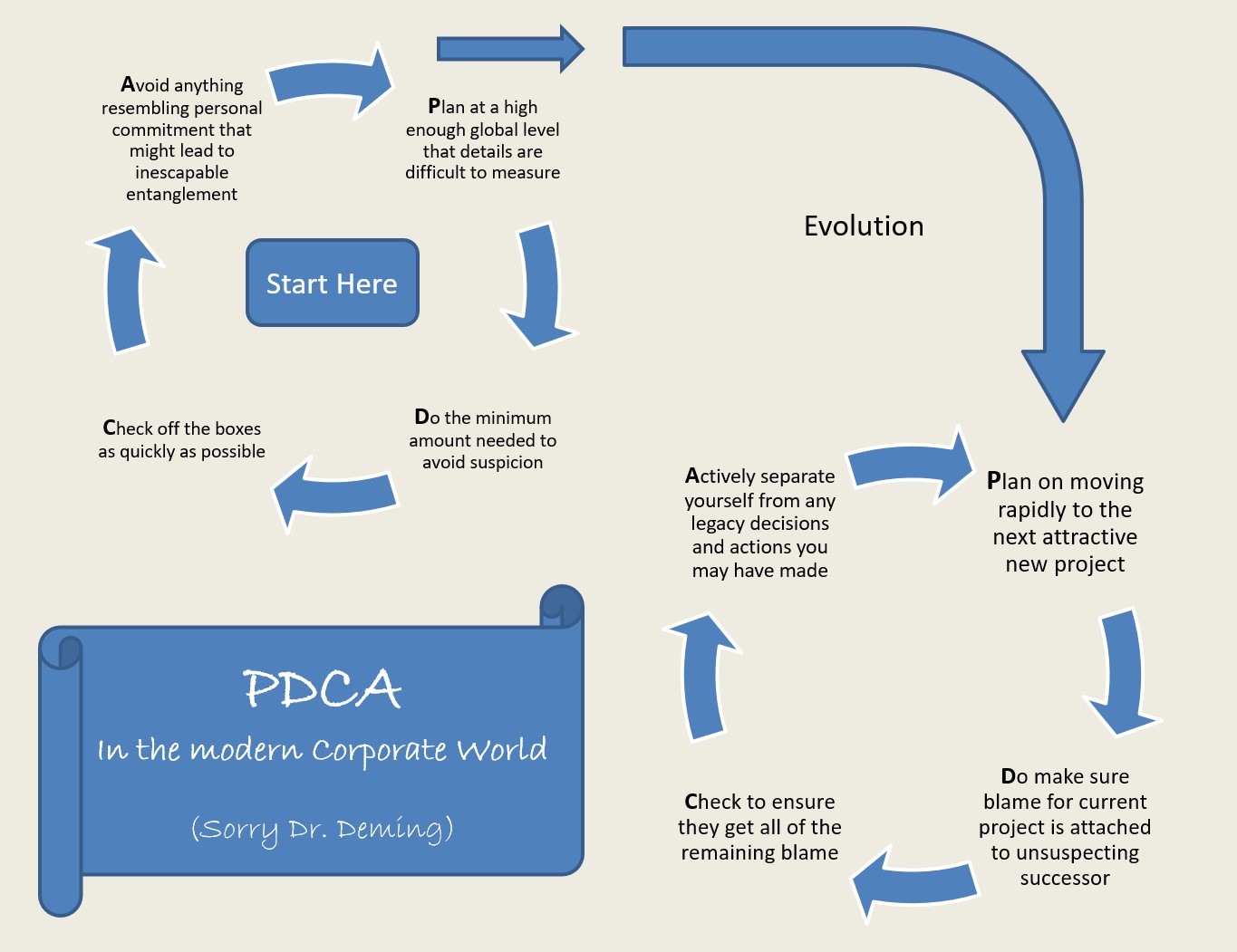
No modern personal excellence guide would be complete without at least a passing reference to the guy who helped start the whole continuous improvement process.
Dr. Deming is famous for helping the Japanese after World War 2 to rebuild their economy. He tried selling his ideas here in the US, but they were pretty set in their ways. The Japanese on the other hand were bombed to smithereens and needed to use new methods to compete globally. They embraced his ideas with alacrity and by the 1970’s were able to produce vehicles that were more efficient than the gas guzzlers that Detroit was shoving out the door. By the 1980’s the Japanese and others were rapidly encroaching on the market. One of the tools they used was PDCA. Plan Do Check Act. This simple planning process was wildly successful and adapted to American programs. In the case of personal excellence, a great corporate climber can use this model and race past their contemporaries.
SMART Goals
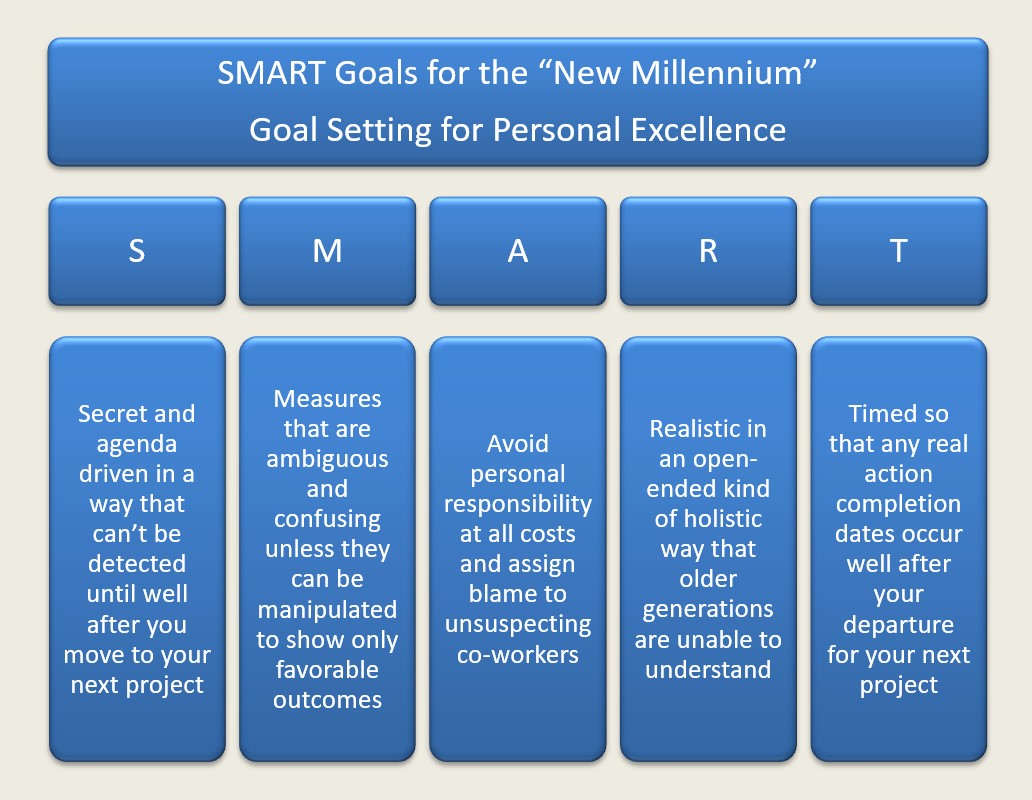
No personal excellence program could be possible with using SMART goals.
But not those old-fashioned ones (Specific, Measurable, Achievable, Realistic and Time Bound).
That formula is for losers. Here we present the new “SMART Goals for the new Millenium”
Problem solving skills are also critical for Personal Excellence
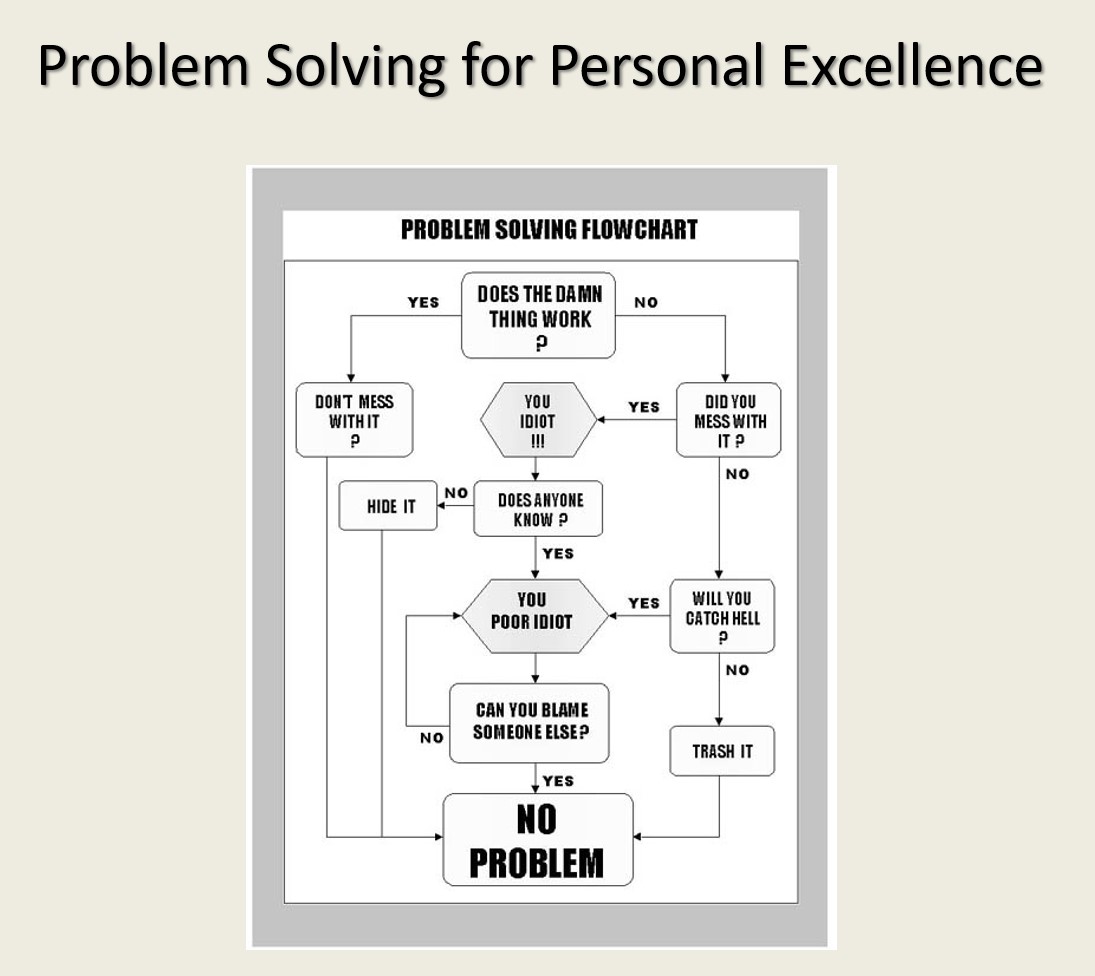
Any skilled corporate climber will be a master of modern problem solving.
Critical skills will include having a shocked face at the right time, playing loosely with the truth, and having the inward capacity to push a baby carriage down the marble stairs of a train station in order to distract your opponent and not having a moment of doubt. (Reference to a scene from Kevin Costner’s movie The Untouchables which I would play right now but the conference room has horrible internet connections)
The I in team
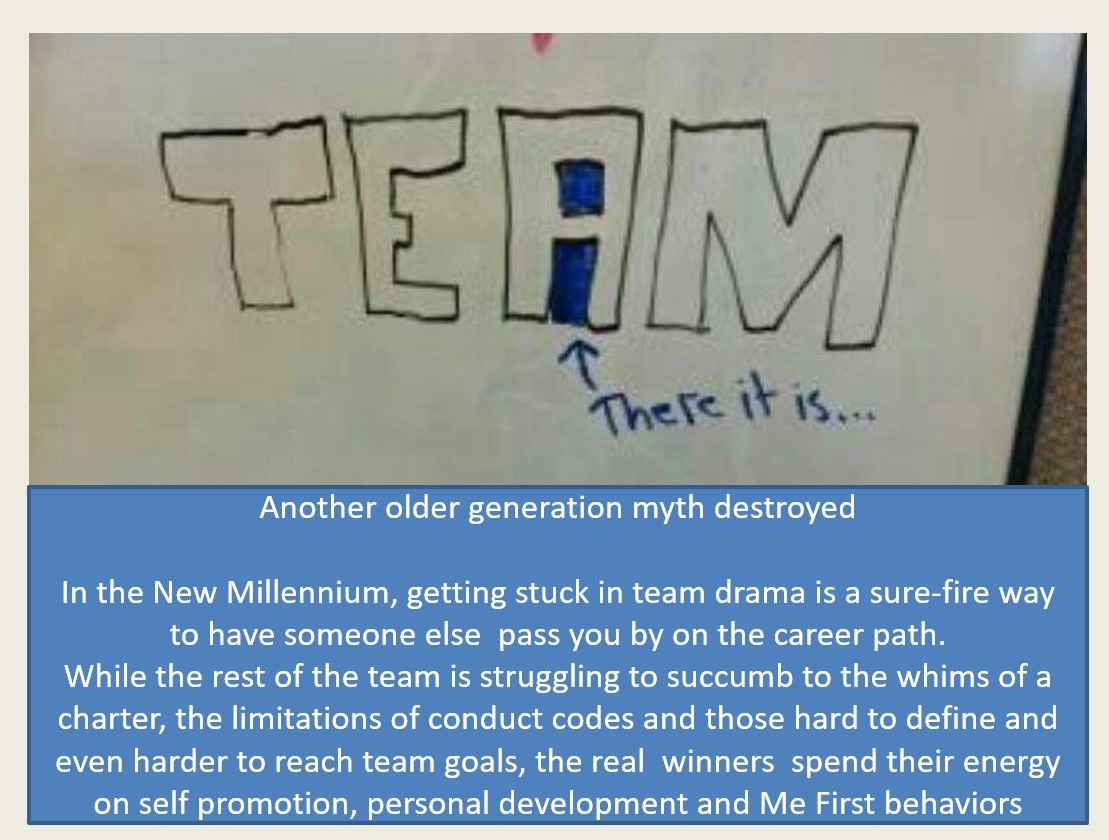
It turns out there is an I in team after all. (Next Slide)
What Personal Excellence Presentation Would Be Complete without one borrowed Dilbert Cartoon
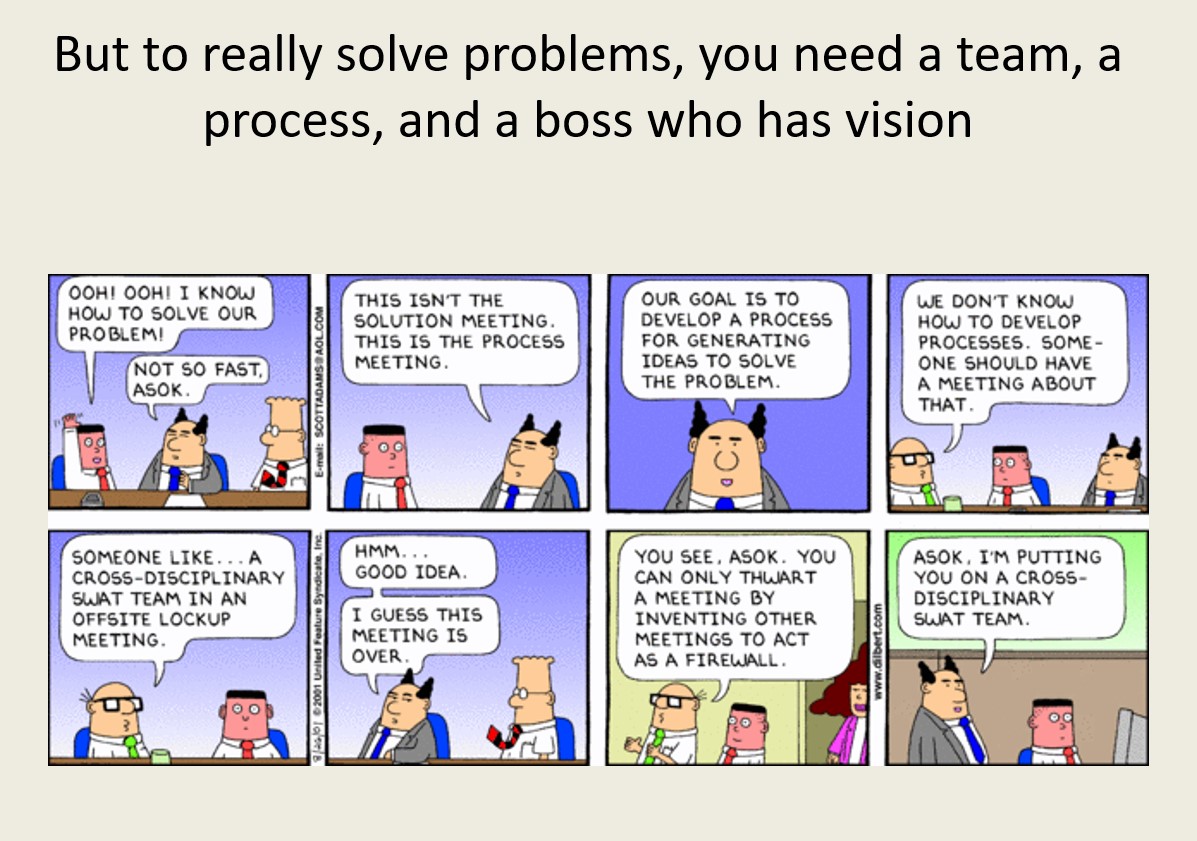
At this point, we would break out into teams and fill out team generated thoughts on flip charts that would be posted on the walls of the conference room.
Someone with the worst handwriting would be tasked with filling out the information and someone else would be tasked with capturing all of the ideas by days end. No one will ever look at the ideas once the conference is over. Except the janitor. Who would also gather up the last of the donuts to take home to his family while everyone else would either gather at the bar and talk about their co-workers and complain about the lack of bonuses for the current calendar year. Rumor has it that a few of the attendees did their own private team building exercises later in the evening but that is just a rumor.
What about the facilitator?
After spending the day on my feet fending off pompous asses that came up with the most ridiculous questions, most of the time I would fall into bed in another strange hotel. I made it a point to rarely intermingle with the participants since it interfered with my planning for the next session. And my sleep. I would hope against hope that the words and ideas I was espousing would make a difference. The principles that came from the original sources like Toyota could have helped make the improvement needed to help so many companies overcome their business cycles. I always went into the room with the thought that eliminating waste and improving flow was common sense. But I am glad to be fully retired now.
At the beginning of the post, I noted that Untold billions of dollars were invested in training and rollouts of these systems in an effort to gain a competitive edge in the marketplace. One could ask, how did that work out?
Well, in some cases it bought a few failing companies some time. A good number of the major players would later require massive government bailouts. I started with Ford, and I am happy to report that they did not. It might be fun to revisit some of the locations I worked with back in the day. But frankly, I do not want to find out that they survived despite what we tried to do, not because of it.
My cats resist my attempt to organize their workday. Debbie has learned over the 45 years we have been together to pacify me when I try to do continuous improvement. Although she is pretty committed to having me finish organizing the garage. I am stuck in the P part of PDCA. Maybe I’ll get to the D part next week. IYKYK

 theleansubmariner
Hey… we’re INSTRUCTORS here. Those touchy-feely FACILITATORS are down the hall watching 12 O’clock High telling everyone how TQL (total quality leadership) is going to revolutionize how the Navy does things.
Wait… did I say that out loud?
ICFTBMT1(SS) Maxey, USN (retired)
wait a minute… are you one of those Master Training Specialists??? Good response
Mac